If you’ve ever paused mid-sentence wondering whether to write “symptomatology” vs “symptomology,” you’re not alone. These two medical terms look nearly identical, sound alike, and are often used interchangeably in casual writing. But in clinical practice, research papers, and academic settings, the distinction matters more than most people realize.
This guide breaks down what each term actually means, how they’re used in real medical contexts, why confusion around them spiked during COVID-19, and how to use the correct term with confidence — whether you’re a student, clinician, medical writer, or simply curious about precise language.
Symptomatology vs Symptomology Meaning in Medical Context
At the core, both words trace back to the same root: symptom, combined with the suffix -logy, meaning “the study of.”
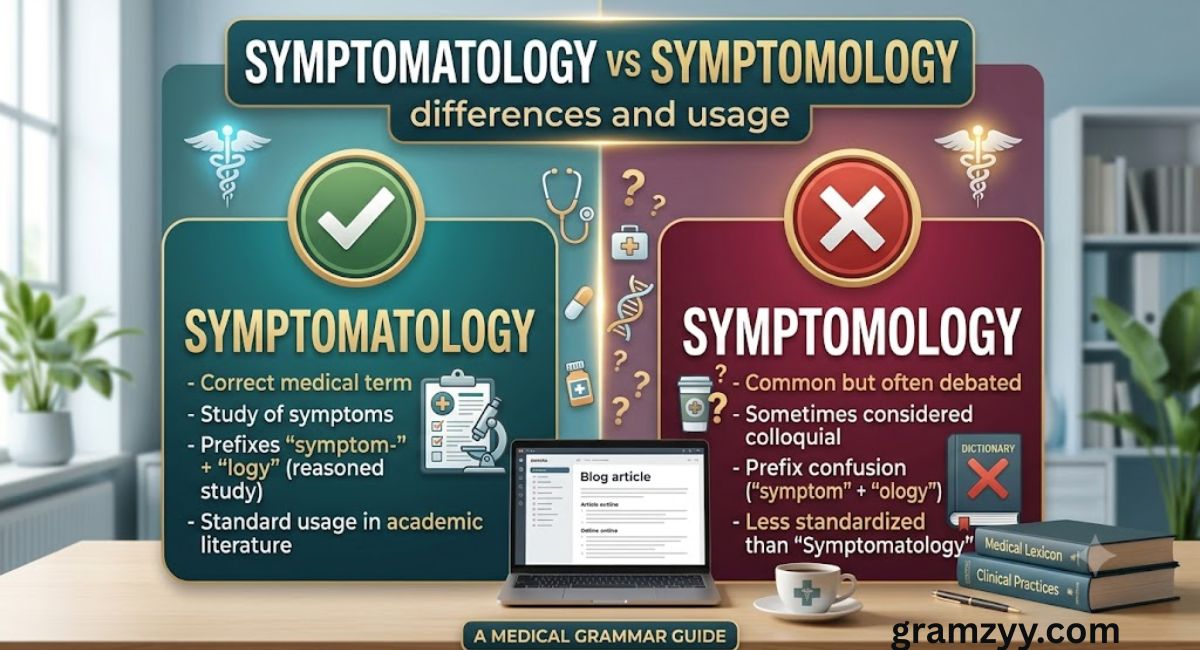
- Symptomatology refers to the branch of medicine concerned with symptoms — both the study of symptoms and the collective set of symptoms associated with a disease.
- Symptomology is a shortened variant that is often used with the same meaning but is considered less formal and less standard in professional medical writing.
In short, symptomatology is the historically correct and dictionary-preferred term, while symptomology is a common but informal alternative that emerged as English speakers naturally simplified the longer word.
| Aspect | Symptomatology | Symptomology |
|---|---|---|
| Formality | Standard, formal medical term | Informal, shortened variant |
| Usage in journals | Widely accepted | Occasionally seen, less preferred |
| Dictionary status | Fully recognized | Recognized but often flagged as a variant |
| Common setting | Clinical documentation, research, academia | Casual writing, everyday speech |
| Recommended use | Yes | Use cautiously |
Symptomatology Definition and Its Role in Clinical Practice
Symptomatology is defined as the branch of medical science that deals with symptoms — their identification, classification, progression, and relationship to underlying disease. It also refers, more simply, to the full set of symptoms a patient presents with.
In clinical practice, symptomatology plays a central role because it:
- Helps physicians build a complete clinical picture of a patient’s condition
- Guides differential diagnosis by comparing symptom patterns across diseases
- Supports treatment planning based on symptom severity and progression
- Forms the basis of psychiatric and psychological assessments, where symptom clusters define specific conditions
Doctors, researchers, and medical educators consistently favor symptomatology because it carries academic weight and appears throughout peer-reviewed literature, textbooks, and clinical documentation.
Symptomology Definition and Why It Creates Confusion
Symptomology carries essentially the same core meaning as symptomatology — the study or description of symptoms — but it’s viewed as a less polished, informally shortened version of the term.
The confusion between the two words happens for a few clear reasons:
- Shorter feels easier — People naturally gravitate toward simpler, shorter words.
- Similar pronunciation — Both words sound nearly identical when spoken quickly.
- Repetition online — Once a variant spreads across websites and social media, more people copy it without checking accuracy.
- Limited awareness — Many writers simply don’t know that symptomatology is the formal, preferred term.
While symptomology does appear in some medical papers and casual healthcare discussions, it’s generally viewed as weaker in credibility compared to symptomatology.
Symptomatology vs Symptomology Difference in Medical Usage
The real difference isn’t about meaning — it’s about register and acceptance. Here’s how professionals distinguish the two:
- Symptomatology is used in formal medical documentation, clinical research, psychiatric evaluations, and academic publishing.
- Symptomology shows up more often in informal conversation, general health articles, and occasionally in less rigorously edited research.
If you’re writing a clinical report, medical thesis, or patient chart, symptomatology is the safer, more professional choice. If you’re having a casual conversation about symptoms, either term is generally understood — though symptomatology still signals more precision.
Examples in Clinical Context
Seeing these words in real sentences makes the difference easier to grasp.
Symptomatology in use:
- The physician documented the patient’s symptomatology before ordering further tests.
- Psychiatric symptomatology often includes changes in mood, sleep, and behavior.
- Researchers tracked the symptomatology of the disease over a six-month period.
Symptomology in use:
- The symptomology of the flu includes fever, chills, and body aches.
- Her interest in symptomology eventually led her toward clinical research.
Both sentence sets are understandable, but only the first set reflects the term you’ll consistently find in formal medical literature.
COVID Usage and Public Confusion
During the COVID-19 pandemic, both terms surged in public use as people searched for information about symptoms, symptom tracking, and disease progression. News outlets, health blogs, and even some official communications used symptomatology and symptomology somewhat interchangeably.
This period highlighted a noticeable gap between scientific communication and public usage. Medical journals and health authorities largely stuck with symptomatology when discussing symptom patterns and disease presentation, while everyday articles and social media posts often defaulted to the shorter, easier-to-type symptomology.
The result was widespread uncertainty about which term was “correct,” especially among readers trying to understand official health guidance while also encountering casual variations across the internet.
How Symptomatology Is Used in Medicine and Clinical Practice
Symptomatology functions as a working tool for healthcare providers throughout the diagnostic and treatment process. In day-to-day practice, it’s used to:
- Organize patient history by grouping related symptoms together
- Compare disease presentations across similar conditions
- Track symptom progression over the course of treatment
- Communicate clearly in referrals, case notes, and consultations
- Support psychiatric diagnosis, where symptom clusters define specific disorders under diagnostic manuals
Medical students are trained early to describe a patient’s symptomatology accurately, since imprecise language can lead to miscommunication between healthcare teams.
Symptomology in Medical Research and Its Limitations
Symptomology does appear in some research contexts, but it comes with notable limitations:
- It’s less consistently used across peer-reviewed journals, which can create inconsistency in terminology.
- Style guides and academic editors often flag it as a nonstandard variant.
- It may reduce perceived credibility in formal writing, even when the underlying meaning is accurate.
- International medical literature tends to favor symptomatology, making symptomology less recognizable in cross-border research.
Because consistency matters in scientific communication, most journals and institutions recommend defaulting to symptomatology unless a specific style guide states otherwise.
Clinical Symptomatology and Diagnostic Importance
Clinical symptomatology refers specifically to the symptoms observed and reported within a clinical setting — during an examination, consultation, or hospital admission. It’s foundational to diagnosis because:
- Diseases often share overlapping symptoms, so a detailed symptomatology helps narrow down possibilities
- The timing, severity, and combination of symptoms can point toward specific conditions
- It provides a baseline for measuring how a patient responds to treatment over time
A well-documented clinical symptomatology often shortens the path to an accurate diagnosis and reduces the risk of misdiagnosis.
Signs vs Symptoms Difference in Clinical Diagnosis
Understanding symptomatology also requires understanding the difference between signs and symptoms, since both feed into the diagnostic process.
| Term | Definition | Who Detects It | Example |
|---|---|---|---|
| Symptom | Subjective experience reported by the patient | Patient | Fatigue, pain, nausea |
| Sign | Objective, observable evidence | Clinician or test | Fever, rash, elevated blood pressure |
Symptoms are what the patient feels and describes, while signs are what a clinician can observe or measure. Symptomatology typically focuses on the patient-reported side, while signs are documented separately during physical examination, though both work together to form a complete clinical picture.
Limitations of Symptomatology in Diagnosis
While symptomatology is essential, it isn’t foolproof. Relying on symptoms alone has real limitations:
- Symptoms can overlap across multiple unrelated conditions, making diagnosis based on symptoms alone unreliable
- Subjectivity means patients may describe the same symptom differently, affecting consistency
- Symptom severity doesn’t always match disease severity — some serious conditions present with mild symptoms, and vice versa
- Cultural and language differences can affect how symptoms are reported and interpreted
- Delayed symptoms in certain diseases can lead to late diagnosis if symptomatology is the only diagnostic tool used
This is why modern medicine pairs symptomatology with lab tests, imaging, and objective clinical signs rather than relying on symptoms alone.
Practice Exercises
Test your understanding of symptomatology and symptomology with the exercises below.
Choose the Correct Term (Medical Context)
- The physician reviewed the patient’s __________ before starting treatment. (symptomatology / symptomology)
- Psychiatric __________ includes mood, behavior, and cognitive changes.
- The __________ of the illness was documented in the case study.
- Researchers analyzed __________ patterns across multiple patient groups.
- __________ is the preferred term in formal medical writing.
Identify Correct or Incorrect Usage
- “The patient’s symptomatology was consistent with early-stage infection.” — Correct / Incorrect
- “Doctors use symptomology to write official diagnostic manuals.” — Correct / Incorrect
- “Her symptomatology improved significantly after treatment.” — Correct / Incorrect
- “The clinical symptomology report was filed with the case notes.” — Correct / Incorrect
Rewrite for Clinical Accuracy
Rewrite the following casual sentences using formal medical terminology:
- “The symptomology of the flu includes fever and cough.”
- “Her symptomology got worse over the weekend.”
- “The study looked at the symptomology of chronic fatigue.”
Clinical Application Scenarios
- A resident is writing a discharge summary. Which term should they use, and why?
- A medical journal editor is reviewing a submitted paper that uses “symptomology” throughout. What feedback might they give?
- A patient asks their doctor to explain their “symptomology.” Is this appropriate, and how might the doctor respond?
Match the Concept
Match each term to its correct description:
| Term | Description |
|---|---|
| A. Symptomatology | 1. Objective, observable clinical evidence |
| B. Symptomology | 2. Formal study and collection of symptoms |
| C. Sign | 3. Informal variant of symptomatology |
| D. Symptom | 4. Subjective experience reported by the patient |
Diagnostic Thinking
- Why is symptomatology alone not always sufficient for an accurate diagnosis?
- How do overlapping symptoms across diseases complicate clinical decision-making?
- Why might two patients with the same disease report different symptomatology?
Answer Key
Choose the Correct Term
- symptomatology
- symptomatology
- symptomatology
- symptomatology (or symptomology, though symptomatology is preferred)
- Symptomatology
Correct / Incorrect Usage
- Correct
- Incorrect — formal manuals use “symptomatology”
- Correct
- Incorrect — formal reports should use “symptomatology”
Rewrite Answers (Correct Versions)
- “The symptomatology of the flu includes fever and cough.”
- “Her symptomatology worsened over the weekend.”
- “The study examined the symptomatology of chronic fatigue.”
Clinical Application Scenarios
- The resident should use “symptomatology” since discharge summaries are formal clinical documents requiring precise, standardized terminology.
- The editor would likely recommend replacing “symptomology” with “symptomatology” throughout, since most journals follow the standard term for consistency and credibility.
- It’s appropriate, though the doctor may explain in plain language that “symptomatology” simply means the full set of symptoms being tracked and evaluated.
Match the Concept
A-2, B-3, C-1, D-4
Diagnostic Thinking
- Because symptoms are subjective and can overlap across multiple conditions, so they must be paired with objective signs and tests for an accurate diagnosis.
- Overlapping symptoms can point to several possible conditions at once, requiring further testing to distinguish between them.
- Because symptom perception, description, and reporting can vary based on individual pain tolerance, communication style, and awareness of their own body.
Conclusion
Both symptomatology vs symptomology point to the same underlying idea — the study and collection of symptoms — but they aren’t equally weighted in professional settings. Symptomatology remains the standard, dictionary-preferred, and academically accepted term used throughout clinical practice, medical research, and psychiatric assessment. Symptomology, while understandable and occasionally used, is best treated as an informal variant rather than a professional standard.
When precision matters — in patient charts, research papers, or clinical communication — choosing symptomatology is the safer, more credible option. Understanding this distinction not only sharpens your medical vocabulary but also reflects a stronger grasp of clinical accuracy and professional communication.(Symptomatology vs Symptomology)
FAQs
Is symptomology a real word?
Yes, it’s a recognized variant of symptomatology, though it’s considered less formal and less preferred in professional medical writing.
Which term should I use in a research paper?
Use symptomatology, since it’s the standard term accepted across peer-reviewed journals and academic institutions. (Symptomatology vs Symptomology)
Do symptomatology and symptomology mean the same thing?
Essentially yes — both refer to the study or collection of symptoms, but symptomatology is the more accurate and widely accepted form.
Why did confusion between these terms increase during COVID-19?
Public health discussions, news coverage, and social media used both terms heavily, and casual usage of “symptomology” spread faster than formal correction could keep up.
What’s the difference between a symptom and a sign?
A symptom is something the patient reports feeling, while a sign is something a clinician can objectively observe or measure.
Can symptomatology alone confirm a diagnosis?
No — symptomatology is an important diagnostic tool, but it’s typically combined with clinical signs, lab tests, and imaging for an accurate diagnosis. (Symptomatology vs Symptomology)