Dysregulated vs Disregulated: If you’ve typed “disregulated” into a document and watched a red squiggly line appear underneath it, you’re not imagining things. This is one of the most common word mix-ups in psychology, medicine, and everyday writing about emotions and behavior. The good news? The fix takes about thirty seconds to learn, and once it clicks, you’ll never second-guess it again.
The Core Difference You Need to Know
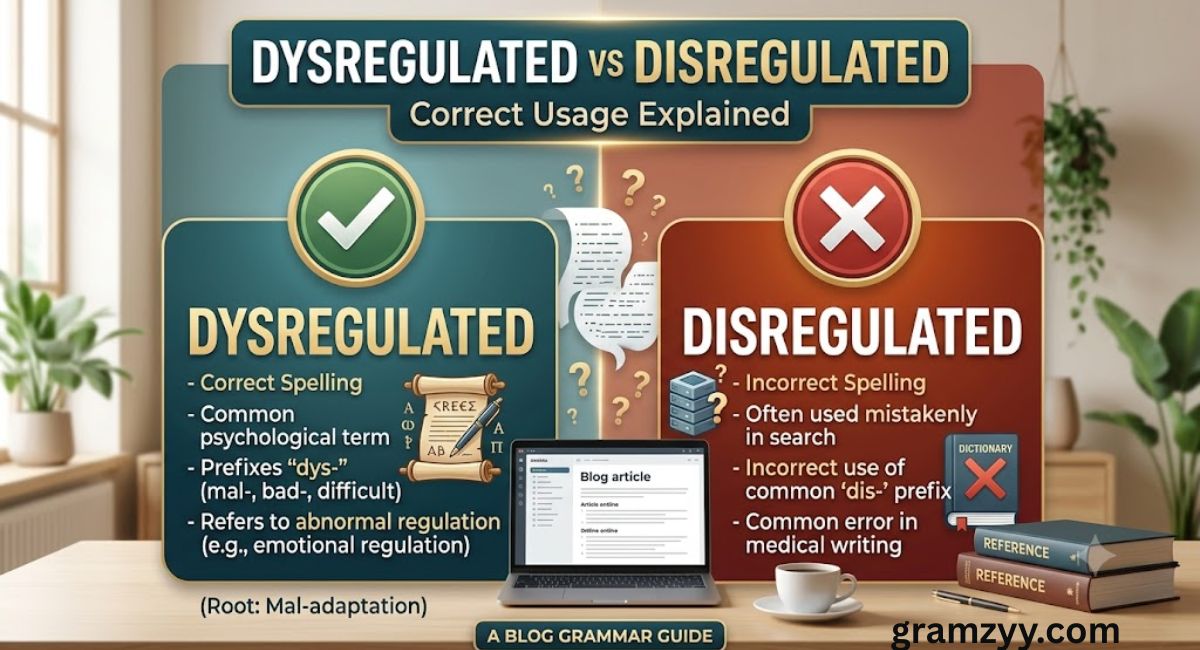
Dysregulated is the correct, dictionary-supported word. Disregulated is not standard English — it’s a common misspelling that pops up because it sounds like it should be right.
The short version:
- Use dysregulated to describe a system, emotion, or behavior that is functioning poorly or abnormally.
- Avoid disregulated entirely in professional, academic, or medical writing.
That one letter — the “y” instead of the “i” — carries real linguistic weight, and it’s the whole reason this confusion exists.
What Does Dysregulated Mean? A Clear, Practical Definition
Dysregulated describes a system that once operated within a normal range but has lost the ability to self-correct or maintain balance. It’s used most often to describe emotions, behavior, hormones, the nervous system, and other biological processes.
Plain-English Definition
In simple terms, dysregulated means “not working the way it’s supposed to.” A dysregulated system still exists and still tries to function — it just does so inconsistently, excessively, or unpredictably.
Understanding the Prefix: Why “Dys” Changes Everything
English prefixes carry meaning, and “dys-” is one of the most precise. It comes from Greek and signals that something is difficult, abnormal, or impaired — not absent.
Prefix Breakdown
| Prefix | Meaning | Example Words |
|---|---|---|
| Dys- | Bad, difficult, abnormal functioning | dysfunction, dyslexia, dystrophy, dysregulated |
| Dis- | Removal, absence, or reversal | disconnect, disorganized, disengage |
| De- | Removal of rules or control | deregulated |
| Un- | Never had it to begin with | unregulated |
This table alone explains why “dysregulated” fits emotional and biological contexts so precisely — regulation is present, just malfunctioning.
Why “Disregulated” Keeps Showing Up (Even Though It’s Wrong)
Common Reasons People Use “Disregulated”
- The word “disorganized” primes people to expect “dis-” before “regulated.”
- Autocorrect sometimes fails to catch it since both spellings look plausible.
- Casual online writing and social media posts spread the incorrect spelling further.
- Non-native English speakers may transfer prefix rules from other languages.
Reality Check: Is “Disregulated” a Word? (Detailed Breakdown)
No major dictionary — including Merriam-Webster, Oxford, or Cambridge — lists “disregulated” as a standard entry. It shows up occasionally in casual text, but it has no accepted clinical or academic standing.
Why “Disregulated” Feels Right (But Isn’t)
The Real Reason Behind the Confusion
“Disregulated” feels intuitive because “dis-” is a far more common prefix in everyday English. Words like disagree, distrust, and disorder train our brains to expect “dis-” as the default negative prefix. But “regulated” isn’t losing its function entirely — it’s malfunctioning, which is exactly what “dys-” communicates.
Why “Dysregulated” Is the Correct Term
Prefix Meaning Matters
“Dys-” specifically implies impaired function, not the total absence of it. A dysregulated nervous system, for example, is still active — it’s simply overreacting or underreacting instead of shutting off completely.
Key Insight
If you can mentally swap the word for “malfunctioning” or “poorly functioning” and the sentence still makes sense, “dysregulated” is the word you want.
What Happens If You Use “Disregulated”?
In Professional Writing
Using “disregulated” in reports, essays, or client documentation can undercut your credibility, especially with readers familiar with the correct term.
In Academic or Medical Contexts
Journals, textbooks, and clinical resources consistently use “dysregulated.” Submitting “disregulated” in academic work may be flagged as a spelling error.
Online Content
For blogs and articles, incorrect spelling can hurt search visibility and trust signals, since readers researching mental health topics expect accurate terminology.
Spot the Difference
❌ Incorrect:
“The child’s emotions became disregulated after the long car ride.”
✅ Correct:
“The child’s emotions became dysregulated after the long car ride.”
Why You Won’t Find “Disregulated” in Dictionaries
Here’s What You’ll Notice
Search any reputable dictionary for “disregulated” and you’ll either get no results or a redirect suggesting “dysregulated.” That absence is a strong signal on its own — legitimate clinical and linguistic terms are documented; “disregulated” simply isn’t.
When People Accidentally Use It
Even experienced writers slip up here, usually while typing quickly or relying on autocorrect. It’s a small, forgivable error — but one worth catching before publishing or submitting formal work.
Quick Fix Strategy
Simple Rule to Remember
Think “dysfunction,” not “disconnect.” If the sentence is about something working badly rather than something being switched off, choose “dys-.”
Memory Trick That Actually Works
Picture the word “dysfunctional.” You’d never write “disfunctional,” right? Apply the same logic here: dysregulated pairs with dysfunctional, dyslexia, and dystrophy — all genuine “dys-“ words describing impaired function.
Don’t Let a Small Mistake Undermine You
One misplaced letter won’t ruin your writing, but repeated use of “disregulated” in professional or academic settings can chip away at your authority. A quick mental check before hitting publish saves that credibility.
Dysregulated Meaning in Psychology: Where It Matters Most
Dysregulated Definition Psychology
In psychology, dysregulated describes an inability to manage or modulate internal states — most often emotional responses — in a way that matches the situation.
Emotional Dysregulation Meaning
Emotional dysregulation happens when someone struggles to control the intensity, duration, or expression of their emotional reactions, often resulting in outbursts, shutdowns, or disproportionate responses to stress.
What Emotional Dysregulation Looks Like in Real Life
Dysregulated Behavior Examples
- Sudden anger over minor inconveniences
- Difficulty calming down after an upsetting event
- Emotional swings that seem disconnected from the situation
- Withdrawal or shutdown under mild stress
Short Scenario
A student receives average feedback on an assignment and reacts with intense frustration that lasts the rest of the day — far beyond what the situation would typically warrant. That disproportionate, hard-to-recover-from reaction is a hallmark of dysregulation.
Dysregulated Emotions vs Normal Emotional Responses
Normal emotional responses are proportional to the trigger and fade with time. Dysregulated emotions tend to be intense, prolonged, and difficult to self-soothe, often interfering with daily functioning.
Dysregulated Nervous System
Signs of a Dysregulated Nervous System
- Feeling constantly on edge or hypervigilant
- Trouble relaxing even in safe environments
- Sudden fatigue or shutdown after stress
- Digestive or sleep disturbances tied to stress
What’s Going On Inside
A dysregulated nervous system often gets stuck in fight-flight-freeze mode, struggling to return to a calm baseline even when no real threat is present.
Dysregulation in Biology: More Than Just Emotions
Scientific Examples
- Dysregulated blood sugar in metabolic conditions
- Dysregulated immune response in autoimmune disorders
- Dysregulated hormone levels affecting mood and energy
Core Concept
Across biology, dysregulation always points to the same idea: a system that should self-correct is no longer doing so reliably.
A Common Mix-Up
People frequently confuse dysregulated with deregulated and unregulated, but the three describe very different situations.
Quick Analogy
Think of a thermostat. A dysregulated thermostat is installed but broken — it overheats or underheats the room. A deregulated thermostat had its safety rules removed. An unregulated thermostat was never installed with any rules at all.
Difference Between dysregulated vs disregulated
| Term | Standard English? | Typical Use |
|---|---|---|
| Dysregulated | Yes | Psychology, medicine, biology, emotional health |
| Disregulated | No | Common misspelling, avoid in formal writing |
Mental Health Dysregulation: Conditions Linked to It
Common Conditions
- ADHD
- Anxiety disorders
- Autism spectrum conditions
- Borderline personality disorder
- Trauma and PTSD
Workplace Emotional Dysregulation
Analysis
An employee who reacts to routine feedback with disproportionate frustration or withdrawal may be experiencing workplace dysregulation. Left unaddressed, it can strain team relationships and reduce performance, even when the underlying cause is stress rather than character.
Dysregulated Child Symptoms and Treatment
Symptoms
- Frequent meltdowns disproportionate to the trigger
- Difficulty transitioning between activities
- Trouble calming down independently
Treatment Approaches
- Structured routines and predictable environments
- Co-regulation with a calm caregiver
- Professional support such as occupational therapy or counseling
How to Fix Emotional Dysregulation (Actionable Steps)
Practical Strategies
- Practice grounding techniques like slow breathing or naming five things you can see.
- Build predictable routines to reduce unnecessary stress triggers.
- Identify early warning signs before reactions escalate.
- Seek support from a therapist trained in emotional regulation strategies.
Quick Tip
Regulation is a skill, not a fixed trait — small, consistent practice genuinely improves it over time.
Dys vs Dis Words: Why This Confusion Keeps Happening
Comparison Table
| Dys- Words | Dis- Words |
|---|---|
| Dysfunction | Disconnect |
| Dyslexia | Disorganized |
| Dystrophy | Disorder |
| Dysregulated | Disengage |
Signs of a Dysregulated Nervous System You Shouldn’t Ignore
Persistent irritability, trouble sleeping, chronic tension, and an inability to relax even during downtime are all signals worth discussing with a healthcare provider, since they can point to a nervous system stuck outside its normal range.
Quick Practice dysregulated vs disregulated
Fill in the Blank
“After the stressful meeting, her mood felt completely ______.”
Fix the Sentence
Incorrect: “His hormones were disregulated after the illness.” Correct: “His hormones were dysregulated after the illness.”
Bonus Challenge (Try This One)
Write one original sentence using “dysregulated” correctly in a workplace or family context.
Pro Tip
If you’re ever unsure while typing, say the word out loud slowly — “dys-regulated” — and remember it rhymes with “dysfunction,” not “disconnect.”
Key Takeaways You’ll Actually Remember
- Dysregulated is correct; disregulated is not a standard word.
- The “dys-” prefix means impaired function, not absence of function.
- Dysregulation appears across psychology, medicine, and biology.
- Small spelling choices affect how credible your writing sounds.
- When in doubt, substitute “malfunctioning” to test the word.
Reference Cambridge Dictionary Definitions
Cambridge Dictionary and other major English dictionaries list “dysregulation” as a recognized term describing impaired regulation of a system, while “disregulated” does not appear as a standard entry.
Conclusion
The debate between dysregulated vs disregulated has one clear answer. Dysregulated is correct. Disregulated is not a real word. It just looks and sounds right, so people use it by mistake. Once you know the “dys-” prefix means impaired function, the confusion disappears. You’ll never mix up dysregulated vs disregulated again.
This small word choice matters more than it seems. Using the correct term makes your writing sound clear and credible. It also helps you understand emotions, behavior, and health more accurately. Whether you’re a student, writer, parent, or professional, knowing dysregulated vs disregulated shows real attention to detail. Choose dysregulated every time. It’s simple, correct, and backed by dictionaries and experts alike.
FAQs
Is disregulated a real word?
No. It’s a common misspelling of dysregulated and isn’t recognized by major dictionaries.
What does dysregulated mean in simple terms?
It means a system, emotion, or behavior isn’t functioning or balancing properly.
Is emotional dysregulation a diagnosis?
No, it’s not a standalone diagnosis, but it commonly appears alongside conditions like ADHD, anxiety, and trauma.
What’s the difference between dysregulated and unregulated?
Dysregulated means regulation exists but works poorly; unregulated means no regulation was ever in place.
Can dysregulation be treated?
Yes. Strategies like grounding techniques, routine-building, and therapy can meaningfully improve regulation skills over time.