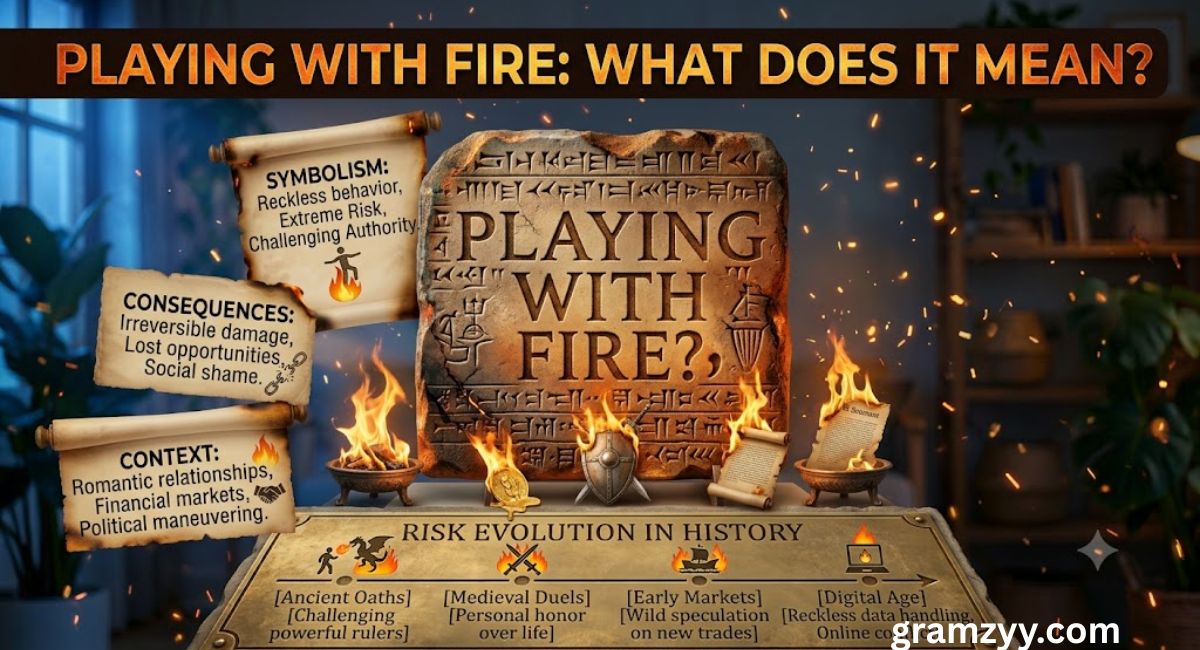
Have you ever told a friend, “You’re playing with fire,” and wondered if you used it right? This idiom shows up everywhere — in news headlines, casual conversation, and even classic literature. But knowing exactly when and how to use it correctly can be trickier than it sounds.
In this guide, you’ll learn the true meaning of “playing with fire,” see real usage examples, understand the difference between its literal and figurative senses, and pick up memory tricks that make this idiom stick for good.
What Does Playing with Fire Mean?
Playing with fire means engaging in risky, dangerous, or reckless behavior that could lead to serious trouble.
At its core, the phrase is a warning. It tells someone that their current actions carry a real chance of harm, loss, or regret — much like handling actual flames without caution can lead to a burn.
The idiom works on two levels:
- Literal meaning: Physically handling fire in an unsafe way, such as a child experimenting with matches or someone ignoring safety gear near open flames.
- Figurative meaning: Taking a risk in life, business, relationships, or decisions that could backfire badly, even if no actual fire is involved.
Most of the time, people use this idiom figuratively. If your coworker says, “You’re playing with fire by missing that deadline again,” they’re not talking about literal flames — they’re warning you about consequences.
Common near-synonyms include:
- Tempting fate
- Courting danger
- Walking on thin ice
- Asking for trouble
- Flirting with disaster
- Gambling with danger
These phrases share the same core idea: doing something that invites unnecessary risk.
How Do You Use Correctly?
Using this idiom well comes down to context, tone, and grammar. It typically pairs with a present participle form (“playing”) but can shift tense depending on the sentence.
| Tense | Example |
|---|---|
| Present continuous | She is playing with fire by ignoring her doctor’s advice. |
| Past tense | He played with fire and lost his savings. |
| Conditional | If you play with fire, you’ll eventually get burned. |
| Present simple | They play with fire every time they skip safety checks. |
Correct Usage Examples
- Investing your entire savings in one volatile stock is playing with fire.
- Skipping deadlines repeatedly is playing with fire if you want to keep your job.
- Ignoring construction site safety protocols is straight-up playing with fire.
- Dating your best friend’s ex is playing with fire.
- Driving without a seatbelt on icy roads is playing with fire.
Each example pairs the idiom with an action that carries real, foreseeable risk — which is what makes the phrase land naturally.
Incorrect Usage Examples
- “He is playing with fire at the campsite.” (This describes literal fire-handling, not risky behavior — confusing without more context.)
- “She’s playing with fire because she likes cooking.” (Cooking with normal caution isn’t inherently risky, so the idiom doesn’t fit.)
The idiom loses its punch when there’s no genuine risk attached to the action being described.
Context Variations
The idiom adapts naturally across different settings:
- Workplace context: “Ignoring data security protocols is playing with fire; one breach could cost the company millions.”
- Academic context: “Turning in plagiarized work is playing with fire when it comes to your grades.”
- Personal relationships: “He’s playing with fire by gossiping about coworkers behind their backs.”
- Financial context: “Borrowing heavily to gamble is playing with fire — you’re bound to get burned eventually.”
What Counts as Literal vs Figurative Use?
Since the phrase can mean two very different things, telling them apart matters for clear communication.
| Aspect | Literal Use | Figurative Use |
|---|---|---|
| Meaning | Physically handling real fire | Taking a risky or dangerous action |
| Example | “The kids were playing with fire near the campsite.” | “He’s playing with fire by lying to his boss.” |
| Context | Camping, safety warnings, fire hazards | Relationships, finance, work, politics, everyday risk |
| Frequency | Rare in everyday speech | Extremely common |
| Tone | Cautionary, literal instruction | Metaphorical warning |
A simple test: if you can replace “fire” with an actual flame and the sentence still makes physical sense, you’re likely in literal territory. If the sentence is really about consequences, trust, money, or safety in a broader sense, it’s figurative.
Common Mistakes
Even confident English speakers slip up with this idiom. Watch out for these errors:
- Using it for low-stakes situations. Not every mildly risky choice deserves this phrase. Save it for situations with real potential fallout.
- Overusing it in one piece of writing. Repeating the idiom multiple times in a short paragraph dilutes its impact and can feel repetitive to readers.
- Misplacing it where literal fire is meant. If you’re actually discussing fire safety, clarify the context so readers don’t assume you mean something risky and unrelated.
- Using it in insensitive contexts. Applying the idiom to serious topics like injury, illness, or tragedy can come across as flippant or careless.
- Forgetting the subject of the risk. A strong sentence names what’s at stake — money, trust, safety — rather than leaving the danger vague.
Memory Tricks That Work
If you want the meaning of “playing with fire” to stick permanently, try these simple techniques:
- Picture the flame. Imagine a lit match inches from a curtain. That single image captures the entire idiom — small, careless choices can spark much bigger problems.
- Link it to “getting burned.” Since the idiom almost always pairs with consequences, remembering the phrase “you’ll get burned” reinforces the warning built into it.
- Connect it to real news. Business and political journalists use this idiom constantly. Noticing it in headlines helps cement its figurative meaning in real-world context.
- Practice with your own life. Write one sentence about a risky decision you’ve made — academic, financial, or personal — using the idiom correctly. Active recall beats passive reading.
- Pair it with synonyms. Associating “playing with fire” with phrases like “walking on thin ice” or “tempting fate” builds a mental cluster of related warnings, making all of them easier to recall.
Conclusion
“Playing with fire” is one of those idioms that instantly communicates danger without needing extra explanation. Whether you’re warning a friend about a risky relationship, describing a shaky business decision, or writing a cautionary story, this phrase adds vivid, memorable weight to your message.
Remember: keep it figurative unless you’re literally near flames, match it with genuinely risky situations, and avoid overusing it in the same piece of writing. Used correctly, it turns an ordinary warning into one that truly lands.
FAQs
What does “playing with fire” mean in a relationship?
It means someone is taking an emotional or trust-related risk, such as flirting with an ex or hiding secrets, that could seriously damage the relationship.
Is “playing with fire” always negative?
Yes, it almost always carries a cautionary or negative tone, warning that the current action could lead to harmful consequences.
Where did the idiom “playing with fire” come from?
Its exact origin is undocumented, but the metaphor of fire representing danger and temptation dates back centuries and appears across many cultures and early English texts.
Can “playing with fire” be used literally?
Yes, though rarely. It can describe someone physically handling flames unsafely, such as a child experimenting with matches without supervision.
Is it grammatically correct to say “played with fire”?
Yes, this is the correct past tense form, used when describing a risky action that already happened, such as “He played with fire and lost the deal.”