If you’ve ever paused mid-sentence wondering whether to type “nighttime” vs “night time,” you’re not alone. This tiny word choice trips up students, bloggers, and even seasoned writers. The good news? Once you understand the rule, you’ll never second-guess it again.
TL;DR:
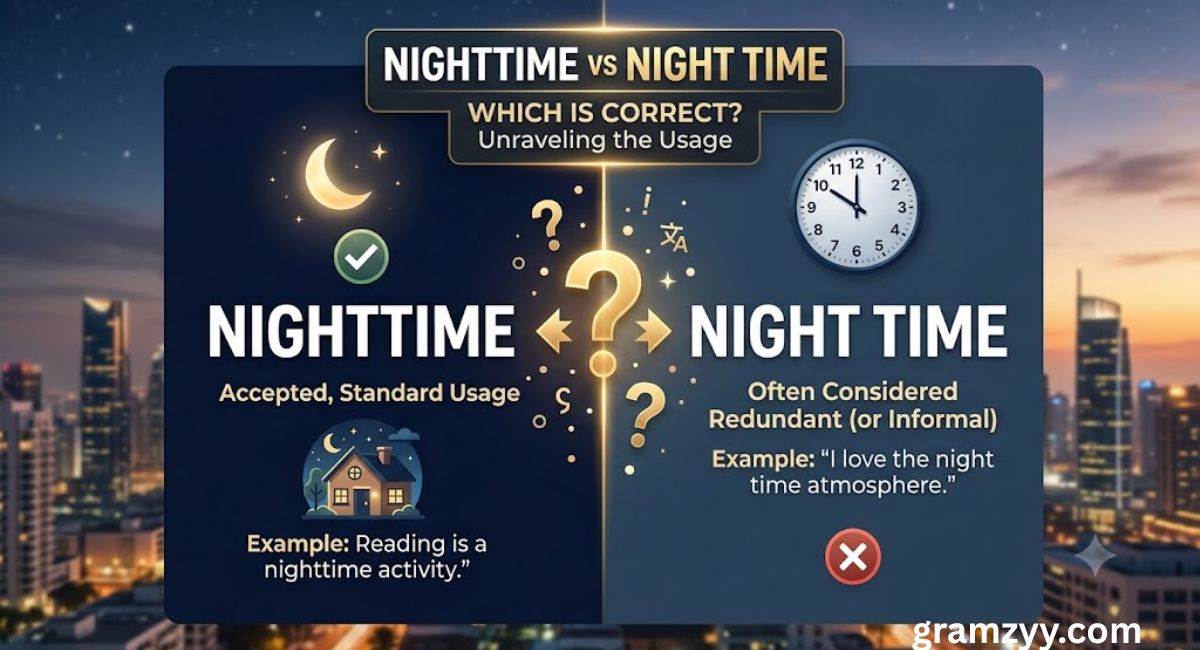
- Nighttime (one word) is the standard, modern spelling in American English. It works as both a noun and an adjective.
- Night time (two words) is older, more informal, and mostly used when you want to emphasize “time” as a separate idea.
- British English often prefers the hyphenated night-time.
- In almost every case — emails, essays, articles, business writing — go with nighttime.
Understanding Nighttime and Night Time
Both terms describe the same thing: the hours of darkness between sunset and sunrise. The meaning never changes. What changes is form, tone, and context.
Nighttime
“Nighttime” is a closed compound noun. It formed the way many English word pairs eventually do — two frequently paired words (“night” + “time”) merged into one over decades of common use. Today it’s the version you’ll find in dictionaries like Merriam-Webster, in newspapers, and in most style guides. It can act as:
- A noun: “Nighttime is my favorite part of the day.”
- An adjective: “Nighttime temperatures can drop below freezing.”
Night Time
“Night time” as two separate words treats each word as its own unit — “night” describing the time period, and “time” reinforcing the concept. It’s not incorrect, but it reads as older, more casual, or occasionally more formal-sounding in a literary sense. You’ll spot it in older texts, some British writing, and everyday conversational contexts.
Grammar Rules and Usage
When to Use Nighttime
Reach for “nighttime” when:
- Writing formal or professional content (reports, articles, business emails)
- Using the word as an adjective before a noun (“nighttime routine,” “nighttime driving”)
- Following American English conventions
- Aiming for a modern, polished tone
When to Use Night Time
“Night time” fits better when:
- You want to place stylistic emphasis on “time” itself
- You’re writing dialogue or casual, conversational content
- You’re quoting or matching an older or British-style text
- The phrase functions loosely and isn’t paired as a tight compound adjective
Common Mistakes to Avoid
| Mistake | Why It’s Wrong | Correct Version |
|---|---|---|
| “I love the night-time in America” (formal US writing) | American English favors the closed form | “I love the nighttime” |
| “Night time flight departs at 9 PM” (as adjective) | Two-word form rarely works well as an adjective | “Nighttime flight departs at 9 PM” |
| Mixing both spellings in one document | Creates inconsistency and looks unpolished | Pick one spelling and stay consistent |
| Assuming spelling changes the meaning | Meaning is identical regardless of spelling | Choose based on style, not definition |
Regional Differences: American vs British English
Spelling preference often comes down to geography:
- American English: “nighttime” (single word) is the standard, preferred form in dictionaries, journalism, and academic writing.
- British English: “night-time” (hyphenated) is more traditional and still common, following the same pattern as “long-term,” “part-time,” and “short-term.”
- Both regions understand and accept “nighttime,” but if you’re writing for a British audience, the hyphenated form may feel more natural to readers.
Historical Context
English compound words typically evolve through three stages: two separate words → a hyphenated form → a single closed word. “Night time” followed this exact path. As “night” and “time” appeared together more frequently in speech and writing, English speakers naturally merged them for efficiency. American English tends to complete this merging process faster than British English, which explains why the hyphenated form still lingers across the UK, Australia, and other Commonwealth countries.
Style and Readability Tips
- Stick to one spelling throughout a single piece of writing for consistency.
- Check your target audience: American readers expect “nighttime”; British readers may expect “night-time.”
- When in doubt, default to “nighttime” — it’s the safer, more widely accepted choice across global English.
- Run your content through a style guide (AP, Chicago, or your company’s internal guide) if you write professionally, since most major guides now favor the closed form.
- Avoid switching spellings mid-document; search-and-replace before publishing to catch inconsistencies.
Practical Examples of Nighttime vs Night Time
- ✅ “Nighttime brings a quiet calm to the city streets.”
- ✅ “The nighttime sky was full of stars.”
- ✅ “We stayed up late talking through the night time.” (casual, two-word emphasis)
- ❌ “The night time schedule changes every winter.” (better as “nighttime schedule”)
- ✅ “Night-time deliveries are common in the UK.” (British usage)
Case Studies
Case Study 1: Academic Writing
University style guides and academic journals almost universally favor “nighttime” as a single word, particularly in scientific and psychological research involving sleep studies, circadian rhythms, and behavioral patterns. Consistency matters here because inconsistent spelling across a paper can distract from credibility and readability, something professors and peer reviewers notice quickly.
Case Study 2: Journalism
Major American news outlets, including those following AP Style, consistently use “nighttime” in headlines and articles — for example, “nighttime curfew” or “nighttime protests.” British publications, on the other hand, frequently retain the hyphenated “night-time” in similar contexts, reflecting regional editorial standards.
Fun Facts About Nighttime
- The word “night” is one of the oldest in the English language, tracing back to Old English “niht.”
- Many languages don’t have a single word for “nighttime” — they use phrases instead, making English’s compound word somewhat efficient by comparison.
- “Nighttime” wasn’t commonly used as a single word until relatively modern printed English standardized spelling.
- Search engine data shows “nighttime” is searched far more often than “night time,” reflecting its dominance in everyday usage.
Visual Comparison: Nighttime vs Night Time
| Feature | Nighttime | Night Time |
|---|---|---|
| Form | One word | Two words |
| Region | American English standard | Common in British English (often hyphenated: night-time) |
| Function | Noun & adjective | Mostly noun |
| Tone | Modern, formal, professional | Casual, older, stylistic |
| Best Used In | Reports, articles, business writing | Conversation, older texts, emphasis |
| Dictionary Status | Standard entry (e.g., Merriam-Webster) | Recognized but less preferred |
FAQs
Is “nighttime” one word or two?
“Nighttime” is one word and is the standard, dictionary-recognized spelling in modern American English.
Is “night time” grammatically incorrect?
No, it’s not wrong — it’s simply less common and considered more informal or stylistic compared to “nighttime.”
Which form does British English prefer?
British English typically favors the hyphenated form, “night-time,” rather than either the closed or fully separated version.
Can “nighttime” be used as an adjective?
Yes, “nighttime” works well as an adjective, as in “nighttime routine” or “nighttime driving.”
Does the spelling change the meaning?
No, both forms mean the same thing — the period of darkness between sunset and sunrise.
Conclusion
The nighttime vs night time debate isn’t about right versus wrong — it’s about context, consistency, and audience. For most modern writing, especially in American English, “nighttime” is your safest and most professional choice. Save “night time” for casual writing or moments where you want to emphasize the word “time” itself. Whichever you choose, staying consistent throughout your document is what truly matters for clear, polished communication.