If you’ve ever paused mid-sentence wondering whether to write “per say” or “per se,” you’re not alone. This is one of the most commonly misspelled Latin phrases in English, and the confusion makes sense once you understand why it happens.
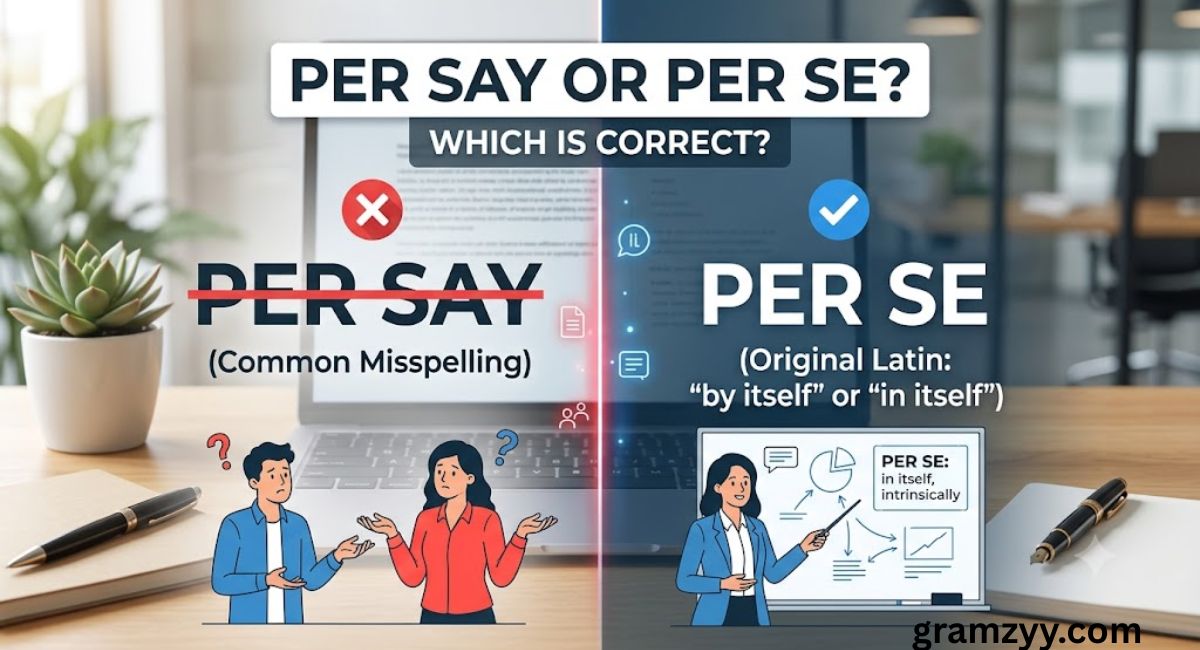
The short answer: per se is correct. “Per say” is a misspelling, plain and simple. But knowing why it’s correct — and how to use it naturally — is what actually makes your writing sound polished. Let’s break it all down.
Why “Per Say” Confuses So Many English Speakers
The mix-up isn’t really about grammar knowledge. It’s about sound.
When people hear the phrase spoken aloud, the second syllable sounds exactly like the English word “say.” Since English speakers naturally spell unfamiliar words the way they sound, “per say” feels like a logical guess.
A few other reasons the error sticks around:
- The phrase is heard far more often than it’s read, especially in conversation, podcasts, and interviews.
- “Per” already looks like a normal English word, so writers assume the second word follows regular English spelling too.
- Autocorrect and spell-checkers don’t always catch it, since “say” is a real word on its own.
- Many people simply haven’t seen the phrase written down often enough to memorize its Latin spelling.
Once you know it’s a borrowed Latin term rather than a native English phrase, the spelling starts to make more sense.
What Does “Per Se” Actually Mean?
Per se means “by itself,” “in itself,” or “intrinsically.” It’s used when you want to separate one specific quality of something from everything surrounding it.
In practice, people use “per se” to soften a statement or clarify that something isn’t inherently true — even if it seems that way on the surface.
For example:
- “The plan isn’t bad per se, but the timeline is unrealistic.”
- “I don’t dislike the city per se — I just find the traffic frustrating.”
In both cases, “per se” isolates one idea (the plan, the city) from a broader judgment, letting the speaker make a nuanced point instead of a blunt one.
The Latin Origins and Evolution of “Per Se”
“Per se” comes directly from Latin, where per means “through” or “by,” and se means “itself.” Combined, the phrase translates literally to “by itself” or “through itself.”
It entered English centuries ago through academic, legal, and philosophical writing, where Latin terms were commonly borrowed to express precise concepts. Legal English still uses “per se” today — for example, in the term “per se violation,” which refers to an act considered illegal on its own merits, without needing further proof of harm.
Over time, the phrase moved from strictly formal contexts into everyday speech and writing, but it kept its original spelling. That’s the key detail: even though pronunciation has drifted toward sounding like “per say,” the written form never changed, because it’s a direct Latin borrowing, not an evolving English word.
“Per Say” – Why People Spell It Wrong
To put it plainly: “per say” has no meaning in English. It isn’t a recognized word, phrase, or idiom in any dictionary or style guide.
The error typically happens for one of these reasons:
- Phonetic spelling – writing a word the way it sounds rather than how it’s actually spelled.
- Lack of exposure – not seeing the correct spelling often enough in books, articles, or professional writing.
- Assumption of English origin – treating the phrase as a normal English expression instead of a Latin one.
If you catch yourself about to type “per say,” pause and swap in “in itself” as a quick mental check. If that substitution makes sense is the phrase you’re reaching for.
Common Mistakes and How to Avoid Them
| Mistake | Why It’s Wrong | Correction |
|---|---|---|
| “per say” | Misspelling based on pronunciation | “per se” |
| “Per se, I agree.” | Awkward placement; sounds unnatural | “I don’t disagree, per se, but I have concerns.” |
| Using “per se” for emphasis | It’s meant to isolate/qualify, not emphasize | Use “specifically” or “exactly” instead |
| Overusing the phrase | Feels repetitive and overly formal | Reserve it for moments needing precise nuance |
A simple rule of thumb: if you can’t naturally replace it with “by itself” or “in itself,” you probably don’t need the phrase in that sentence at all.
Synonyms and Substitutes for “Per Se”
Depending on tone and context, several alternatives can express a similar idea:
- In itself
- By itself
- Intrinsically
- Strictly speaking
- Technically
- As such
- Essentially
These substitutes work well when you want to avoid sounding overly formal or when writing for a casual audience that may not be familiar with Latin phrasing.
“Per Se” vs. “Necessarily” – Subtle but Important Difference
These two words are often confused because they can appear in similar sentence structures, but they don’t mean the same thing.
- Per se isolates something to examine it on its own terms.
- Necessarily implies an automatic or guaranteed outcome.
Compare:
- “The design isn’t flawed per se.” (On its own, the design is fine.)
- “The design isn’t necessarily flawed.” (It might be fine, or it might not — there’s uncertainty.)
“Per se” points to intrinsic quality. “Necessarily” points to certainty or inevitability. Swapping one for the other subtly changes what you’re actually claiming.
“Per Se” vs. “So to Speak” – Different Purposes, Different Feel
“So to speak” is used to soften a figurative or unusual word choice, almost like a verbal wink to the reader. “Per se,” on the other hand, isolates a literal quality of something.
| Phrase | Purpose | Example |
|---|---|---|
| Per se | Isolates something to clarify meaning | “It’s not expensive per se, just inconvenient to pay for.” |
| So to speak | Signals figurative or informal language | “He’s the captain of this ship, so to speak.” |
They’re rarely interchangeable, since one deals with literal qualification and the other with figurative expression.
Tips to Remember the Correct Form (“Per Se”)
- Remember it’s Latin, not English — Latin spelling doesn’t follow English pronunciation rules.
- Think of the substitution test: if “in itself” fits, “per se” is correct.
- Picture the “se” as matching words like “resume” or “cliché” — borrowed spellings that don’t sound the way they look.
- Read it more than you hear it. Seeing the correct spelling repeatedly helps it stick.
- When in doubt, a quick search or grammar checker can confirm your spelling before you hit publish.
Enhancing Your English with “Per Se”
Mastering small distinctions like “per se” versus “per say” does more than fix a spelling error — it signals attention to detail. In professional emails, academic papers, and public-facing content, precise language builds credibility and trust with your reader.
Latin-derived phrases like this one are common in English (think “vice versa,” “status quo,” or “et cetera”). Getting comfortable with their correct spelling and usage is a small but meaningful step toward more confident, polished writing.
Conclusion
Per se is the only correct spelling. It’s a Latin phrase meaning “by itself” or “in itself,” used to isolate one quality of something from a broader judgment. “Per say” is a phonetic misspelling with no accepted meaning in English.
Next time you’re unsure, run the quick substitution test: swap in “in itself.” If the sentence still makes sense, you’re using the phrase correctly.
FAQs
Is “per se” formal or casual?
It works in both. You’ll see it in legal writing, academic papers, and everyday conversation alike.
Does “per se” need italics or quotation marks?
No. Since it’s fully absorbed into English, most style guides (AP, Chicago, MLA) treat it as a standard phrase, not a foreign term.
Is “per se” one word or two?
Two separate words: “per” and “se.” Writing it as “perse” changes the meaning entirely (it’s an unrelated color/name).
Can “per se” start a sentence?
Technically yes, but it sounds awkward and unnatural. It reads better placed mid-sentence, right after the idea it qualifies.
Is “per se” losing popularity in modern writing?
No. It’s still widely used in 2026 across news, business, and academic writing, and remains a standard part of everyday English.