Emaculate vs Immaculate: If you’ve ever typed the word “emaculate” and had your spell-checker throw a red squiggly line at you, you’re not imagining things. This is one of the most common spelling mix-ups in English, and it trips up even confident writers. The short version: only one of these words is real, and knowing which one — and why — will save you from an embarrassing typo in your next email, essay, or blog post.
In this guide, we’ll break down the correct spelling, the real meaning, how to use it properly in a sentence, and the small memory tricks that make sure you never mix them up again.
Quick Answer: Emaculate vs Immaculate at a Glance
Here’s the answer without the fluff:
| Word | Correct Spelling? | Meaning | Where You’ll See It |
|---|---|---|---|
| Immaculate | ✅ Yes | Perfectly clean, flawless, free from any mark or fault | Dictionaries, professional writing, everyday speech |
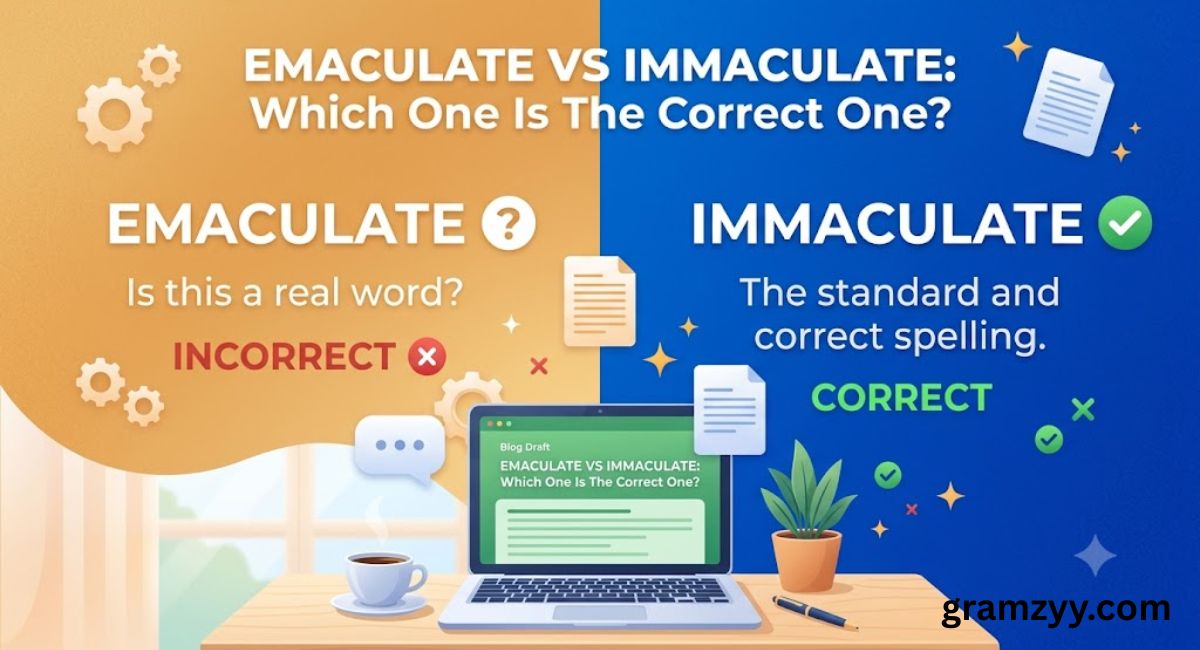
| Emaculate | ❌ No | No meaning — it’s a misspelling | Nowhere; it doesn’t exist in Merriam-Webster or Oxford |
If you remember nothing else, remember this: immaculate is the only real word here. “Emaculate” is not an alternate spelling, a regional variant, or an informal version — it’s simply incorrect.
Define Emaculate
“Emaculate” is not a recognized English word. It does not appear in any major dictionary, and it carries no independent definition of its own. When people write “emaculate,” they almost always mean “immaculate” and have either mistyped it, mispronounced it in their head while typing, or picked up the error from something they read online.
Some writers also confuse “emaculate” with emaciated (extremely thin, undernourished), but the two words have no real connection beyond a passing similarity in sound.
Define Immaculate
Immaculate is an adjective that means perfectly clean, spotless, or completely free from flaws, stains, or errors. It comes from the Latin word immaculatus, meaning “unstained,” built from in- (not) and maculatus (stained or spotted).
It’s used to describe:
- Physical cleanliness (an immaculate kitchen, an immaculate car)
- Appearance (an immaculate suit, immaculate handwriting)
- Performance or work (an immaculate presentation, immaculate records)
- Moral or religious purity (as in the “Immaculate Conception”)
How To Properly Use The Words In A Sentence
Since only one of these words is real, “proper use” really only applies to one of them — but it helps to see exactly how that plays out.
How To Use Emaculate In A Sentence
There is no correct way to use “emaculate” in a sentence, because it isn’t a word. If you find it in a draft, the fix is simple: replace it with “immaculate.”
- ❌ Her desk was always emaculate.
- ✅ Her desk was always immaculate.
How To Use Immaculate In A Sentence
“Immaculate” works as an adjective before or after a noun, and it fits naturally in both casual and formal writing.
- The hotel room was immaculate from top to bottom.
- He showed up to the interview in an immaculate suit.
- She kept immaculate records throughout the entire project.
More Examples Of Emaculate & Immaculate Used In Sentences
Seeing more examples side by side makes the correct usage stick.
Examples Of Using Emaculate In A Sentence
Since “emaculate” isn’t a legitimate word, there are no valid example sentences for it — only examples of the mistake in action, followed by the correction:
- ❌ The garden looked emaculate after the gardener finished. → ✅ immaculate
- ❌ His emaculate attention to detail impressed the client. → ✅ immaculate
- ❌ She gave an emaculate performance on stage. → ✅ immaculate
Examples Of Using Immaculate In A Sentence
- The surgeon’s technique was immaculate, with no room for error.
- Their new house had an immaculate white kitchen.
- The team delivered an immaculate final report before the deadline.
- His immaculate reputation took years to build.
- The museum’s marble floors were kept immaculate by daily cleaning.
Common Mistakes To Avoid
Even careful writers slip up here. These are the patterns worth watching for.
Using “Emaculate” Instead Of “Immaculate”
This is by far the most common error. It usually happens because the word is spoken quickly, and the first syllable (“im”) gets softened until it sounds like “em.” Autocorrect doesn’t always catch it because “emaculate” can look plausible at a glance.
Assuming “Immaculate” Means “Perfect”
“Immaculate” is often used loosely as a synonym for “perfect,” but its core meaning is specifically about being free from stains, flaws, or blemishes — it leans heavily toward cleanliness and precision rather than general excellence. Something can be immaculate (spotless) without being perfect in every other sense, such as design or function.
Offering Tips On How To Avoid Making These Mistakes In The Future
- Break the word down: im- (not) + maculate (stained) = “not stained.”
- Say it slowly out loud — “im-MAC-u-late” — before you type it.
- Use a memory anchor like “immaculate conception,” a well-known phrase that always spells the “im” correctly.
- Run a quick spell-check on any document before sending it, especially formal ones.
- If in doubt, search “is emaculate a word” — the answer will always be no.
Context Matters
Understanding where and how each word fits is just as important as knowing the correct spelling.
Emaculate
There is no legitimate context for “emaculate.” It should never appear in formal writing, casual writing, or speech. If it shows up in a document, it’s a spelling error that needs correcting, full stop.
Immaculate
“Immaculate” fits naturally across many contexts:
- Everyday speech: describing a clean home or tidy appearance
- Professional writing: describing precise, error-free work
- Religious and cultural references: the “Immaculate Conception” or “immaculate purity”
- Descriptive and creative writing: setting a scene of spotless, well-kept surroundings
Examples
| Context | Sentence |
|---|---|
| Home | The apartment was immaculate before the guests arrived. |
| Work | Her spreadsheet formulas were immaculate — not a single error. |
| Fashion | He always dresses in an immaculate three-piece suit. |
| Religious | Catholics observe the Feast of the Immaculate Conception each December. |
Exceptions To The Rules
Emaculate Exceptions
There are no legitimate exceptions. “Emaculate” is not accepted in any dialect, style guide, or dictionary — American, British, or otherwise. It is always a spelling mistake, regardless of context.
Immaculate Exceptions
“Immaculate” itself has no unusual exceptions in spelling, but it’s worth noting a few usage nuances:
- It’s almost always used to describe cleanliness, precision, or purity — not general happiness or general “goodness.”
- In religious contexts, it carries a specific theological meaning tied to being free from sin, which is more specific than everyday usage.
- It doesn’t typically apply to abstract emotions (you wouldn’t say someone had an “immaculate mood”).
Practice Exercises
Test what you’ve learned with these quick exercises.
Exercise 1: Fill In The Blank
Choose the correct word — emaculate or immaculate — for each sentence.
- The chef kept the kitchen _______ during every shift.
- Her _______ attention to detail made her the best editor on the team.
- The car dealership always displays _______ vehicles on the showroom floor.
- He wore an _______ tuxedo to the awards ceremony.
- The report was _______, without a single typo.
(Answer: All five blanks should be filled with “immaculate.” “Emaculate” is never correct.)
Exercise 2: Sentence Completion
Complete each sentence using “immaculate” in the correct form.
- After the deep clean, the office looked completely __________.
- The bride’s dress was __________, without a single wrinkle.
- Investigators praised the __________ condition of the crime scene evidence.
- The athlete’s __________ technique earned a perfect score.
FAQs
Is “emaculate” a real word?
No. “Emaculate” does not appear in any major dictionary and has no accepted meaning. It’s a common misspelling of “immaculate.” (Emaculate vs Immaculate)
What does “immaculate” mean?
“Immaculate” means perfectly clean, spotless, or completely free from flaws, stains, or errors.
Why do people write “emaculate” instead of “immaculate”?
It usually happens because the word sounds like “em-” when spoken quickly, leading to a phonetic spelling mistake rather than a typing error.
Is “emaculate” the same as “emaciated”?
No. “Emaciated” is a real word meaning extremely thin or undernourished. It’s unrelated to “immaculate” in meaning, despite a slight similarity in sound.
What’s the easiest way to remember the correct spelling?
Think of the phrase “Immaculate Conception” — it’s a widely known term that always uses the correct “im-” spelling, making it an easy mental anchor.
Conclusion
The debate between “emaculate” vs “immaculate” isn’t really a debate at all — “immaculate” is the only correct spelling, and “emaculate” simply doesn’t exist in standard English. The confusion comes down to how the word sounds when spoken quickly, not an actual grammar rule with two valid options.
Once you understand the Latin roots (in- + maculatus, meaning “not stained”), the correct spelling becomes much easier to remember. Whether you’re writing a professional email, a school essay, or a casual text, using “immaculate” correctly shows attention to detail and strengthens your credibility as a writer. Next time you catch yourself typing “emaculate,” pause, correct it, and move forward with confidence. (Emaculate vs Immaculate)