You’re typing an email, a resume, or a course description, and your fingers pause over the keyboard. Is it “training” or “trainning”? That flicker of doubt is more common than you’d think, and it happens to careful writers just as often as beginners.
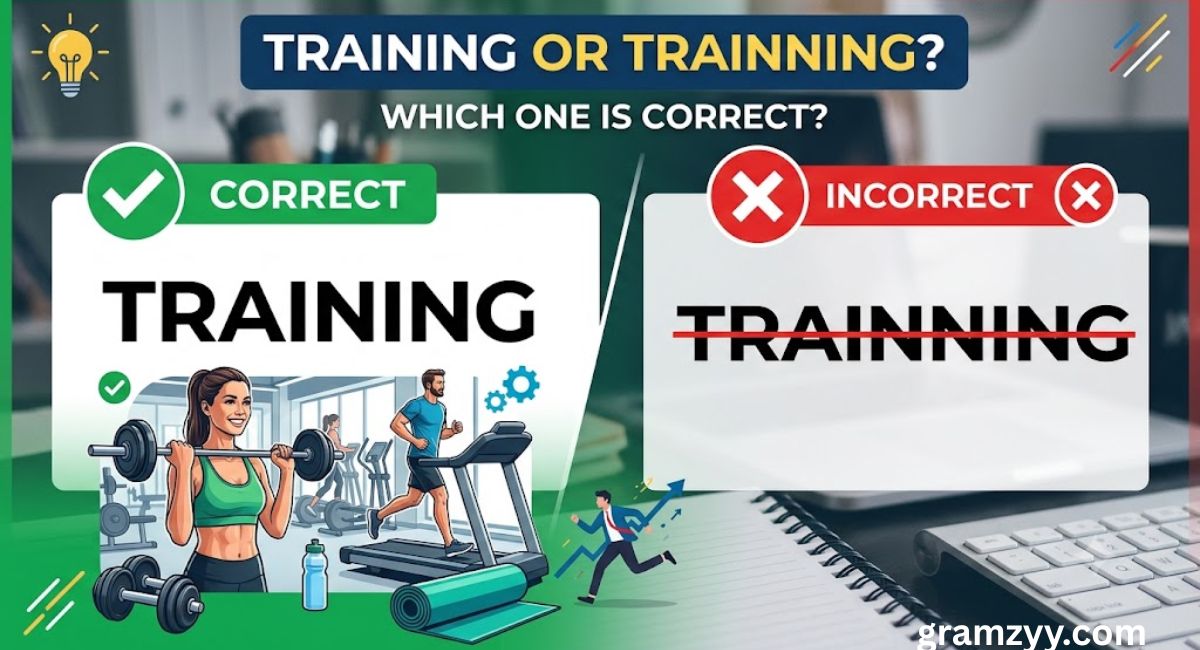
The short answer: training is the only correct spelling. “Trainning” is a misspelling that doesn’t appear in any dictionary, style guide, or accepted form of English. But understanding why this mix-up happens — and how to make sure it never trips you up again — is worth a few minutes of your time, especially if you write professionally.
This guide breaks down the correct spelling, its origin, why the error keeps showing up, and practical ways to lock the right version into memory for good.
Understanding the Correct Spelling
English spelling rules aren’t always intuitive, but this one is refreshingly simple. The word you want, in every context — business, education, sports, healthcare, or casual conversation — is training.
- Correct: training
- Incorrect: trainning
There’s no situation, region, or dialect where “trainning” is acceptable. American English, British English, Canadian English, and Australian English all agree on this one. If a spell-checker underlines “trainning” in red, that’s not a glitch — it’s doing its job.
Why “Training” Is Correct
“Training” is built from the base verb train plus the suffix -ing. English generally follows a straightforward pattern here:
- Take the root verb (train).
- Add -ing directly to the end.
- Result: training.
No letters are dropped, and — this is the key part — no letters are doubled. The rule that doubles a final consonant before “-ing” (as in run → running or stop → stopping) only applies to short, stressed syllables ending in a single vowel plus a single consonant. “Train” ends in a consonant cluster after a vowel team sound (the “ai”), so it doesn’t qualify for consonant doubling. The “n” stays single, and you simply get training.
Why “Trainning” Is Incorrect
“Trainning” breaks that exact rule by doubling the “n” unnecessarily. This happens for a very human reason: English is full of words where doubling does apply, and those patterns are contagious.
Common reasons people write “trainning” by mistake:
- Pattern confusion with words like running, beginning, or swimming, which do double their final consonant.
- Typing speed — an extra key gets hit before the brain catches up.
- Auto-correct or muscle memory carried over from other “-ing” words.
- Non-native speaker patterns, where doubling rules across languages differ from English.
Whatever the cause, “trainning” has no dictionary entry, no historical usage, and no accepted context. It’s simply an error to fix, not a variant to consider.
The Origin and Meaning of “Training”
Etymology
The word traces back to the verb train, which entered English in the late 14th century from Old French trainer (to drag or draw along), itself rooted in Vulgar Latin. Over centuries, the meaning shifted from the literal idea of “drawing out” or “pulling” toward the more figurative sense of shaping, disciplining, or preparing something — a plant, an animal, or eventually a person — through guided practice. The noun “training” followed naturally once “train” took on this instructional meaning.
Definition
As a noun, training refers to the process of teaching, developing, or practicing a skill, behavior, or body of knowledge, typically through structured instruction or repeated practice. As a verb form (the present participle of “train”), it describes the ongoing act of instructing or preparing someone or something.
Common dictionary definitions include:
- The action of teaching a person or animal a particular skill or behavior.
- The process of learning the skills needed for a particular job or activity.
- Physical exercise done to improve strength, fitness, or performance.
Common Contexts for “Training”
“Training” shows up across nearly every field imaginable:
- Workplace: onboarding programs, compliance courses, leadership development
- Sports and fitness: gym routines, coaching sessions, athletic conditioning
- Education: workshops, seminars, certification programs
- Technology: training a machine learning model on a dataset
- Animals: teaching a dog to sit, stay, or fetch
Examples
- “I’m attending a leadership training next week.”
- “Our team completed compliance training before the audit.”
- “She’s training for her first marathon.”
- “The company invests heavily in employee training programs.”
- “The model was trained on a large dataset before deployment.”
Why Spelling Accuracy Matters
It’s tempting to treat a single misspelled letter as a trivial slip. In practice, spelling accuracy carries more weight than most people assume.
Real-World Consequences
- Job applications: Resumes and cover letters with spelling errors are often discarded before a human even reviews the qualifications.
- Official forms: Applications for certifications, benefits, or professional licenses can face delays if key terms are misspelled.
- Business communication: Emails, proposals, and reports with basic errors can undermine a company’s credibility with clients or partners.
- Academic work: Misspellings in assignments or publications can affect grades and how peers or reviewers perceive the work.
Communication Clarity
Beyond first impressions, correct spelling supports clear communication. A misspelled word can momentarily confuse a reader, slow down comprehension, or make instructions (like training manuals or safety guidelines) harder to follow accurately. In fields like healthcare, aviation, or compliance, that kind of ambiguity isn’t just embarrassing — it can be genuinely risky.
Side-by-Side Comparison
| Feature | Training (Correct) | Trainning (Incorrect) |
|---|---|---|
| Dictionary entry | Yes — Merriam-Webster, Oxford, Cambridge | No |
| Spelling rule followed | Yes — verb + “-ing,” no doubling needed | No — doubles “n” unnecessarily |
| Accepted in professional writing | Yes | No |
| Recognized by spell-checkers | Yes | Flagged as an error |
| Used in formal/legal documents | Yes | Never |
| Regional variants (US/UK/AUS) | Same spelling everywhere | Not valid anywhere |
Tips for Remembering the Correct Spelling
Mnemonics and Memory Aids
- Think of a moving train: train + ing = training. Picture the train pulling one car after another — one “n,” moving forward, nothing doubled.
- Break it into two visible chunks: TRAIN + ING. If you can spell “train” on its own, you already have the hard part done.
- Write a quick reminder for yourself: “Training = 1 N.”
Pronunciation Rules
The stress in “training” falls entirely on the first syllable — TRAY-ning. Only one “n” sound is actually pronounced. Since the doubled-consonant rule in English is tied to short, stressed vowel sounds (like in running), and “train” has a long vowel sound instead, there’s no pronunciation reason to double the letter either.
Common Misspelling Patterns
| Base Word | Correct “-ing” Form | Rule Applied |
|---|---|---|
| Train | Training | No doubling — long vowel sound |
| Run | Running | Doubling — short vowel + single consonant |
| Begin | Beginning | Doubling — stressed final syllable |
| Explain | Explaining | No doubling — same pattern as “train” |
| Swim | Swimming | Doubling — short vowel + single consonant |
Notice that “training” follows the same pattern as other “-ain” verbs like explain → explaining or maintain → maintaining. None of these double their final consonant.
Special Cases
Applications Requiring Accuracy
Certain documents leave zero room for spelling errors, since a mistake can create real administrative friction:
- Certification and licensing forms, where an incorrect spelling could complicate eligibility verification.
- Legal and compliance documents, where precise terminology matters for audits or regulatory review.
- Academic transcripts and applications, where spelling errors can affect how an application is perceived.
- Technical documentation, such as employee handbooks or safety training manuals, where clarity directly affects understanding.
Importance Across Industries
- Corporate HR: Training records, onboarding materials, and performance reviews all rely on consistent, correct terminology.
- Healthcare: Training documentation tied to certifications or compliance must be error-free to avoid processing delays.
- Education: Instructors and students alike are judged partly on written accuracy in reports and coursework.
- Sports and coaching: Training logs, athlete assessments, and program descriptions benefit from professional, error-free writing.
Conclusion
The rule here is simple and permanent: training is correct, and trainning is not — in any industry, region, or context. The confusion usually comes from English’s inconsistent doubling rules, where words like running and beginning double their final consonant while “-ain” words like training and explaining do not.
Once you connect the spelling back to its root word — train + ing — the uncertainty tends to disappear for good. Whether you’re writing a resume, a workplace report, or a coaching plan, using the correct spelling reinforces clarity and professionalism in every piece of writing you produce.
FAQs
Is “trainning” ever correct in British English?
No. Both British and American English recognize only “training” as the correct spelling.(Training or Trainning)
Why do people double the “n” in “trainning”?
It usually happens by analogy with words like “running” or “beginning,” which do double their final consonant before “-ing.” (Training or Trainning)
Does “training” ever change spelling in other tenses?
No. The base verb “train” changes to “trained” (past tense) and “training” (present participle), but the “n” is never doubled in either form.
Is “training” a noun or a verb?
It functions as both — a noun referring to the process of instruction, and a verb form (the present participle of “train”) describing an ongoing action. (Training or Trainning)
Can spell-checkers always catch “trainning”?
Most modern spell-checkers flag it automatically, but it’s still worth proofreading manually, especially in official or high-stakes documents. (Training or Trainning)