If you’ve ever paused mid-sentence wondering whether to say “she has” or “she have,” you’re not alone. This is one of the most common subject-verb agreement questions in English, and the answer is simpler than it feels.
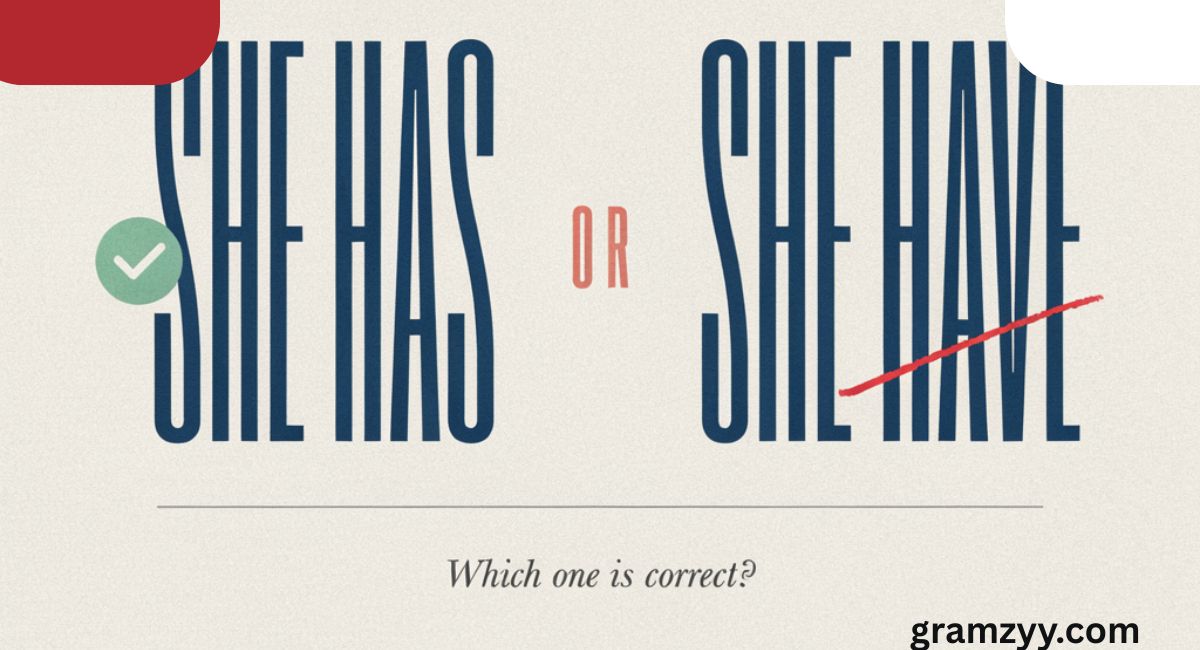
The correct form is always “she has.” “She have” is grammatically incorrect in standard English, whether you’re writing an email, a school essay, or a business report. The confusion usually comes from mixing up singular and plural subjects, or from fast, informal speech where sounds blur together.
This guide breaks down the rule in plain language, walks through real example sentences, flags the mistakes people make most often, and gives you practical tips to lock the pattern into memory for good.
Contextual Examples
Basic Rule and Parts of Speech
English verbs change form depending on who or what is doing the action — this is called subject-verb agreement. The verb “to have” has two present-tense forms:
| Subject | Correct Verb | Example |
|---|---|---|
| I, you, we, they | have | They have a plan. |
| He, she, it | has | She has a plan. |
“She” is a third-person singular pronoun, and third-person singular subjects (he, she, it) always pair with has in the simple present tense. This rule doesn’t change based on meaning, tone, or context — it stays fixed whether you’re describing possession, feelings, obligations, or actions.
Example 1 — Simple Present (Affirmative)
- She has a new laptop.
- She has two younger brothers.
- She has a busy schedule this week.
Example 2 — Simple Present (Negative)
Negatives use the auxiliary “does,” so the main verb drops back to its base form:
- She does not have a car. ✅
- She doesn’t have time today. ✅
- ~~She does not has a car.~~ ❌
Example 3 — Question Form
Questions also rely on “does,” which shifts the verb back to “have”:
- Does she have a driver’s license?
- Does she have any siblings?
Example 4 — Present Perfect Tense
In the present perfect tense, “has” pairs with a past participle:
- She has finished her homework.
- She has visited Paris three times.
- She has already emailed the report.
Example 5 — Use With Modal Verbs
After modal verbs like should, could, would, or might, the verb always reverts to “have,” never “has”:
- She should have called earlier.
- She could have won the award.
- She might have forgotten her keys.
Example 6 — Plural Subject Contrast
Comparing singular and plural subjects side by side makes the pattern click:
- She has a dog. → They have a dog.
- She has finished. → We have finished.
Example 7 — Compound Subject
Compound subjects joined by “and” usually take “have,” since they act as a plural unit:
- She and her sister have a shared apartment.
- Tom and she have completed the project together.
Example 8 — Contracted Forms
In speech and casual writing, “she has” often contracts to “she’s”:
- She’s finished her homework. (= She has finished her homework.)
- She’s got a great idea. (= She has got a great idea.)
Note that “she’s” can also mean “she is,” so context determines the meaning.
Common Mistakes
Mistake 1 — Using “She Have” in Present Simple
The most frequent error is saying “she have” instead of “she has” in a plain statement.
- ❌ She have a meeting today.
- ✅ She has a meeting today.
Mistake 2 — Using “Has” After Auxiliary Does
Once “does” appears in a sentence, the main verb should never take an “s.”
- ❌ Does she has time to talk?
- ✅ Does she have time to talk?
Mistake 3 — Confusion With Plural or Compound Subjects
Learners sometimes apply “has” to compound subjects that function as plurals.
- ❌ She and her friends has a plan.
- ✅ She and her friends have a plan.
Mistake 4 — Mixing Tenses in Reporting
In reported or indirect speech, writers sometimes shift tense incorrectly, pairing “has” with a past-tense structure.
- ❌ She said she has already left. (inconsistent tense)
- ✅ She said she had already left.
Mistake 5 — Misreading Contractions
Because “she’s” can stand for both “she is” and “she has,” readers sometimes misinterpret the intended meaning, especially in fast reading or listening.
- She’s tired. (she is)
- She’s finished the report. (she has)
Mistake 6 — Using “Have” After “She” in Perfect Tenses Incorrectly
Some writers drop the “s” from “has” when building present perfect sentences.
- ❌ She have lived here for ten years.
- ✅ She has lived here for ten years.
American vs British English Differences
Core Rule: Same in Both Varieties
The has/have rule for “she” is identical across American and British English. “She has” is correct in both, and “she have” is nonstandard in both.
Contraction Usage
Both varieties use “she’s” as the contraction for “she has,” though British English speakers may use it slightly more often in casual writing and dialogue.
Tag Questions and Informal Variants
Tag questions follow the same structure on both sides of the Atlantic:
- She has a car, doesn’t she?
Informal dialects in various English-speaking regions sometimes use “she have,” but this is considered nonstandard and should be avoided in formal writing everywhere.
Past Forms and Perfect Tenses
Past and perfect tense forms of “have” (had, has had) work identically in American and British English. The real difference in has/have usage shows up with collective nouns, not with “she”:
| Structure | American English | British English |
|---|---|---|
| Collective noun | The team has won. | The team have won. |
| Pronoun “she” | She has won. | She has won. |
Regional Colloquialisms
Some regional dialects (in both the US and UK) use “she have” in casual, spoken speech. This is a feature of informal or nonstandard dialects, not an accepted rule for formal writing, business communication, or academic work.
Idiomatic Expressions
“Has Got” and Possession
In British English especially, “has got” is common for possession, and it still uses “has” with “she”:
- She has got a new phone. (= She has a new phone.)
“Has To” for Obligation
“Has to” expresses necessity or obligation and always follows the same subject-verb rule:
- She has to finish the report by Friday.
- She has to attend the meeting.
Present Perfect Idioms
Many everyday idioms use “has” with “she” because they’re built on the present perfect structure:
- She has her heart set on it.
- She has what it takes.
- She has no idea.
Avoiding Confusion With “Have Got”
Don’t confuse “have got” (a fixed idiomatic phrase) with the plain verb “have.” Both still follow the same agreement rule with “she”:
- ✅ She has got a plan.
- ❌ She have got a plan.
Practical Tips
Tip 1 — Use the Omission and Replacement Check
Replace “she” with “he” or “it.” If “he has” or “it has” sounds correct, then “she has” is correct too.
Tip 2 — For Negatives and Questions, Use Do/Does
Remember that “does” already carries the tense, so the main verb stays in its base form: “have,” not “has.”
Tip 3 — Watch Auxiliary Combinations
After modal verbs (should, could, would, must, might), always use “have,” never “has.”
Tip 4 — Teach Contractions Carefully
When teaching or learning “she’s,” clarify whether it means “she is” or “she has” based on the rest of the sentence.
Tip 5 — Use Short Sentences for Clarity
Practicing with short, simple sentences makes the has/have pattern easier to internalize before moving to longer, complex ones.
Tip 6 — Check Verb Agreement in Compound Subjects
If “she” is joined with another subject by “and,” the compound subject is plural and takes “have.”
Tip 7 — Use Visual Timelines for Tenses
Mapping out simple present, present perfect, and past perfect on a timeline helps clarify when “has” and “had” apply.
Tip 8 — Avoid Nonstandard Speech in Formal Writing
Even if “she have” appears in casual conversation or dialect, keep formal writing — emails, reports, essays — strictly standard.
Tip 9 — Use Proofreading Quick-Fixes
Before submitting any written work, search for “she have” as a final check and correct it to “she has.”
Tip 10 — Teach With Minimal Pairs
Comparing near-identical sentences side by side (she has / they have) reinforces the pattern faster than isolated rules.
Revision Examples
Revision 1 — Fixing Subject–Verb Disagreement
- ❌ She have a new job.
- ✅ She has a new job.
2 — Correcting Auxiliary Use in Questions
- ❌ Does she has any questions?
- ✅ Does she have any questions?
Revision 3 — Fixing Modal and Perfect Mix
- ❌ She must has finished by now.
- ✅ She must have finished by now.
Revision 4 — Clarifying Contraction Meaning
- ❌ She’s a headache. (unclear/incorrect meaning)
- ✅ She has a headache.
Conclusion
The rule behind “she has or she have” comes down to one core principle: third-person singular subjects — he, she, it — always take “has” in the simple present tense, while “have” belongs with I, you, we, they, and plural nouns. The only exceptions are questions and negatives built with “does,” and structures that follow a modal verb, where “have” returns as the base form.
Once this pattern is clear, subject-verb agreement stops being a guessing game. Whether you’re writing a business email, a school assignment, or everyday messages, using “she has” correctly signals attention to detail and helps your writing sound polished and professional.
FAQs
Is it ever correct to say “she have”?
Only after a modal verb (she should have, she could have) or after “does” in questions and negatives (does she have). As a standalone statement, “she have” is incorrect. (She Has or She Have)
Why do people confuse “has” and “have” with “she”?
Because most subjects in English use “have,” the brain often defaults to that pattern, causing “she have” to slip in even though “she” is one of the few subjects that requires “has.”
Does British English ever use “she have”?
No. Standard British and American English both require “she has.” Any use of “she have” is limited to informal dialects, not accepted grammar.
What does “she’s” mean — “she is” or “she has”?
It can mean either, depending on context. “She’s tired” means “she is tired,” while “she’s finished” means “she has finished.” (She Has or She Have)
Is “she has got” correct?
Yes. “Has got” is a common, especially British, way of expressing possession, and it still follows the has/have rule tied to “she.”
How can I quickly check if I’ve used the right form?
Replace “she” with “he” or “it” in the sentence. If it still sounds correct, “has” is the right choice; if not, review the sentence structure.