If you’ve ever stared at a rainbow and wondered whether indigo vs violet are really two separate colors—or just names for the same shade—you’re not alone. Painters mix them differently, scientists measure them differently, and everyday speakers often use the words interchangeably.
This guide breaks down indigo vs violet in plain English: what each color looks like, where they sit on the light spectrum, how to use the words correctly, and the common mix-ups that trip people up in design and writing.
Quick Answer: Indigo vs Violet
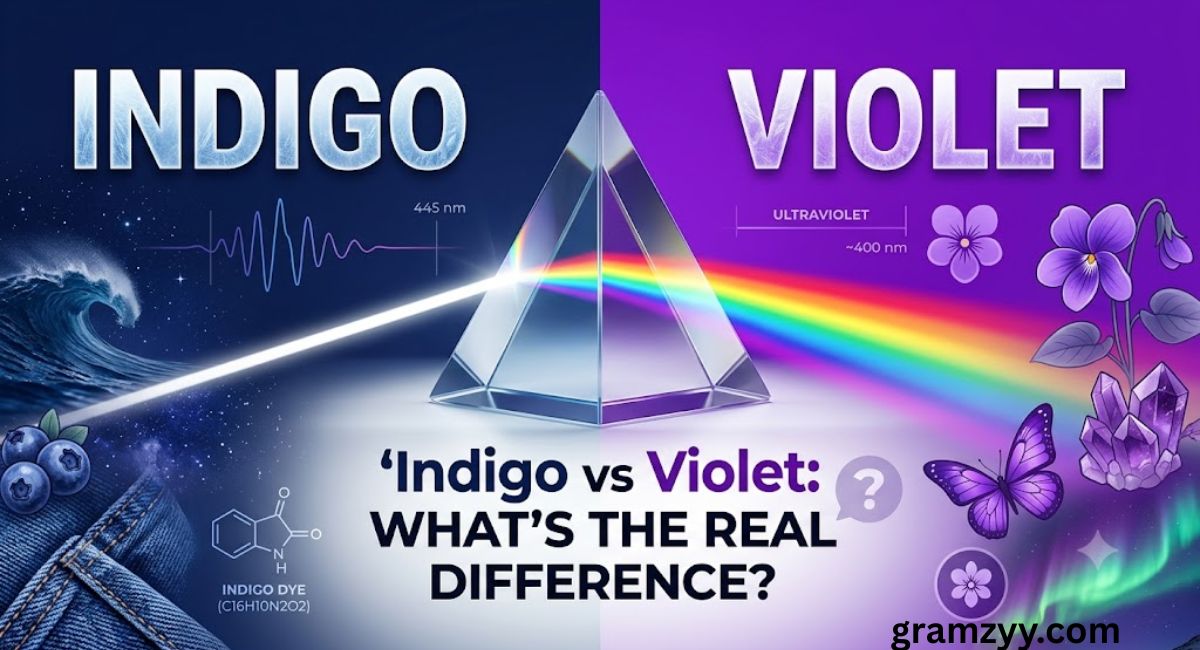
Indigo is a deep, dark blue-purple shade that leans heavily toward blue. Violet is a brighter, lighter purple shade that sits at the very end of the visible light spectrum, closest to what our eyes perceive as pure purple. In short: indigo is darker and bluer; violet is lighter and more purple.
Understanding the Basics of Indigo vs Violet
Both colors appear in the rainbow, both are part of the ROY G BIV sequence (Red, Orange, Yellow, Green, Blue, Indigo, Violet), and both are often grouped under the broader “purple family.” But that’s where the similarities end.
Key Difference
The core difference comes down to wavelength and tone:
- Indigo has a longer wavelength than violet and sits between blue and violet on the spectrum. It reads as a deep, dusky blue with a hint of purple.
- Violet has the shortest wavelength of any visible color, giving it a brighter, more vivid purple appearance.
Think of indigo as “midnight denim” and violet as “fresh lavender petals.”
Comparison Table
| Feature | Indigo | Violet |
|---|---|---|
| Tone | Deep, dark blue-purple | Bright, light purple |
| Position in spectrum | Between blue and violet | Shortest wavelength, end of spectrum |
| Common association | Denim, night sky, wisdom | Flowers, royalty, creativity |
| Mood | Calm, introspective | Playful, vibrant |
| Hex code (approx.) | #4B0082 | #8F00FF |
| Grammar role | Noun / Adjective | Noun / Adjective |
Correct Meanings & Uses
What Is Indigo?
Indigo refers to a dark, dusky shade that blends blue and purple, with blue as the dominant note. The name comes from the indigo plant, historically used to make natural blue dye for fabric, including traditional denim.
Key Characteristics:
- Deep and cool-toned
- Closer to navy blue than to bright purple
- Often used to describe denim, night skies, and deep sea water
- Symbolically linked to intuition, depth, and calm
Example Sentences:
- “She painted the bedroom wall a rich indigo to create a calming atmosphere.”
- “The dye from the indigo plant has been used for centuries to color fabric.”
- “Twilight gave the sky an indigo glow just before nightfall.”
Sentence Breakdown:
In each example, “indigo” functions as an adjective describing a noun (wall, glow) or as a noun referring to the color/plant itself. Notice how it consistently signals depth and darkness rather than brightness.
What Is Violet?
Violet is a bright, vivid color that sits at the far end of the visible light spectrum, closest to what human eyes register as pure purple. It’s the color of violets (the flower), lavender fields, and light passing through a prism at its shortest visible wavelength.
Key Characteristics:
- Bright and vivid, not dark
- Leans toward pink-purple rather than blue-purple
- Common in flowers, fashion, and branding
- Symbolically linked to royalty, luxury, and creativity
Example Sentences:
- “She wore a violet gown to the gala, and it stood out beautifully.”
- “Violet is the last color visible before ultraviolet light.”
- “The garden was full of violet crocuses in early spring.”
Sentence Breakdown:
Here, “violet” also works as both adjective and noun. Unlike indigo, it describes something lighter and more saturated, without the heavy blue undertone.
Case Study Section
Real-Life Example: Workplace Design Discussion
A marketing team asked an interior designer for “indigo accent walls” to match a calm mood board. Working from a quick verbal brief, the designer ordered paint in bright violet instead, assuming the client simply meant “a shade of purple.”
Result:
The walls looked far too vibrant for the intended corporate, calming vibe. The client had to repaint, losing time and budget.
Correct Approach:
The designer should have confirmed the exact hex code or shown physical swatches before ordering, since indigo and violet create noticeably different moods even though both fall under the purple umbrella. This shows why precise color vocabulary matters in design, branding, and fashion work.
Grammar Rules Explanation
As Nouns:
Both words can name the color itself.
- “Indigo is my favorite color for jeans.”
- “Violet suits her complexion perfectly.”
As Adjectives:
Both words can describe a noun directly.
- “An indigo scarf” (deep blue-purple scarf)
- “A violet dress” (bright purple dress)
Neither word changes form when used as an adjective—no “-ish” or “-y” suffix is needed, unlike words such as “blue” becoming “bluish.”
Common Mistakes Section
Why Do People Confuse Indigo vs Violet?
Most confusion comes from the fact that both colors sit close together on the color wheel and both get lumped into the general “purple” category in casual speech. Add in inconsistent screen displays and paint mixing, and the line blurs even further.
Common Grammar Confusions Table
| Mistake | Why It’s Wrong | Correct Usage |
|---|---|---|
| Using “indigo” for anything purple | Indigo specifically means dark blue-purple | Use “violet” for bright purple shades |
| Saying “violet” for denim jeans | Denim is traditionally indigo-dyed | Use “indigo” for denim-blue tones |
| Treating them as identical synonyms | They occupy different spectrum positions | Treat as related but distinct hues |
| Capitalizing inconsistently | Style guides vary | Lowercase unless starting a sentence |
Causes of Errors:
- Both colors are grouped under “purple” in everyday language.
- Screen and print colors render differently, making shades look similar.
- Many people never learned the rainbow’s technical color order (ROY G BIV).
- Marketing and paint brands don’t always use standardized names.
Usage in Different Contexts
1. Everyday Conversation
People often say “purple” as a catch-all, but if precision matters—like describing an outfit—indigo signals something darker and violet signals something brighter.
2. Professional Writing
Design briefs, product listings, and technical documents (like art or physics writing) should use the exact term with a hex code or Pantone reference to avoid miscommunication.
3. Creative Writing
Writers use indigo to evoke calm, mystery, or nightfall, while violet often conveys energy, romance, or vibrancy. Choosing the right word shapes the reader’s mental image.
4. Social Media/Texting
Casual use is more forgiving here, but hashtags like #violethair or #indigodye still perform better when matched to the actual shade shown in the photo.
Why It Matters (Important Section)
Getting indigo vs violet right isn’t just about sounding smart—it affects real outcomes. Designers who mislabel colors risk costly reprints. Writers who misuse the words weaken their imagery. Students studying optics need the distinction to understand how the visible spectrum works. Brands also lose customer trust when product descriptions don’t match delivered colors. Precision here builds clarity and credibility across creative, academic, and commercial work.
Special Exception Section
Rainbow Debate
Not everyone agrees indigo deserves its own place in the rainbow. Sir Isaac Newton originally added indigo as a seventh color partly to match the cultural significance of the number seven, rather than pure optical necessity. Many modern scientists argue indigo isn’t easily distinguishable from blue or violet by the human eye, making it more of a transitional shade than a true spectral band. Violet, by contrast, is universally accepted as a genuine spectral color with its own measurable wavelength.
Quick Recap Checklist
- Indigo = dark, blue-leaning purple
- Violet = bright, light-leaning purple
- Indigo sits between blue and violet on the spectrum
- Violet has the shortest wavelength of visible light
- Both work as nouns and adjectives
- Use hex codes or swatches in professional settings to avoid confusion
- Indigo’s rainbow status is scientifically debated; violet’s is not
Practice Examples
Test yourself by filling in the blanks:
- The sky turned ______ at dusk. → Indigo
- She wore a ______ dress to the party. → Violet
- The spectrum ends in ______ light. → Violet
- Traditional denim dye comes from the ______ plant. → Indigo
FAQs
Is indigo the same color as violet?
No. Indigo is a darker, blue-leaning shade, while violet is brighter and closer to pure purple.
Which color is darker, indigo or violet?
Indigo is darker than violet in almost every context, from paint to digital hex codes.
Why is indigo sometimes left out of the rainbow?
Because it’s difficult for the human eye to distinguish from blue or violet, so some scientists consider it a transitional shade rather than a true spectral color.
Is violet a real spectral color?
Yes, violet is a genuine spectral color with the shortest wavelength visible to the human eye.
Can indigo and violet be used interchangeably in casual speech?
Casually, yes, since both fall under the “purple family,” but for precise design, writing, or scientific use, they should be treated as distinct shades.
Conclusion
Indigo and violet may sit side by side in the rainbow, but they carry different tones, moods, and meanings. Indigo brings depth and calm with its dark, blue-based hue, while violet adds brightness and energy with its light, purple-based shade. Whether you’re painting a room, writing a story, or just settling a friendly debate about rainbow colors, knowing this difference helps you communicate with more accuracy and confidence.