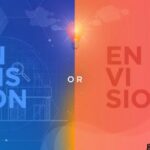
If you’ve ever paused halfway through a sentence wondering whether to type “invision” or “envision,” you’re not alone. This is one of the most common spelling mix-ups in English, and it trips up students, marketers, and even experienced writers. The short answer: envision is the correct word. “Invision” isn’t a standard English term at all — except when it’s capitalized as InVision, the name of a well-known design software company.
This guide breaks down exactly when to use each form, why the confusion happens, and how to avoid the mistake for good — with real examples, common errors, and quick-reference tables you can bookmark.
Contextual Examples
Seeing words in context is the fastest way to lock in correct usage. Below are practical examples covering everyday writing, brand references, and grammar edge cases.
General Usage With Envision
“Envision” is a transitive verb, which means it needs an object — you always envision something.
- I envision a future where remote teams collaborate effortlessly.
- She envisions opening her own bakery within five years.
- The architect envisioned a building that blended with the landscape.
- We envision steady growth for the company next quarter.
Notice that each sentence pairs “envision” with a goal, idea, or mental image. Drop the object and the sentence feels incomplete — “I envision” on its own doesn’t work as a full thought.
Brand Name Invision (Proper Noun)
When people write “invision” in a business or tech context, they’re often thinking of InVision, a digital product design and prototyping platform used by UX and UI teams.
- Our design team shared the mockups in InVision.
- The prototype was built using InVision’s collaboration tools.
- We reviewed the wireframes together inside InVision.
As a proper noun, InVision should always keep its brand capitalization (a lowercase “i” followed by a capital “V”), never a generic lowercase spelling.
Incorrect Verb Form With Invision
This is where most errors happen. Writers borrow the brand spelling and mistakenly use it as a verb.
| Incorrect | Correct |
|---|---|
| We invision a brighter future. | We envision a brighter future. |
| She invisions a new product line. | She envisions a new product line. |
| They invisioned success early on. | They envisioned success early on. |
“Invision” simply doesn’t function as a verb in standard English — treating it like one is a spelling error, not a stylistic choice.
Present Participle And Progressive Forms
Envision follows regular verb conjugation rules, so its progressive form is straightforward.
- I am envisioning a completely redesigned website.
- The team is envisioning a more sustainable supply chain.
- They were envisioning a merger before the market shifted.
The progressive form always uses “envisioning” — never “invisioning,” which isn’t a recognized spelling in any dictionary.
Adjective And Noun Derivatives
Envision also produces useful adjective and noun-like forms through its past participle and related nouns.
- The envisioned outcome exceeded expectations. (adjective use)
- Her vision for the project matched what she had envisioned. (referencing the noun “vision”)
- The company’s envisioned roadmap includes three new product lines.
These derivative forms keep the same “en-” spelling throughout — there’s no version that shifts to “in-.”
Infinitive Uses
The infinitive form, “to envision,” appears often in formal and persuasive writing.
- It’s hard to envision a solution without more data.
- Leaders need to envision long-term goals, not just quarterly wins.
- To envision real change, you have to challenge old assumptions.
Common Mistakes
Even confident writers slip up with this pair. Here are the errors that show up most often, and how to fix them.
Mistake: Using “invision” as a Verb Instead of “envision”
This is the single most frequent error. Because “envision” is pronounced with a soft opening syllable, it can sound like it starts with “in-.” But the correct prefix is “en-,” meaning “to put into” or “to cause.”
Fix: Always double-check that any verb describing imagination or mental visualization starts with “en.”
Mistake: Lowercasing Brand Name
Writing “invision” (lowercase, no capital V) when referring to the design tool is incorrect. The brand name is stylized as InVision.
Fix: Capitalize the brand exactly as the company does, and reserve lowercase “envision” strictly for the verb.
Mistake: Confusing Pronunciation And Spelling
Because English speakers often blend the “en” sound into “in” when talking quickly, spelling gets influenced by how the word sounds rather than how it’s built.
Fix: Remember the word’s structure — “en” (to make) + “vision” (sight) — rather than relying on how it sounds out loud.
Mistake: Incorrect Verb Tense After Envision
Tense mismatches happen when writers pair envision with the wrong time reference.
- Incorrect: We envision yesterday a new strategy.
- Correct: We envisioned a new strategy yesterday.
Fix: Match the verb tense to any time-related word in the sentence — past tense for past events, present tense for ongoing beliefs or goals.
Mistake: Using Envision With Passive Meaning Without Auxiliary
Envision can appear in passive voice, but it needs the correct auxiliary verb structure.
- Incorrect: The plan envision by the board last year.
- Correct: The plan was envisioned by the board last year.
Fix: In passive constructions, always include a form of “to be” (“was,” “is,” “were”) before “envisioned.”
American vs British English Differences
Spelling And Usage
Unlike many word pairs that split along American and British lines (color/colour, organize/organise), “envision” is spelled identically in both regions. There is no British variant spelled “invision” — that idea is a myth. However, British English often favors a close cousin: envisage. Both words share a similar meaning, but envisage leans slightly more formal and is more common in UK business and academic writing.
| Region | Preferred Term | Notes |
|---|---|---|
| American English | Envision | Common in everyday and business writing |
| British English | Envisage (also uses envision) | Envisage feels more formal; envision is understood and used too |
Brand Name Recognition
InVision, the software company, is recognized globally regardless of region. Whether a writer is in New York or London, the brand name keeps its capitalization and spelling — it isn’t localized or adapted for British or American audiences.
Tone And Register
American writing tends to use “envision” freely across casual and formal contexts, from marketing copy to strategic plans. British writing sometimes reserves “envisage” for formal reports and leans on simpler alternatives like “imagine” or “picture” in casual contexts.
Idiomatic Expressions
Envision As Part Of Fixed Phrases
Certain phrases built around “envision” appear repeatedly in business, coaching, and motivational writing:
- Envision the possibilities
- Envision your future self
- Hard to envision
- Difficult to envision a world where…
These phrases work because “envision” carries a forward-looking, aspirational tone that fits goal-setting language.
Envisage Versus Envision
Envisage and envision aren’t perfectly interchangeable in tone. often implies a concrete, planned expectation, while envision leans toward imaginative or aspirational thinking.
- The committee envisaged a three-year rollout. (planned, formal)
- She envisioned a world with cleaner cities. (aspirational)
Brand-Based Idioms
Because InVision is popular in design circles, some professionals casually say “let’s InVision it,” meaning “let’s prototype it.” This is workplace slang, not standard grammar, so avoid it in formal writing.
Creative Uses And Wordplay
Marketing copy sometimes plays with both spellings intentionally — for example, “We envision it, then InVision it.” This only works when both words are spelled correctly and the pun is clearly intentional.
Practical Tips
Tip 1: Decide Meaning From Context First
Ask whether you mean “to imagine” (envision) or a specific design tool (InVision). The intended meaning almost always settles the spelling.
Tip 2: Capitalize Brand Names Correctly
Always capitalize InVision with a lowercase “i” and capital “V” when referring to the company or software.
Tip 3: Use Envision With Correct Verb Forms
Stick to standard conjugations: envision, envisioned, envisioning. There’s no version that begins with “in.”
Tip 4: Avoid Mixing Envision And Envisage Without Purpose
Pick one term based on your audience’s regional expectations, and stay consistent throughout a document.
Tip 5: Keep Modifiers Close
Place adverbs and time markers near the verb they modify to avoid confusing sentence structure.
Tip 6: Watch Passive Voice With Envision
Include an auxiliary verb (“was,” “is,” “were”) whenever you use envision passively.
Tip 7: Spell-Check Brand Names Separately
Standard spell-checkers often flag InVision as an error. Add it to your custom dictionary so it isn’t auto-corrected.
Tip 8: Use Parallel Structures When Listing
When listing envisioned goals, keep verb forms consistent — “to grow, to expand, and to innovate,” not a mix of tenses.
Tip 9: Localize Carefully
Writing for a British audience? Consider “envisage” for a more formal tone in reports and proposals.
Tip 10: Edit For Concision
Read your sentence aloud. If “envision” feels forced, “imagine” or “picture” may communicate the idea more naturally.
FAQs
Is invision ever a correct spelling?
No, “invision” is not a recognized English word. It’s only correct when capitalized as the brand name InVision.
What does envision mean?
Envision means to imagine, visualize, or picture a future outcome or possibility in your mind.
Is InVision the same as envision?
No, InVision is a proper noun referring to a design software company, while envision is a common verb meaning to imagine.
Should I use envision or envisage?
Use envision for general American English writing, and envisage for a more formal tone, especially in British English contexts.
Why do people confuse invision and envision?
The confusion comes from pronunciation — “en-” and “in-” sound alike when spoken quickly — combined with the popularity of the InVision brand name.
Conclusion
The rule is simple once you break it down: envision is the verb you use whenever you’re imagining, planning, or picturing something that hasn’t happened yet. InVision, capitalized, refers only to the design software company — never use it as a verb. “Invision” in any other form is a spelling mistake, not a valid alternative.
Keep this distinction in mind, double-check your capitalization when referencing the brand, and your writing will stay accurate, polished, and professional every time.