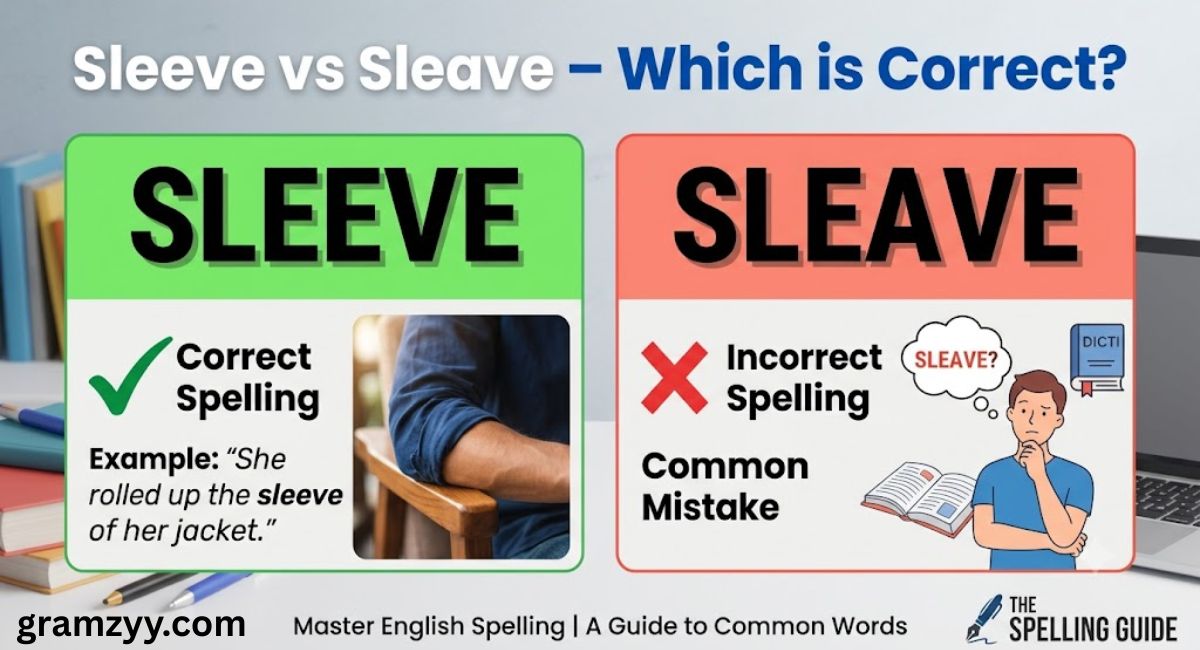
Sleeve vs Sleave: Have you ever typed “sleave” instead of “sleeve” and then paused, wondering if you’d made a mistake? You’re not alone. These two words look almost identical, sound the same when spoken quickly, and yet mean completely different things. One of them belongs in everyday conversation. The other barely survives outside of old poetry.
This guide breaks down exactly what each word means, where they came from, and — most importantly — which one you should actually be using. By the end, you’ll never second-guess this spelling again.
What Does “Sleeve” Mean?
“Sleeve” is the correct, modern English word. It’s the one you already use without thinking, and it’s the one every dictionary, style guide, and grammar checker will confirm as standard.
Definition and Pronunciation
A sleeve is the part of a garment — a shirt, jacket, dress, or sweater — that covers all or part of the arm. It’s pronounced “sleev,” rhyming with “leave” and “believe.”
Beyond clothing, “sleeve” has picked up several extended meanings over time, including:
- A protective cover for an object (a record sleeve, a laptop sleeve)
- A cylindrical mechanical part that fits over another (a piston sleeve)
- An idiom for having something in reserve (“a trick up your sleeve”)
Origins and Etymology
“Sleeve” comes from the Old English word slīefe or slȳf, related to the idea of something one “slips” the arm into. It has stayed remarkably consistent through Middle English and into modern usage, which is part of why it feels so natural today. Unlike many English words, sleeve keeps the same spelling in both British and American English — no transatlantic variation to worry about.
Common Uses of Sleeve
Sleeve shows up constantly across different fields:
| Context | Example Meaning |
|---|---|
| Fashion & tailoring | The arm-covering part of clothing |
| Sports & fitness | Compression sleeves for arms or legs |
| Technology | A padded case for laptops or tablets |
| Music | A record or vinyl album cover |
| Mechanics | A protective cylindrical casing |
| Idioms | Having a plan “up your sleeve” |
Examples of “Sleeve” in Sentences
- She rolled up her sleeves before starting the painting job.
- The vintage jacket has soft leather sleeves.
- He always keeps a strategy up his sleeve during negotiations.
- I bought a padded sleeve to protect my laptop while traveling.
- The mechanic replaced the worn sleeve inside the engine cylinder.
Notice how effortless the word feels in each sentence. That’s usually a strong sign you’re using the right one.
What About “Sleave”?
“Sleave” is a real English word, but it’s old, rare, and almost never appropriate in modern writing. Historically, it referred to raw or untwisted silk thread — fine fibers that hadn’t yet been spun or woven into fabric.
It’s most famous for appearing in Shakespeare’s Macbeth, where sleep is described as something that “knits up the ravell’d sleave of care.” In that line, “sleave” represents tangled threads, used as a metaphor for a troubled, unraveled mind that sleep helps repair.
Outside literature, historical textile writing, and academic analysis, “sleave” has essentially disappeared from everyday English.
Why People Mistakenly Use “Sleave”
This mix-up isn’t random — a few patterns explain it clearly:
- Identical pronunciation. Both words sound exactly the same when spoken aloud.
- Familiar spelling pattern. English often uses “ea” before certain consonant sounds (leave, weave, heave), so “sleave” looks plausible by association.
- Autocorrect and typing habits. A single slipped keystroke can turn “sleeve” into “sleave” without anyone noticing.
- Rare exposure to the real word. Because “sleave” only appears in classic literature, most people have never actually learned what it means — so when they see it, they assume it’s just an alternate spelling.
Examples of “Sleave” in Sentences
- “Sleep that knits up the ravell’d sleave of care” — Macbeth, William Shakespeare
- The weaver separated each sleave of raw silk before spinning it into thread.
- Historical textile records describe bundles of sleave stored for later dyeing.
As you can see, these examples relate to threads and fibers — never to clothing, technology, or idioms.
How to Decide: Sleeve or Sleave?
Here’s a simple comparison to settle the debate for good:
| Feature | Sleeve | Sleave |
|---|---|---|
| Status | Standard modern English | Rare, archaic |
| Meaning | Arm covering, casing, cover | Raw silk thread or fiber |
| Common usage | Very common | Almost never used |
| Found in | Everyday speech, fashion, tech | Old literature, historical texts |
| Correct for clothing? | Yes | No |
| Recommended for writing? | Always | Only in historical/literary context |
Quick Tips to Choose Correctly
- If you’re talking about clothing, gadgets, sports gear, or an idiom — use sleeve.
- If you’re not quoting Shakespeare or discussing historical textile spinning, you almost certainly don’t need sleave.
- A simple memory trick: “Two E’s for the sleeves on a tee.” Double E, just like the two arms a shirt holds.
- When in doubt, default to sleeve — it’s correct in over 99% of real-world situations.
Why This Confusion Happens
English is a blended language, shaped by Old English, Norse, French, and Latin influences. That mixed heritage is exactly why spelling doesn’t always match pronunciation cleanly. Words that sound alike but come from different roots — like sleeve and sleave — are a natural byproduct of that history.
Interestingly, once you understand sleave’s real meaning (raw silk thread), the confusion tends to fade. It stops feeling like a random alternate spelling and starts feeling like its own distinct, historical word.
Using “Sleeve” in Everyday Conversations
Because sleeve is so versatile, it naturally fits into countless everyday sentences:
- Fashion: “The dress has three-quarter sleeves.”
- Fitness: “Compression sleeves help with circulation during workouts.”
- Tech: “My phone case has a card sleeve on the back.”
- Idiom: “She always has a backup plan up her sleeve.”
This flexibility is exactly why sleeve dominates modern English, while sleave has quietly faded into the background of dictionaries and old texts.
Simple Tips to Remember These Words
- Picture it: Sleeve = the part of a shirt that covers your arm. Easy visual, easy word.
- Rhyme it: Sleeve rhymes with leave and believe — all common, modern words.
- Context check: If the sentence involves clothing, casings, or idioms, it’s sleeve. If it involves untwisted silk or centuries-old poetry, it might be sleave.
- When unsure, search it: A quick dictionary check takes seconds and prevents an awkward mistake in professional writing.
Conclusion
Sleeve vs Sleave: The verdict is clear: sleeve is the word you want in virtually every modern context — clothing, technology, sports, and common idioms. Sleave survives only as a historical term for raw silk thread, most famously immortalized by Shakespeare. Unless you’re deep in literary analysis or textile history, you’ll never need it.
Next time you’re typing quickly and pause over the spelling, remember: two E’s, like two arms in a sleeve — simple, clean, and correct.
FAQs
Is “sleave” a real word?
Yes, but it’s archaic and rare, historically referring to raw or untwisted silk thread. (Sleeve vs Sleave)
Which spelling should I use for clothing?
Always use “sleeve” — it’s the only correct spelling for the arm-covering part of a garment.
Why do sleeve and sleave sound the same?
They share a nearly identical pronunciation, which is the main reason people confuse the spellings. (Sleeve vs Sleave)
Is “sleave” used in modern English?
Rarely — it mostly appears in historical texts, literature, or academic discussions of textiles.
Where does “sleave” appear in famous literature?
It’s best known from Shakespeare’s Macbeth, in the phrase “the ravell’d sleave of care.”
Does British English spell “sleeve” differently than American English?
No, “sleeve” is spelled the same way in both British and American English.