Have you ever worked hard on something, only to watch it fall apart and realize you have to start all over again? That feeling has a name — and in the English language, it has an idiom too. “Back to square one” is one of the most widely used expressions in everyday English, and understanding it correctly can sharpen both your communication and your writing. Whether you’re a student, a professional, or someone learning English as a second language, this guide covers everything you need to know about this popular idiom.
What Does “Back to Square One” Mean?
“Back to square one” means returning to the very beginning of a task or process because a previous attempt has failed completely. It signals that all prior progress has been lost and a fresh start is necessary.
In simple terms: you tried, it didn’t work, and now you must begin again from scratch.
Definition: To go back to square one means to start over from the beginning, usually after a setback, failure, or unexpected obstacle.
Cambridge Dictionary defines it clearly: “If you are back to Box one, you have to start working on a plan from the beginning because your previous attempt failed completely.” Merriam-Webster similarly lists it as meaning simply “to start over.”
Where Did the Phrase Come From?
The exact origin of “back to square one” is debated, but a few strong theories exist:
| Theory | Details |
|---|---|
| Radio Football Commentary | In the 1920s–30s, the BBC divided football pitches into numbered squares to help radio listeners follow the game. If the ball returned to square one (near the goalkeeper), commentators would say “back to square one.” |
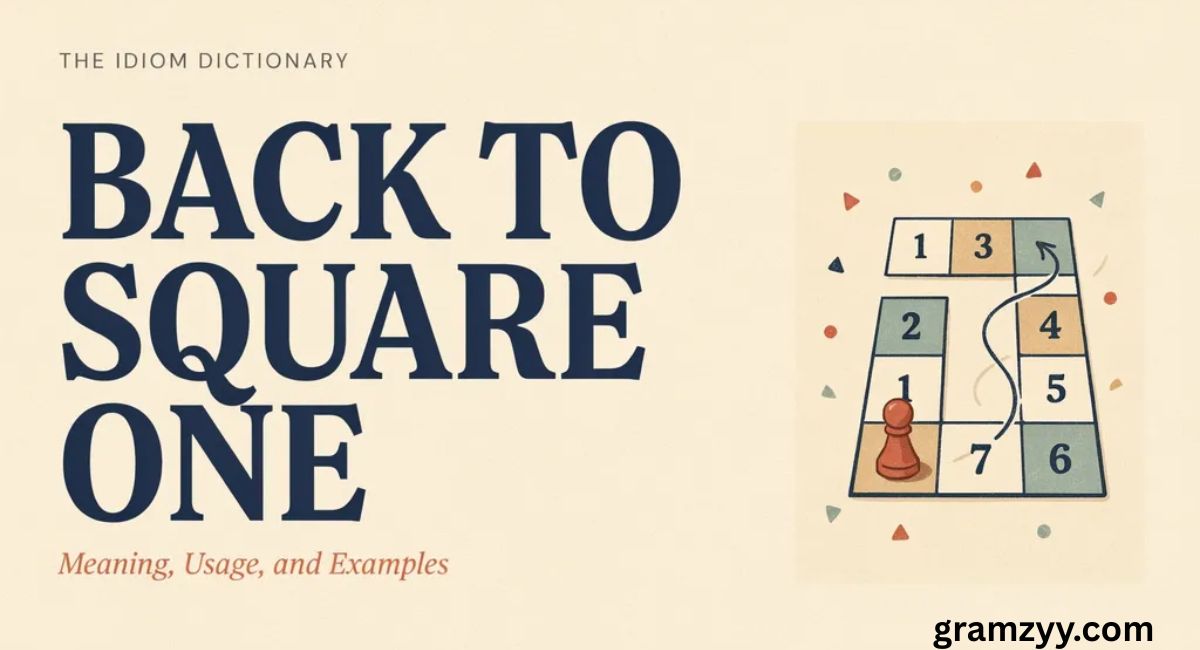
| Board Games | Games like Snakes and Ladders send players back to the start after landing on the wrong square — a direct parallel to the idiom’s meaning. |
| Hopscotch | In the street game hopscotch, certain moves force a player to hop back to the first square, restarting from the beginning. |
| Newspaper Cartoons | Some early 20th-century comics used numbered grid panels; reverting to the first frame was described as going “back to square one.” |
The earliest confirmed printed use appeared in a 1952 edition of the Manchester Guardian, where it described the failure of an economic plan and the need to restart from the beginning. This confirms the phrase was already well understood by the public at that time.
“Back to Square One” in Real Life
Correct Usage Examples
The idiom works best when someone or something has genuinely lost all progress and must restart. Here are natural, correct examples across different contexts:
Business & Work:
- The client rejected the entire proposal, so our team is back to square one on the project.
- After the merger fell through, the company was back to square one in its search for a strategic partner.
- The software update created new bugs and erased key data, sending the developers back to square one.
Personal Life:
- My sister’s divorce was finalized last month, and she’s really struggling with being back to square one at 42.
- I trained all summer, but an injury put me back to square one just before the competition.
- I paid off all my credit card debt, but an unexpected emergency expense sent me right back to square one.
Education:
- After failing the exam, she felt back to square one in her preparation.
- The research team’s hypothesis was disproved by new data, putting them back to square one.
Politics & Society:
- After the election loss, the party went back to square one and rebuilt its entire platform.
- Peace negotiations collapsed, and both sides found themselves back to square one.
Incorrect Usage Examples
Even native English speakers sometimes misuse this idiom. Here’s what to avoid:
| ❌ Incorrect | Why It’s Wrong | ✅ Correct Alternative |
|---|---|---|
| “The project went well, so we’re back to square one.” | The idiom implies failure, not success. | “The project succeeded, so we can move forward.” |
| “She cooked back to square one for dinner.” | You can’t “cook back to square one” — it’s not a physical place. | “She had to restart the recipe from scratch.” |
| “I’m back to square one because I revised one paragraph.” | Small edits are not a full restart. | “I made a minor revision to the paragraph.” |
| “The team won, and now they’re back to square one.” | Winning doesn’t mean starting over. | “The team won and is now preparing for the next round.” |
Key rule: Only use “back to square one” when progress has been substantially lost and a full restart is required — not for minor setbacks or corrections.
See also: Nor in Sentences: Meaning, Rules, and Examples
Context Variations
The phrase adapts easily to different grammatical forms without losing its meaning:
- Simple past: “After the storm, we were back to square one with our outdoor plans.”
- Present tense: “Every time we make progress, something goes wrong and we’re back to square one.”
- Infinitive form: “The board decided to go back to square one and redesign the entire product.”
- Noun phrase: “Starting from square one is frustrating, but sometimes it’s the only option.”
You’ll also see the variation “starting from square one,” which carries the same meaning but frames the restart as a beginning rather than a return.
Common Mistakes with “Back to Square One”
Beyond incorrect usage, here are the most frequent errors learners and writers make with this idiom:
- Using it for minor setbacks. “Back to square one” implies a complete restart, not a small revision. If you only fixed a typo, that’s not going back to square one.
- Confusing it with “back to the drawing board.” These phrases are close in meaning but slightly different:
- Back to the drawing board = you need to redesign or rethink a plan
- Back to square one = you must restart from the very beginning, often after total failure
- Using it positively. The idiom almost always carries a negative or frustrated tone. Using it in a celebratory context sounds unnatural.
- Treating it literally. It’s a figurative expression. “Box one” is not an actual physical square — it represents the starting point of a process.
- Overusing it. If every small obstacle becomes “back to Box one,” the phrase loses its impact. Reserve it for genuine, complete restarts.
How to Remember “Back to Square One”
Memorizing idioms is easier when you connect them to a visual or story. Here are a few memory tricks:
- Picture a board game. Imagine yourself playing Snakes and Ladders. You’re almost at the end — then you land on a snake and slide all the way back to square one. That sinking feeling? That’s the idiom.
- Think of a football field. Visualize an early BBC broadcaster, map in hand, describing the ball rolling all the way back to the goalkeeper — back to Box one on the pitch.
- Link it to the feeling. The phrase captures a specific emotional experience: the frustration of lost effort. When you feel that pang of “we have to start over,” that’s your cue to use this idiom.
- Create a personal sentence. The best way to internalize any idiom is to write a sentence from your own life. Think of a time when a plan failed completely and you had to restart — then describe it using “back to Box one.”
When Should You Use “Back to Square One”?
Not every failure or setback calls for this idiom. Here’s a quick guide to help you decide:
Use “back to square one” when:
- A plan has failed completely, with no salvageable parts
- All previous progress has been erased or rendered useless
- You or your team must restart the entire process from the beginning
- Negotiations, projects, or strategies collapse entirely
Do NOT use “back to square one” when:
- You’re making minor adjustments or revisions
- A project is progressing normally with small hiccups
- Something went well and you’re ready for the next phase
- Only one aspect of a plan needs rethinking (use “back to the drawing board” instead)
Quick decision checklist:
- [ ] Has all meaningful progress been lost?
- [ ] Is a full restart required, not just a revision?
- [ ] Did a failure, rejection, or unexpected obstacle cause the situation?
If you answered “yes” to all three, “back to Box one” is the right choice.
See also: As the Crow Flies: Meaning, Usage, and Examples
Synonyms and Related Expressions
To keep your language fresh and avoid repetition, here are related idioms and phrases with similar meanings:
| Expression | Meaning |
|---|---|
| Back to the drawing board | Rethink and redesign a plan from scratch |
| Start from scratch | Begin something with no prior work or preparation |
| Back at the beginning | Informal way of saying you’ve returned to the start |
| Return to the starting point | More neutral, formal version |
| Zero progress | Emphasis on no advancement being made |
Opposite expressions (when things go well):
- Move forward
- Stay on track
- Make progress
- Continue as planned
FAQs
What is the literal meaning of “back to square one”?
Literally, “square one” refers to the first position on a numbered grid or board. Figuratively, it means returning to the starting point after a failure.
Is “back to square one” formal or informal?
It is primarily informal and conversational, though it appears in journalism, business writing, and casual speech.
What is the difference between “back to square one” and “back to the drawing board”?
“Back to the drawing board” focuses on redesigning a plan; “back to square one” means restarting the entire process from the beginning.
Can “back to square one” ever be positive?
Occasionally, yes — a reset can signal a fresh opportunity. However, the phrase typically carries a frustrated or disappointed tone.
When was “back to square one” first used in print?
The earliest confirmed printed use was in the Manchester Guardian in 1952, though the phrase likely existed in spoken language before that.
Is “starting from Box one” the same as “back to Box one”?
Yes. Both mean beginning again from the very start, though “starting from Box one” can sometimes imply beginning something new rather than restarting after failure.
Conclusion
“Back to square one” is one of those idioms that feels universally understood — because the experience it describes is something almost everyone has lived through. Plans fail. Projects collapse. Efforts come undone. And sometimes, the only path forward is to go right back to the beginning and try again.
Now that you know its meaning, origin, correct usage, and common pitfalls, you’re fully equipped to use this phrase naturally and confidently — whether in conversation, professional writing, or everyday speech. And the next time a plan doesn’t work out, remember: being back to Box one isn’t the end of the story. It’s just a new first chapter.