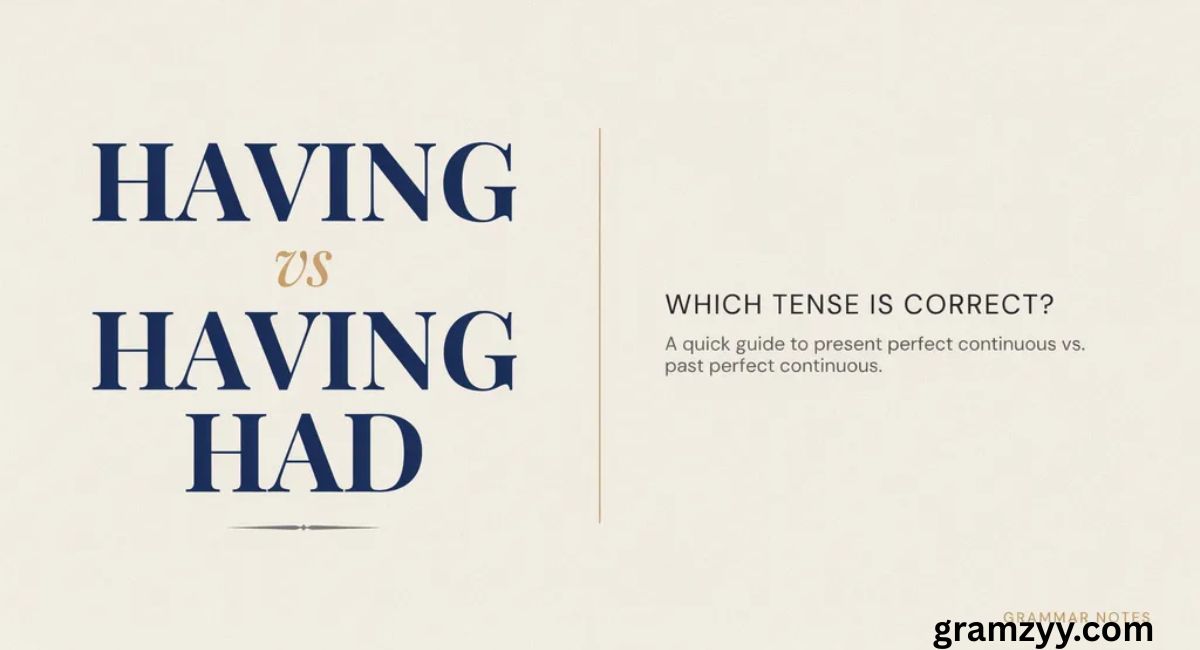
Having vs having had: If you have ever written a sentence and paused to wonder whether to write having or having had, you are not alone. This is one of those grammar points that trips up even confident English speakers. The two forms look nearly identical, yet they carry very different meanings — and using the wrong one can quietly distort your timeline.
The short answer: both are grammatically correct. The right choice depends entirely on when the action happened and how it relates to other events in the sentence.
What’s the Difference Between Having and Having Had?
At the heart of this confusion is the verb have. It functions as both a main verb (showing possession or experience) and a helping verb (building perfect tenses). Having and having had each pull have in a different direction.
| Feature | Having | Having Had |
|---|---|---|
| Form | Present participle of have | Perfect participle (having + past participle of have) |
| Time relationship | Same time as the main action, or links past to present | Action was completed before another past action |
| Usage | Present perfect continuous; participial clauses | Past perfect; perfect participle clauses |
| Example | Having coffee, she read the news. | Having had coffee, she left the café. |
| Tone | Natural in speech and writing | More formal; common in written English |
The key distinction comes down to sequence. Having describes an action that happens at the same time as something else, or shows an ongoing connection to the present. Having had signals that one action was already finished before a second action began.
See also: Nor in Sentences: Meaning, Rules, and Examples
How Does Each Tense Work?
Present Perfect Continuous (Having)
Formula: Subject + have/has + been + having + object
This structure places the action in the past and stretches it toward the present. It stresses duration — the action either continues right now or it has just ended.
- We have been having a lot of rain lately.
- She has been having trouble sleeping.
Notice that the action is not a single completed event. It is an ongoing pattern or situation that still feels connected to now.
In participial clauses, having without an auxiliary verb describes two actions happening at the same time:
- Having lunch, he glanced through his emails. (eating and reading at once)
- Having guests over, she tidied the living room. (the presence of guests overlaps with the tidying)
Past Perfect (Had Had)
Formula: Subject + had + had + object
This one surprises writers who are not used to seeing the word had twice. The first had is the auxiliary verb; the second had is the past participle of have. Together they form the past perfect tense, which shows that one past action was completed before another past event.
- I had had breakfast before she arrived.
- He had had a long day, so he went to bed early.
- We had had some technical problems, so we called an engineer.
The double had is grammatically precise. In spoken English, the contracted form is far more common: I’d had dinner already.
Perfect Participle (Having Had)
Formula: Having + had + object, [subject + main verb]
This is the participial construction that most writers mean when they ask about having had. It compresses a two-step timeline into a single phrase at the start of a sentence, showing that the first action was fully completed before the second began.
- Having had breakfast, I skipped the morning snack.
- Having had no prior experience, she adapted surprisingly quickly.
- Having had a long discussion, the team finally reached a decision.
This structure is especially useful in formal and academic writing because it avoids the slightly awkward had had repetition while still communicating the same sequence of events clearly.
Examples in Different Situations
Present Perfect Continuous With “Having”
These sentences show ongoing situations linked to the present:
- I have been having headaches every afternoon this week.
- The department has been having budget issues for months.
- They have been having regular meetings to track progress.
Past Perfect With “Had Had”
These sentences describe a sequence of two past events:
- By the time the meeting started, she had had three cups of coffee.
- He told me he had had a rough journey.
- The project had had several delays before the new manager arrived.
Perfect Participle With “Having Had”
These show cause-and-effect or sequence in a tighter, more elegant structure:
- Having had enough rest, he felt ready for the interview.
- Having had the opportunity to travel, she sees the world differently.
- Having had no formal training, he built the entire website himself.
Informal Conversations
In everyday speech, native speakers rarely use the full perfect participle form. The same ideas are expressed more simply:
| Formal / Written | Informal / Spoken |
|---|---|
| Having had dinner, we went for a walk. | After dinner, we went for a walk. |
| Having had no experience, she learned fast. | She had no experience but learned fast. |
| Having had a busy week, I needed a break. | I’d had a busy week, so I needed a break. |
This does not mean the formal structures are wrong — they are standard in academic writing, business emails, and literature. But in casual conversation, simpler constructions feel more natural.
See also: Stay in Touch vs Keep in Touch: What’s the Difference?
When Should You Use Each One?
Use this quick guide to make the right choice every time:
Use having (present participle) when:
- Two actions happen at the same time → Having coffee, we chatted.
- You are using the present perfect continuous → She has been having a difficult time.
- You want to describe an ongoing state → Having a positive mindset helps.
Use had had (past perfect) when:
- You are telling a story in the past and need to show which event came first → He had had surgery before the diagnosis.
- You are writing in a narrative or reporting what someone said → She told me she had had enough.
Use having had (perfect participle) when:
- You want to show sequence in a formal, concise way → Having had the training, they handled it well.
- You are writing a formal essay, report, or academic paper.
- You want to express cause and effect between two past actions.
Common Mistakes to Avoid
Even advanced writers fall into these traps. Here are the most frequent errors:
- Using having when sequence matters
- ❌ Having dinner, I went home.
- ✅ Having had dinner, I went home. (dinner was finished before leaving)
- Dangling participles — the subject of the participial phrase must match the subject of the main clause.
- ❌ Having had coffee, the meeting started. (the meeting did not have coffee)
- ✅ Having had coffee, we started the meeting.
- Forgetting the second had in past perfect
- ❌ I had breakfast before she arrived. (simple past — not wrong, but loses the sequencing emphasis)
- ✅ I had had breakfast before she arrived. (past perfect — clearly places breakfast before her arrival)
- Overusing having had in casual writing
- In everyday emails or social messages, stick to simpler constructions. Reserve the perfect participle for formal contexts. (having vs having had)
- Confusing having as simultaneous vs. completed
- Having dinner, he watched TV. → eating and watching at the same time ✅
- Having dinner, he left. → ❌ (implies he left while still eating — use having had dinner)
Memory Tricks
Struggling to keep these straight? Try these simple techniques:
- The “finished first” test: Ask yourself — did the first action finish before the second one started? If yes, use having had. If the two actions overlap, use having.
- The contraction test for had had: Try swapping the first had for a contraction. If I’d had sounds right, the past perfect is correct. Example: I’d had enough. ✅
- The “same time” clue: If you can replace having with while, the simple present participle is correct. While having lunch, she read the news. ✅
- Visualize a timeline: Draw a line. If both actions sit at the same point, use having. If one action ends clearly before the next begins, use having had.
See also: Aging vs Ageing — Which Is Correct?
FAQs
Is “having had” grammatically correct?
Yes. Having had is a perfect participle used to show that one action was completed before another. It is fully grammatical and common in formal writing. (having vs having had)
Can I use “had had” in everyday conversation?
Yes, though the contracted form I’d had or she’d had is more natural in speech. The full form had had is correct in both formal and informal contexts.
What is the difference between “having” and “having had” in a sentence?
Having describes simultaneous or ongoing actions; having had shows that the first action was fully completed before the second one began. (having vs having had)
Is “having had” too formal for modern writing?
Not at all — it is common in academic papers, business reports, and professional emails. In casual texting or conversation, simpler phrasing is usually preferred.
Can “having had” start a sentence?
Yes. Starting a sentence with having had is standard: Having had some experience in the field, she was well-prepared. (having vs having had)
Conclusion
The difference between having vs having had comes down to one simple question: Did the first action finish before the second one started? If the answer is yes, having had is your form. If the actions overlap or the situation is ongoing, having works perfectly.
Both forms are correct in English — context is everything. Once you understand the timeline each form describes, the choice becomes second nature. Practice spotting these structures in books, articles, and academic texts, and you will start using them confidently in your own writing. (having vs having had)