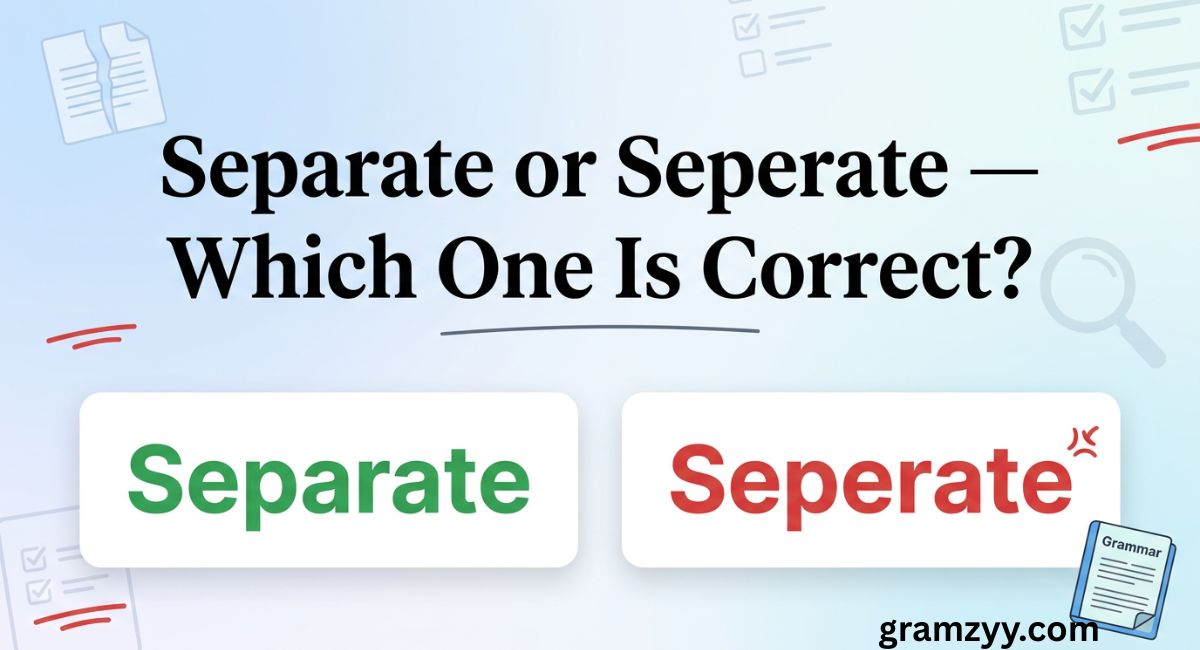
Separate or Seperate which one is Correct: If you’ve ever paused mid-sentence wondering whether it’s “separate” or “seperate,” you’re in good company. This is one of the most commonly misspelled words in the English language, and the mix-up happens to native speakers and learners alike.
Here’s the short answer: “separate” is correct, and “seperate” is always a misspelling. There is no context, dialect, or style guide in which “seperate” is acceptable. This article breaks down exactly why the mistake happens, how to use “separate” correctly as a verb and adjective, and how to avoid the error for good — with practical examples, common mistakes, and memory tricks you can actually use.
Contextual Examples
Understanding “separate” is easier when you see it working in real sentences. Below are the definition, grammar roles, and eight examples covering every common use case.
Definition and Quick Guide
Separate comes from the Latin separare, meaning “to set apart.” It functions as:
- A verb (to divide, part, or keep apart) — pronounced /ˈsep.ər.eɪt/
- An adjective (distinct, individual, apart from others) — pronounced /ˈsep.ər.ət/
- A noun (rare) — referring to individual clothing items that mix and match
| Word | Status | Notes |
|---|---|---|
| Separate | ✅ Correct | Verb, adjective, or noun |
| Seperate | ❌ Incorrect | Common misspelling, not a real word |
| Separated | ✅ Correct | Past tense / adjective form |
| Seperated | ❌ Incorrect | Misspelling |
| Separation | ✅ Correct | Noun form |
| Seperation | ❌ Incorrect | Misspelling |
| Separately | ✅ Correct | Adverb form |
Quick memory rule: “Separate” has two A’s, one on each side of the R — think of the R as a wall separating the two A’s.
Example 1 — Verb Use (Simple Present)
The teacher separates the students into two groups for the science project.
Here, “separates” acts as a present-tense verb showing an action performed regularly or habitually.
Example 2 — Verb Use (Simple Past)
They separated the recycling from the regular trash before the truck arrived.
“Separated” is the past-tense form, describing a completed action.
Example 3 — Adjective Use (Attributive)
Each employee was given a separate desk in the new office.
Here, “separate” directly modifies the noun “desk,” describing it as distinct from others.
Example 4 — Adjective Use (Predicative)
Our opinions on the matter are completely separate.
In this case, “separate” follows a linking verb (“are”) and describes the subject rather than sitting directly before a noun.
Example 5 — Compound and Modifier Precision
She keeps her work life and personal life in separate, well-defined categories.
Precision matters here — pairing “separate” with a second modifier (“well-defined”) sharpens meaning without creating redundancy.
Example 6 — Wrong Spelling Example and Correction
- ❌ Incorrect: Please keep the plates and cups seperate.
- ✅ Correct: Please keep the plates and cups separate.
This is the exact type of error spell-checkers sometimes miss because “seperate” can look plausible at a glance.
Example 7 — Hyphenated/Derived Forms
The report used a well-separated timeline to distinguish each phase of the project.
Derived and hyphenated forms still follow the same spelling rule — the root word never changes to “seper-.”
Example 8 — Verb With Object and Preposition
You need to separate the important documents from the junk mail.
“Separate” frequently pairs with the preposition “from,” forming a natural collocation used in both formal and casual writing.
Common Mistakes
Even confident writers slip up with “separate.” Here are the five most frequent errors and how to fix them.
Mistake 1 — Spelling Mix-Up: Vowel Swap
The most common error is swapping the second “a” for an “e,” producing “seperate.” This happens because the word is often pronounced with a reduced, unclear vowel sound in casual speech.
Mistake 2 — Wrong Verb Form or Agreement
- ❌ The manager separate the tasks among the team.
- ✅ The manager separates the tasks among the team.
Subject-verb agreement errors are common when “separate” is used as a present-tense verb with a third-person singular subject.
Mistake 3 — Confusing Adjective and Verb Roles
- ❌ We need to keep this file separately from the others. (should be adjective, not adverb, when modifying a noun directly)
- ✅ We need to keep this file separate from the others.
Mixing up “separate” (adjective) and “separately” (adverb) changes the grammatical role and can make a sentence sound awkward.
Mistake 4 — Double Determiners and Article Misplacement
- ❌ This is a the separate issue.
- ✅ This is a separate issue.
Stacking articles or determiners before “separate” is a fragment-level error that often slips through fast typing.
Mistake 5 — Run-On and Fragment Problems
- ❌ We separated the boxes it was easier that way.
- ✅ We separated the boxes because it was easier that way.
Run-on sentences involving “separate” usually happen when writers connect two independent clauses without proper punctuation or a conjunction.
See also: How Was Your Night? Meaning, Usage, and Examples
American vs British English Differences
A common question is whether “separate” is spelled differently in American and British English. Here’s the breakdown.
Core Spelling: Same Across Varieties
Unlike words such as “color/colour” or “organize/organise,” “separate” is spelled identically in American, British, Canadian, and Australian English. There is no regional variant.
Usage and Frequency
Both American and British English use “separate” with equal frequency across formal writing, business communication, and everyday speech. Data from language corpora shows no meaningful regional gap in how often the word appears.
Prepositional Collocations
| Region | Common Pairing | Example |
|---|---|---|
| American English | separate from | Keep your work separate from your personal life. |
| British English | separate from | He wanted his career kept separate from his family life. |
The preposition “from” dominates in both dialects, making this one of the most stable collocations in English.
Formal vs Informal Tone
In formal writing — legal documents, academic papers, and business reports — “separate” often appears in phrases like “separate entity” or “separate jurisdiction.” In informal speech, it’s more commonly used casually, as in “let’s keep these separate for now.”
Idiomatic Expressions
“Separate” appears in several fixed phrases and idioms that go beyond its literal meaning.
Common Phrases With Separate
- Separate the wheat from the chaff — to distinguish valuable things from worthless ones
- Go your separate ways — to end a relationship or partnership
- A separate matter entirely — used to signal an unrelated topic
Fixed Expressions Using Separate
- Separate but equal — a historical and legal phrase referring to segregated systems claimed to offer equal treatment
- Separation of powers — a governance principle dividing authority among branches of government
- Judicial separation — a legal term describing a formal split between spouses without full divorce
Wrong Idiom With Misspelling
- ❌ They decided to seperate the wheat from the chaff.
- ✅ They decided to separate the wheat from the chaff.
Idioms are especially vulnerable to this misspelling since writers focus on the phrase’s meaning rather than checking each word.
Phrasal Verbs and Variants
While “separate” isn’t technically a phrasal verb, it frequently combines with prepositions to form functional multi-word expressions:
- Separate out (to isolate specific items from a group)
- Separate off (to divide or partition physically)
- Separate into (to divide something into distinct parts)
Practical Tips

Use these ten tips to lock in the correct spelling and usage permanently.
Tip 1 — Memory Tricks for Correct Spelling
Remember: “There’s a rat in separate.” Spotting the hidden word “rat” between the two A’s is one of the most effective mnemonics for this exact word.
Tip 2 — Use a Quick Search or Dictionary
When in doubt, a five-second dictionary check settles it instantly. Most major dictionaries list only “separate” — “seperate” won’t appear as a valid entry.
Tip 3 — Check Verb Forms
Before submitting any document, scan for verb agreement: “separate” (plural/first-second person) vs. “separates” (third-person singular).
Tip 4 — Read Aloud to Catch Agreement
Reading your sentence aloud often reveals awkward verb agreement or misplaced modifiers that silent reading misses.
Tip 5 — Keep Modifiers Close
Place “separate” directly next to the noun it modifies to avoid ambiguity, especially in longer sentences with multiple clauses.
Tip 6 — Prefer Plain Phrases in Manuals
In technical writing or instructions, favor simple, direct phrasing like “keep separate” over more complex constructions that increase the risk of grammatical slips.
Tip 7 — Check Collocations
Pair “separate” with “from” rather than other prepositions when describing division between two things — it’s the most natural and widely accepted collocation.
Tip 8 — Avoid Run-Ons and Fix Fragments
Use conjunctions (“because,” “so,” “and”) or proper punctuation when connecting clauses that include “separate” as the main verb.
Tip 9 — Use Spell-Checker but Verify
Spell-checkers catch “seperate” most of the time, but don’t rely on them blindly — always do a final manual read-through.
Tip 10 — Teach the Rule With Examples
If you’re helping someone else learn, show them side-by-side correct and incorrect examples rather than just stating the rule. Visual comparison speeds up retention.
See also: Continual vs Continuous — Difference and Usage Explained
Revision Examples and Edits
Here’s a before-and-after table showing common sentences revised for correct spelling, grammar, and clarity.
| Original (Incorrect) | Revised (Correct) |
|---|---|
| Please keep these files seperate. | Please keep these files separate. |
| The two teams work seperately on the project. | The two teams work separately on the project. |
| We need a seperate meeting for this topic. | We need a separate meeting for this topic. |
| The couple annouced their seperation last week. | The couple announced their separation last week. |
| He seperated the invoices by month. | He separated the invoices by month. |
Conclusion
“Separate” is the only correct spelling — “seperate” is a misspelling with no valid use in English, regardless of context, tense, or region. The confusion usually comes down to pronunciation, since the vowel in the middle syllable often sounds unclear in casual speech. By remembering the “a rat in separate” trick, double-checking verb agreement, and reading your writing aloud, you can eliminate this error permanently and write with more confidence. (Separate or Seperate which one is Correct)
FAQs
Is it “separate” or “seperate”?
“Separate” is the correct spelling in all cases. “Seperate” is a common misspelling and is never grammatically correct.
Why do people misspell “separate” as “seperate”?
The middle vowel sound in “separate” is often reduced in speech, making it easy to mishear or mistype as an “e” instead of an “a.” (Separate or Seperate which one is Correct)
Is “seperate” a word in any dictionary?
No. “Seperate” does not appear as a valid entry in any major English dictionary, including Merriam-Webster, Oxford, or Cambridge.
Does British English spell “separate” differently from American English?
No. “Separate” is spelled identically in both American and British English, unlike many other words with regional spelling differences.
What part of speech is “separate”?
“Separate” can function as a verb (to divide), an adjective (distinct or apart), and occasionally as a noun (individual clothing pieces).
What’s a good trick to remember the spelling?
Look for the hidden word “rat” between the two A’s: sep-a-r-a-te. This visual cue helps prevent the common vowel swap. (Separate or Seperate which one is Correct)