Have you ever stared at an email, cursor blinking after “Please let me know ___ to contact,” unsure which word to type? You’re not alone. This is one of the most common grammar hesitations in professional and everyday English.
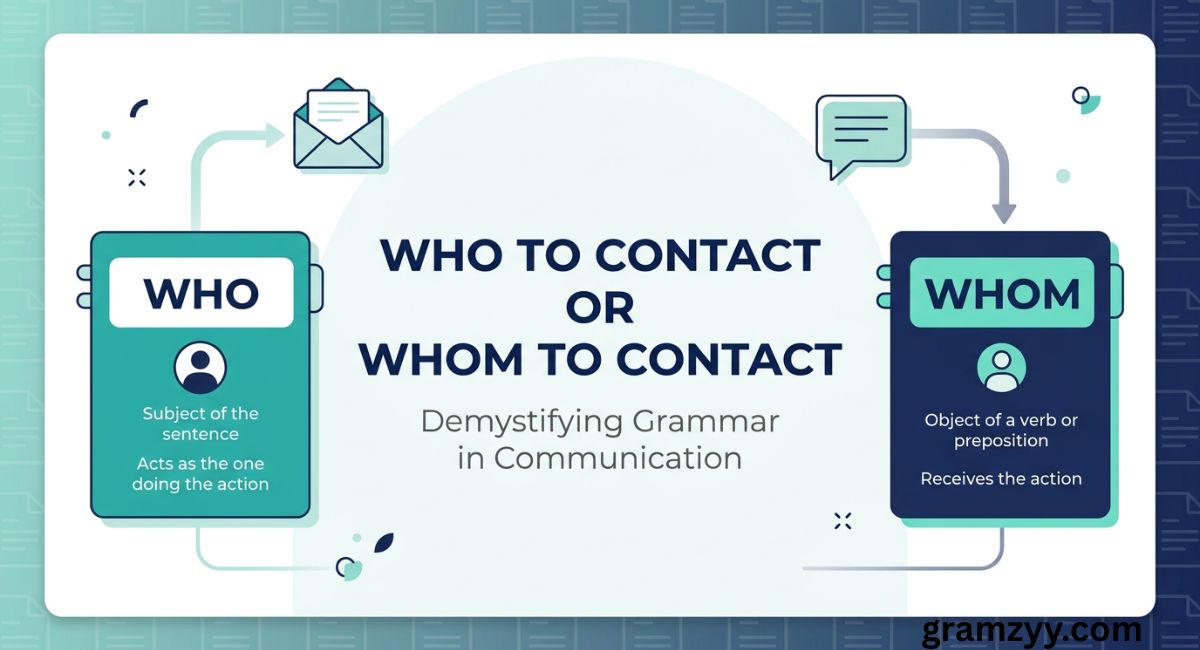
The short answer: “whom to contact” is technically correct, because “whom” is the object of the verb “contact.” But “who to contact” is now widely accepted, especially in casual speech, emails, and web content, where natural tone matters more than textbook precision.
This guide breaks the rule down in plain English, walks through real-world examples, flags common mistakes, and gives you practical tests you can use in seconds — no grammar degree required.
Contextual Examples
Grammar rules make more sense with real sentences. Here’s how “who” and “whom” behave in different situations.
Quick Rule Summary (Parts of Speech Focus)
| Pronoun | Grammatical Role | Replaces | Example |
|---|---|---|---|
| Who | Subject | he, she, they | Who called the office? |
| Whom | Object | him, her, them | Whom did you call? |
The simplest test: if you can answer the question with “he” or “she,” use who. If you’d answer with “him” or “her,” use whom.
Example 1 — Direct Question (Subject)
“Who is handling customer support this week?”
Here, “who” performs the action of handling. You could answer “She is handling it,” so the subject form is correct.
Example 2 — Direct Question (Object)
“Whom did the manager assign to the project?”
The manager did the assigning; the person is receiving that action. You’d answer “He assigned him,” which confirms the object form.
Example 3 — Embedded Question in a Sentence
“I’m not sure who to contact about my invoice.”
This is the classic case people struggle with. Technically, “contact” needs an object, so “whom” is grammatically precise. In practice, “who” dominates in speech and informal writing because the sentence still reads clearly.
Example 4 — Formal Object After Preposition
“To whom should I address this letter?”
Whenever a preposition (to, for, with, by) sits directly before the pronoun, “whom” is the standard formal choice.
Example 5 — Prepositional Object
“The client with whom we spoke yesterday confirmed the order.”
“Whom” follows “with,” making it the object of the preposition. This construction is common in formal or legal writing.
Example 6 — Embedded Object With Infinitive
“Please tell me whom I should notify.”
Even though “whom” sits early in the sentence, it’s the object of “notify.” This structure often appears in business correspondence and instructional content.
Example 7 — Casual Speech Use
“Who should I talk to about this?”
In spoken English, almost nobody says “whom” here. Moving the preposition to the end of the sentence (“talk to”) makes “who” feel natural, even though strict grammar would prefer “To whom should I talk?”
See also : Takes One to Know One
Common Mistakes
Even confident writers slip up with who and whom. Here are the errors that show up most often.
Mistake 1 — Using Who When Whom Is Required
Writing “Who did you give the report to?” instead of “Whom did you give the report to?” is common in casual writing but flagged in formal editing.
Mistake 2 — Avoiding Whom After Prepositions
Many writers instinctively drop “whom” after words like “to,” “for,” or “with,” producing phrases like “the person who I spoke with” instead of “the person with whom I spoke.”
Mistake 3 — Misidentifying Subject in Embedded Clauses
A frequent error is writing “I don’t know whom is coming” when “who” performs the action of “coming,” making “who” the correct subject form.
Mistake 4 — Overuse of Whom in Casual Writing
Some writers sprinkle “whom” into every sentence to sound formal, even in emails or social posts. This can come across as stiff or overly rigid rather than polished.
Mistake 5 — Neglecting Verb Agreement in Questions
Errors like “Whom is responsible for the task?” mix up subject and object roles. Since “is responsible” needs a subject, “who” is correct here, not “whom.”
American vs British English Differences
General Pattern
Both American and British English follow the same core grammar rule: “who” for subjects, “whom” for objects. Neither variety has officially abandoned “whom,” but usage patterns differ slightly in tone and formality.
Formality and Preposition Placement
British formal writing tends to preserve “whom” a bit longer in official documents, legal texts, and academic papers. American English leans more casual overall, favoring sentence-final prepositions (“who did you talk to”) even in fairly formal business contexts.
Trends in Casual Speech
In everyday conversation on both sides of the Atlantic, “whom” has largely faded. Most native speakers default to “who,” and few listeners notice or mind the shift.
Style Guide Notes
Major style guides reflect this relaxed trend:
- AP Stylebook — recommends “whom” only when necessary for clarity.
- Chicago Manual of Style — accepts “who” in informal and online writing.
- Oxford style guidance — treats “whom” as correct but increasingly formal-sounding.
See also : Tortuous vs Torturous — Meaning, Difference, and Examples
Idiomatic Expressions
Common Phrases With Who/Whom
Certain expressions have become fixed in English and don’t follow flexible rules — they’re used exactly as tradition dictates.
Fixed Formal Phrases
- “To Whom It May Concern” — a standard opening for formal letters and cover letters.
- “Whom shall I say is calling?” — a traditional, formal phone greeting.
Casual Idioms That Drop Whom
- “Who do you think you are?” — universally uses “who,” even though grammar purists might argue for an object form.
- “Who’s calling?” — the everyday, relaxed alternative to formal phone etiquette.
When Idioms Guide Choice
When a phrase is fixed by convention, like “To Whom It May Concern,” grammar rules take a back seat to tradition. Changing it to “To Who It May Concern” would look like an error, not a stylistic choice.
Practical Tips
Tip 1 — Use the “He/Him” Test
Replace the pronoun with “he” or “him” in your head. If “he” fits, use who. If “him” fits, use whom. Both “whom” and “him” end in “m” — an easy memory trick.
Tip 2 — Look for Prepositions
If the pronoun directly follows “to,” “for,” “with,” “by,” or “about,” lean toward “whom,” especially in formal writing.
Tip 3 — Check Clause Role
Isolate the clause containing the pronoun and ask whether it performs the action (who) or receives it (whom).
Tip 4 — When Writing Emails and Formal Letters
For business letters, legal documents, or messages to senior executives, “whom” signals precision and professionalism. For everyday internal emails, “who” reads naturally without sounding careless.
Tip 5 — Keep Sentences Short for Clarity
Shorter sentences make subject and object roles easier to spot. “Who called?” and “Whom did you call?” are far easier to analyze than long, layered clauses.
Tip 6 — Use Rephrasing to Avoid Awkwardness
If “whom” feels stiff, restructure the sentence. “Whom should I contact about refunds?” can become “Who should I contact about refunds?” without losing meaning.
Tip 7 — Read Aloud and Check Flow
If a sentence sounds forced or overly formal when read out loud, it probably needs rephrasing rather than a strict grammar fix.
Tip 8 — Teach the Rule With Examples
When explaining this to others, show both forms side by side: “Who called?” versus “Whom did you call?” Visual comparison speeds up understanding.
Tip 9 — Use Reliable Grammar Tools If Unsure
Grammar checkers can flag whether “whom” is technically correct, but remember that many tools now favor “who” for readability, so use your judgment alongside the suggestion.
Tip 10 — Balance Correctness and Readability
Grammar accuracy matters, but so does how naturally your writing flows. In most modern content, clarity wins over rigid formality — unless your audience specifically expects traditional precision.
See also: Soft Guy Era Drizzle Drizzle Meaning
Revision Examples and Edits
Seeing before-and-after edits makes the rule click faster.
| Original | Issue | Revised |
|---|---|---|
| I don’t know whom is coming to the meeting. | “Whom” wrongly used as subject | I don’t know who is coming to the meeting. |
| Whom is responsible for the task? | “Whom” wrongly used as subject | Who is responsible for the task? |
| Who did you give the report to? | Informal object use | Whom did you give the report to? (formal) / Who did you give the report to? (casual) |
| Please tell me who I should meet with. | Object of preposition dropped | Please tell me whom I should meet with. (formal) / Please tell me who to meet. (casual) |
| The person who I spoke with was helpful. | Object after preposition | The person with whom I spoke was helpful. (formal) |
Conclusion
The debate between “who to contact” and “whom to contact” comes down to one simple grammar rule: subjects use who, objects use whom. Strictly speaking, “whom to contact” is the grammatically precise choice because it functions as the object of “contact.” But modern English, especially in emails, websites, and everyday conversation, has largely embraced “who to contact” for its natural, conversational tone.
The best approach isn’t picking a side — it’s knowing your audience. Save “whom” for formal letters, legal writing, and academic work where precision counts. Reach for “who” in casual emails, web copy, and everyday speech where clarity and flow matter most. Once you internalize the he/him test, you’ll never have to pause mid-sentence again.
FAQs
Is it correct to say “who to contact” or “whom to contact”?
Both are used, but “whom to contact” is grammatically correct since “whom” is the object of “contact.” “Who to contact” is widely accepted in casual and everyday writing.
Which style guides recommend using “who” over “whom”?
The AP Stylebook and Chicago Manual of Style both favor “who” in informal and online writing, reserving “whom” for cases where clarity truly requires it.
How can I quickly tell whether to use who or whom?
Replace the pronoun with “he” or “him.” If “he” fits, use who; if “him” fits, use whom.
Is “whom” becoming outdated in English?
“Whom” isn’t obsolete, but it’s used far less in casual speech and writing. It remains standard in formal letters, legal text, and fixed phrases like “To Whom It May Concern.”
Should I use “whom” in business emails?
Use “whom” for formal emails to executives, clients, or official correspondence. For everyday internal emails, “who” sounds natural and is widely accepted.
What is the easiest rule to remember the difference?
Who acts like “he” (subject); whom acts like “him” (object). Both “whom” and “him” end in “m,” which makes the trick easy to recall.