Have you ever heard someone say, “It’s only five miles as the crow flies” and wondered what crows have to do with measuring distance? You are not alone. This centuries-old English idiom still pops up in travel conversations, news reports, and everyday speech. Understanding it correctly can sharpen both your communication and your grasp of one of the most vivid expressions in the English language.
In this guide, you will learn exactly what “as the crow flies” means, when to use it, where it came from, and how to avoid the most common mistakes people make with it.
What does “as the crow flies” mean?
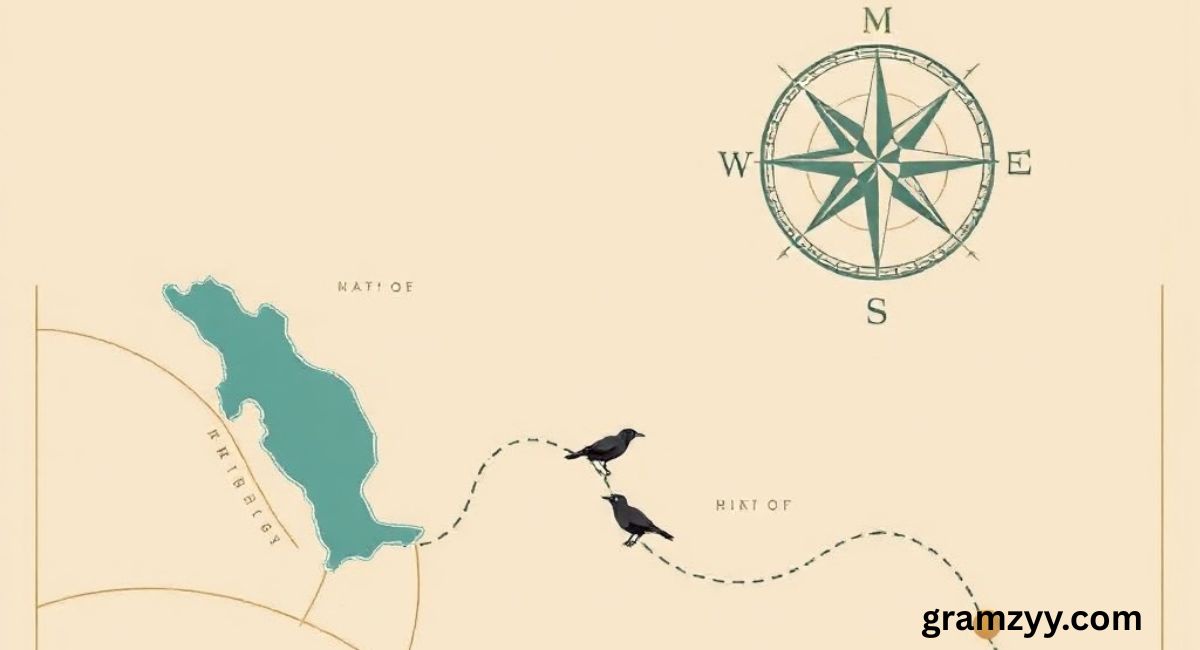
“As the crow flies” means the straight-line distance between two points, measured without accounting for roads, terrain, buildings, rivers, or any other obstacle. Think of it as drawing a perfectly straight line between Point A and Point B on a map — that measurement is the distance “as the crow flies.”
Simple definition: The shortest possible distance between two locations, in a direct line, ignoring all real-world barriers.
The phrase works because a bird in the air faces none of the detours a person on the ground must take. While you might need to wind around a mountain, cross a bridge, or follow a curved highway, a crow can fly straight across without any of those limitations.
A quick look at the origin
The expression dates back to the late 1700s. One of its earliest documented appearances is in The London Review of English and Foreign Literature (1767). It became widely known after Charles Dickens used it in his 1838 novel Oliver Twist:
“We cut over the fields at the back with him between us — straight as the crow flies — through hedge and ditch.”
One popular theory links the phrase to sailors who kept cages of crows aboard ships. When land was needed, a crow was released from the crow’s nest in hopes it would fly directly toward shore. Whether or not that story is fully accurate, the underlying image — a bird flying in an unobstructed straight line — gave the idiom its lasting meaning.
See also: Indolence vs. Insolence: The Definitive Guide
When should you use this phrase?
Use “as the crow flies” when you want to describe a reference distance rather than a practical travel distance. It is especially useful when:
- Contrasting two types of distance — straight-line vs. road distance
- Giving a rough geographic reference — how far one place is from another in simple terms
- Writing travel content, journalism, or storytelling where descriptive, vivid language adds color
- Discussing maps or geography in a casual, non-technical way
It is common in casual conversation, news writing, and literary prose. In formal technical writing — such as engineering reports or GPS data documentation — you would more likely use the term “straight-line distance” or “linear distance” instead.
| Context | Best Phrasing |
|---|---|
| Casual conversation | “It’s about five miles as the crow flies.” |
| News / journalism | “The two cities are 80 miles apart as the crow flies.” |
| Technical / scientific writing | “The straight-line distance is 8 km.” |
| Map-based analysis | “Linear distance between the points is 12 miles.” |
Is it always accurate?
No — and that is actually the whole point of the phrase.
“As the crow flies” gives you the ideal minimum distance, not the real-world travel distance. In practice, the actual route you take by road, trail, or public transit is almost always longer than the crow-flies distance. Sometimes significantly so.
Consider this real-world example: The north and south rims of the Grand Canyon are roughly 10 miles apart as the In a straight line. But driving between them takes close to 200 miles because of the terrain and the road network that exists.
Situations where the gap is especially large include:
- Mountainous regions — roads must follow valleys and switchbacks
- Coastal areas — water forces long detours around bays and inlets
- Dense urban environments — one-way streets and city blocks add distance
- Remote or rural areas — roads may not go directly between two points at all
So when someone says “it’s only two miles as the In a straight line,” they are giving you a useful frame of reference — not a navigation instruction.
Examples of “as the crow flies”
Correct usage
These sentences show the phrase used properly — to describe straight-line distance as a reference point:
- “The nearest town is 12 miles away as the crow flies, but the mountain road makes it a 25-mile drive.”
- “Their offices are less than a mile apart as the In a straight line, though commuting between them takes nearly 30 minutes.”
- “As the crow flies, London and Paris are only about 340 kilometers apart.”
- “We could see the lighthouse from here — it’s not far as the In a straight line, but there’s no road going directly to it.”
- “The research lab confirmed the outbreak in Kinshasa, nearly 1,800 kilometers away as the crow flies.”
Each example above contrasts the crow-flies distance with the real-world limitation, which is where the phrase earns its place in a sentence.
Incorrect usage
Avoid these common misuses:
| Incorrect | Correct | Why |
|---|---|---|
| “He walked as the crow flies to the store.” | “He walked in a straight line to the store.” | The phrase describes distance, not the way someone physically travels |
| “It’s five miles as crow flies.” | “It’s five miles as the crow flies.” | The article “the” is required — it’s a fixed idiom |
| “She ran as the crow flies every morning.” | “She ran the most direct route every morning.” | The idiom applies to measured distance, not a habit or activity |
Context variations
The phrase adapts naturally across different contexts:
- Geography: “The two capitals are separated by 600 miles as the crow flies.”
- Urban planning: “As the crow flies, the new school is close — but students still need bus routes due to the highway.”
- Sports/travel writing: “The finish line is only three kilometers away as the crow flies, but the trail adds another two.”
- Historical writing: “Explorers recorded that the territory stretched 400 miles broad as the crow flies.”
See also: Kafkaesque Meaning, Usage, and Examples
Common mistakes with “as the crow flies”
Even experienced writers trip up with this idiom. Here are the errors to watch for:
- Dropping “the” — The phrase must be used in its complete form: as the crow flies. Saying “as crow flies” is grammatically incorrect and sounds unnatural.
- Using it for direction, not distance — The idiom describes how far, not which way. Avoid using it as a substitute for compass directions.
- Treating it as an exact measurement — The phrase is approximate and conceptual. Do not pair it with highly precise figures in formal contexts without clarifying the measurement method.
- Confusing it with “in a beeline” — These two phrases are close in meaning but not identical. A beeline also suggests direct movement, but it is more often used for movement through space (especially for people or animals), while “as the crow flies” is specifically tied to measured distance.
- Overusing it in technical writing — In data-heavy or scientific documents, opt for “straight-line distance” or “geodesic distance” to maintain precision and clarity.
How do you remember this phrase?
The easiest way to lock this idiom in your memory is through a simple mental image.
Picture a crow perched at one location. It spreads its wings and flies in a perfectly straight line to another location — no roads, no curves, no detours. That straight flight path is “as the crow flies.”
Another mental trick: focus on the word “flies.” Flying suggests freedom from the ground, from roads, from all the obstacles that make land travel longer. The crow is not stuck following a map — it takes the most direct path nature allows.
You can also connect it to maps. Next time you use Google Maps, note the difference between the straight-line distance and the driving distance. That gap — sometimes small, sometimes enormous — is what this idiom is all about.
Synonyms and alternatives worth knowing:
- In a straight line
- In a beeline
- Point A to Point B
- Direct distance
- Straight-line distance
- As the bird flies
- Line of sight
See also: Introduction To vs Introduction Of: What’s the Difference?
Conclusion
“As the crow flies” is one of those idioms that earns its place in the English language because it does something no technical term quite manages — it gives you an instant visual. You see the bird, you see the straight line, and you immediately understand that the real-world journey will be longer and more complicated than the ideal path.
Use it when you want to give a meaningful distance reference, contrast two types of distance, or add a touch of descriptive life to your writing. Just remember: keep the full phrase intact, apply it to distance (not direction or activity), and save it for contexts where its casual, vivid quality is a strength rather than a limitation.
FAQs
What does “as the crow flies” mean in simple terms?
It means the shortest straight-line distance between two points, ignoring roads or obstacles.
Is “as the crow flies” still used today?
Yes, it remains widely used in everyday speech, journalism, and travel writing.
What is the origin of the phrase “as the crow flies”?
It dates to at least 1767, with one of its most famous early appearances in Charles Dickens’s Oliver Twist (1838).
Can you use “as the crow flies” for small distances?
Yes, the phrase works for any distance — whether it’s half a mile or hundreds of kilometers.
What is the difference between “as the crow flies” and “in a beeline”?
Both suggest directness, but “as the crow flies” specifically refers to measured straight-line distance, while “in a beeline” more often describes direct movement or travel.
Is “as the crow flies” formal or informal?
It is informal to semi-formal. In strictly technical writing, prefer “straight-line distance” or “linear distance.”
Do crows actually fly in straight lines?
Not always — crows sometimes circle and wheel in the air. The phrase reflects the idea of their directness rather than strict ornithological fact.
How do you calculate “as the In a straight line” distance?
You can use online tools like Google Maps (which shows straight-line distance) or GPS apps that measure geodesic distance between coordinates.