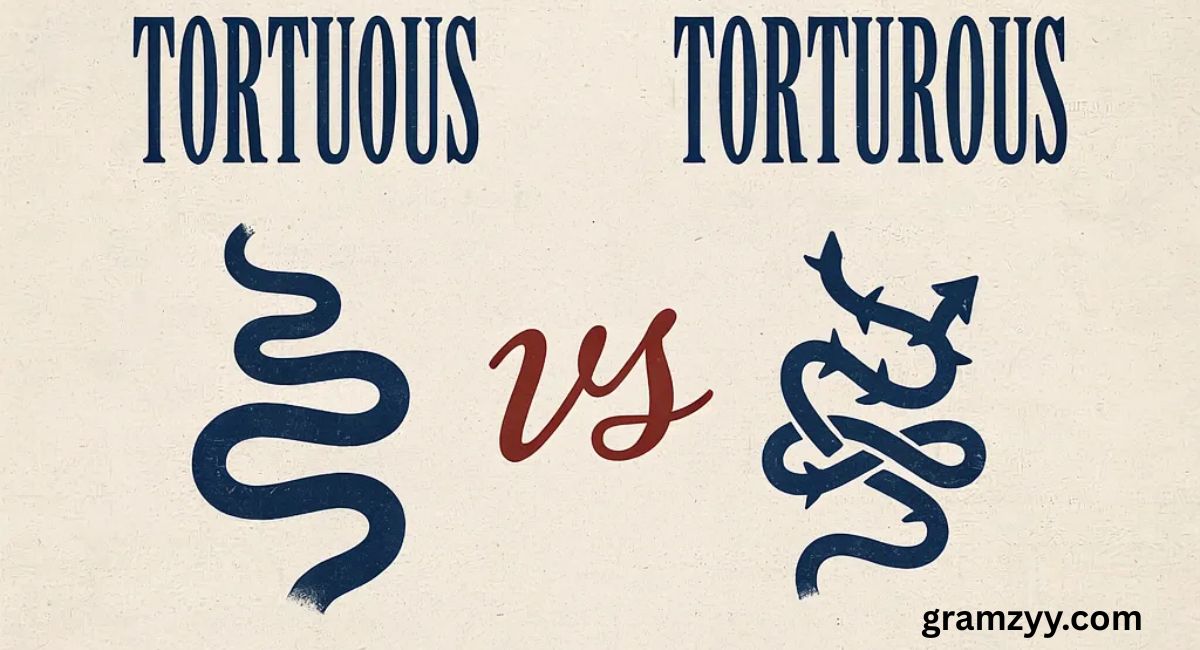
If you’ve ever paused mid-sentence wondering whether to write “tortuous” vs “torturous,” you’re in good company. These two words trip up even experienced writers, editors, and native English speakers on a regular basis. They look almost identical, sound almost identical, and even share the same Latin ancestor — but they mean very different things.
Tortuous describes something full of twists, turns, or bends — a winding road, a complicated argument, a convoluted process. Torturous describes something that causes pain or suffering, echoing its close cousin “torture.” One letter — a single extra “r” — separates a description of shape from a description of agony.
This guide breaks down the origin, grammar, usage, and real-world examples of both words so you never second-guess yourself again.
Why Does Your Brain Keep Mixing These Up?
There’s a real linguistic reason these words feel so slippery. Tortuous and torturous sit in what linguists call a dense phonological neighborhood — they differ by just one sound. Your brain processes them as near-twins during word retrieval, which means it has to work a little harder to pull out the correct one.
Add to that the shared Latin root, similar spelling, and overlapping subject matter (both can describe a difficult experience), and the confusion makes complete sense. It isn’t a sign of poor vocabulary — it’s simply how human word-recognition works when two terms are this close in sound and history.
Core Concepts and Historical Evolution of Tortuous vs Torturous
Etymology and Semantic Bifurcation
Both words trace back to the Latin verb torquēre, meaning “to twist” or “to wrench.” From there, the paths diverge — a process linguists call semantic bifurcation, where two words from the same root gradually acquire distinct meanings.
- Tortuous comes from Latin tortuosus (“full of twists”), via Middle French tortueux. It kept the literal sense of winding or bending.
- Torturous comes from Latin tortura (“a twisting” or “torment”), the same root that gave English the word “torture.” Over time, the meaning shifted from the physical act of twisting to the suffering caused by it.
By the late Middle English period, both words existed in the language with separate, settled meanings — one describing shape, the other describing pain.
Grammatical Mechanics and Semantic Field Divergence
Both words are adjectives, and both can be used literally or figuratively. But they belong to entirely different semantic fields:
| Feature | Tortuous | Torturous |
|---|---|---|
| Core meaning | Winding, twisting, indirect | Painful, agonizing |
| Root association | Shape and structure | Torture and suffering |
| Tone | Neutral or descriptive | Negative, judgmental |
| Typical subjects | Roads, rivers, arguments, plots, procedures | Experiences, ordeals, waiting, pain |
| Pronunciation | TOR-choo-us | TOR-cher-us |
The key distinction: tortuous is descriptive, not emotional. A tortuous road can be beautiful. Torturous, on the other hand, always signals distress — you can’t use it in a neutral context.
See also: Soft Guy Era Drizzle Drizzle Meaning
How Tortuous vs Torturous Work in Real Sentences
Formal and Academic Contexts
In academic, legal, and journalistic writing, tortuous typically describes complex reasoning, procedures, or processes:
- “The negotiations followed a tortuous path through three rounds of committee review.”
- “Her tortuous argument left the panel struggling to follow the logic.”
Torturous appears in formal writing when describing genuine hardship:
- “The refugees endured a torturous journey across the border.”
- “Recovery after the surgery proved torturous for the patient.”
Casual and Conversational Usage
In everyday speech, people often reach for torturous when something feels unbearably slow, boring, or uncomfortable:
- “That meeting was absolutely torturous.”
- “Waiting in that line for two hours was torturous.”
Tortuous shows up less in casual speech but still appears when describing physical routes or rambling explanations:
- “We took a tortuous back road to avoid traffic.”
- “His directions were so tortuous I got lost twice.”
The Nuance Trap
Here’s where it gets tricky: many situations genuinely qualify for both words at once. A steep, winding mountain trail is tortuous because of its twists — and it might also be torturous if it leaves you exhausted and in pain.
The trap is assuming the words are interchangeable just because a single scenario fits both. They aren’t synonyms. Ask yourself:
- Am I describing shape, structure, or complexity? → Use tortuous.
- Am I describing pain, suffering, or distress? → Use torturous.
When context doesn’t make the intended meaning obvious, it’s often safer to swap in a clearer word altogether, such as winding or painful.
See also: Run Like the Wind: Meaning and Usage
Tortuous vs Torturous in Classic Literature
Classic Literature
Writers have long used tortuous to paint vivid pictures of physical or intellectual complexity — winding streets, twisting rivers, or convoluted reasoning in a character’s internal monologue. The word lends itself naturally to descriptive, atmospheric prose, especially in Gothic and Victorian fiction where narrow, meandering streets or tangled plots set the mood.
Torturous, by contrast, appears in literature depicting hardship, imprisonment, or emotional anguish — used to intensify a character’s suffering rather than describe their surroundings. It’s the word of choice when an author wants the reader to feel discomfort, not just observe complexity.
Modern Stylistic Applications
Contemporary journalism and content writing lean on tortuous for describing political processes, legal battles, and Brexit-style bureaucratic gridlock — anything with excessive back-and-forth. Torturous shows up in reviews, personal essays, and lifestyle writing to describe grueling workouts, painful waits, or emotionally draining experiences.
Modern style guides generally recommend precision: if a sentence could plausibly use either word, add more context or choose a more specific synonym instead.
Synonyms and Variations of Tortuous vs Torturous
Semantic Neighbors and Substitutes
Tortuous synonyms:
- Winding
- Circuitous
- Meandering
- Convoluted
- Serpentine
- Labyrinthine
Torturous synonyms:
- Agonizing
- Excruciating
- Grueling
- Punishing
- Harrowing
- Brutal
Notice that no tortuous synonym implies pain, and no torturous synonym implies neutrality. That contrast is the fastest way to check which word you actually need.
Visualizing the Difference
Picture a decision path: if what you’re describing involves physical or figurative twists and turns, follow that branch to tortuous. If what you’re describing involves pain, suffering, or distress, follow the other branch to torturous. If both apply — like an exhausting, winding hike — it’s grammatically correct to use both words in the same piece of writing, just not to substitute one for the other.
Regional Variations
American and British English use both words the same way, with no meaningful difference in definition. The main regional variation is pronunciation emphasis and frequency — torturous appears slightly more often in casual American speech to describe boredom or discomfort, while tortuous is more common in British journalism when discussing bureaucratic or political processes.
Common Mistakes When Using Tortuous vs Torturous
- Using torturous when you mean winding. “The torturous mountain road” should usually be “tortuous,” unless you specifically mean the drive was painful.
- Using tortuous when you mean painful. “The tortuous wait for exam results” technically misapplies the word — “torturous” fits better since there’s no literal twisting involved.
- Confusing either with “tortious.” This is a legal term describing a civil wrong (a tort) and has nothing to do with twisting or pain.
- Assuming they’re interchangeable. They overlap in some contexts but are not synonyms — each carries a distinct core meaning.
- Relying on sound alone. Because the words are pronounced so similarly, writers often choose by ear instead of checking meaning — this is the single biggest source of errors.
Practical Tips and Field Notes for Tortuous vs Torturous
The Editor’s Field Note
Professional editors flag this pair constantly. A reliable check before publishing: read the sentence and ask whether removing the twisting/pain distinction changes the meaning. If your sentence is about a process, path, or argument, tortuous almost always fits. If it’s about an experience that hurt, bored, or exhausted someone, torturous is the correct call. When still unsure, swap in a plain synonym like “winding” or “painful” — if the sentence still makes sense, you’ve confirmed the right word.
Mnemonics and Memory Aids
- Torturous has “torture” hidden inside it — same double letters, same pain-related meaning.
- Tortuous is missing that second “r” — think of it as a road with turns, not torment.
- Remember the phrase: “Twists mean tortuous; torment means torturous.”
- Vocabulary teachers often use the phrase “torture us” as a playful cue for torturous — a room full of suffering people might say exactly that.
See also: Continual vs Continuous — Difference and Usage Explained
Conclusion
Tortuous and torturous share a Latin root and a single-letter spelling difference, but their meanings point in completely different directions. Tortuous describes shape — twists, turns, and complexity. Torturous describes suffering — pain, agony, and distress. Keeping the etymology and the “extra r for torture” trick in mind is usually enough to get it right every time. When a sentence could genuinely go either way, don’t be afraid to reach for a clearer synonym instead.
FAQs
Are tortuous and torturous ever interchangeable?
Not really. They can both apply to the same situation — like an exhausting, winding hike — but they describe different qualities of it, so one isn’t a substitute for the other.
What’s the easiest way to remember the difference?
Torturous contains the word “torture” and relates to pain; tortuous relates to twists and turns, like a winding road.
Is “tortious” related to these words?
Yes, tortious shares the same Latin root but is a legal term referring to a civil wrong (a tort), unrelated to twisting or suffering.
Which word describes a winding mountain road?
Tortuous, since it refers to the physical twists and turns of the road, not any pain involved.
Which word describes a painful, drawn-out experience?
Torturous, since it refers to suffering or distress rather than shape or direction.
Can a sentence correctly use both words together?
Yes — for example, “The tortuous trail became torturous after hours of climbing” correctly uses both, since one describes the path and the other describes the pain it caused.