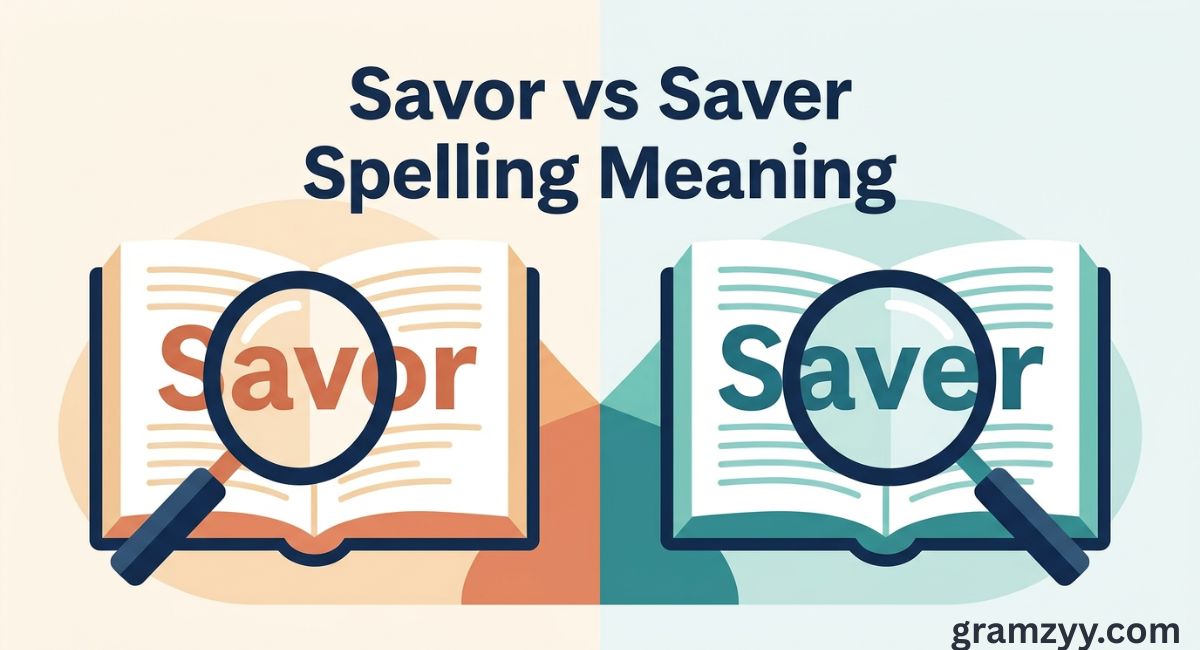
Few word pairs trip up writers as quietly as Savor vs Saver Spelling Meaning. They sound almost the same when spoken aloud, they share nearly every letter, and yet they mean completely different things. One word belongs to the world of taste, memory, and emotion. The other belongs to the world of money, resources, and habits.
If you’ve ever paused mid-sentence wondering whether to write “she savors her coffee” or “she is a saver,” you’re not alone. This guide breaks down the spelling, meaning, grammar, and real-world usage of both words so you never have to guess again.
Contextual Examples
Understanding savor vs saver starts with seeing how each word behaves in an actual sentence. Below are the core definitions, followed by contextual examples that show each word doing its job.
Basic Definitions and Parts of Speech
Here’s a quick side-by-side breakdown before diving into examples:
| Word | Part of Speech | Core Meaning | Related To |
|---|---|---|---|
| Savor | Verb / Noun | To enjoy something deeply and slowly, or a pleasant taste/quality | Taste, emotion, experience |
| Saver | Noun | A person or thing that saves money, time, or resources | Money, efficiency, protection |
Both words are pronounced the same way, which is exactly why they get mixed up in writing, texting, and even voice-to-text software. The spelling is where the real difference lives. (Savor vs Saver Spelling Meaning)
Example 1 — Savor as a Verb
When savor works as a verb, it describes an action — the act of enjoying something fully.
- She closed her eyes to savor the first bite of dessert.
- He wanted to savor the quiet morning before work began.
- They savored every second of their reunion.
Example 2 — Savor as a Noun
Savor can also function as a noun, referring to a taste, smell, or distinctive quality something carries.
- The soup had a rich, smoky savor that lingered on the tongue.
- There was a savor of nostalgia in her old letters.
Example 3 — Saver as a Noun (Person)
Here, saver refers to a person who consistently saves money or resources.
- My uncle has always been a disciplined saver.
- She’s a natural saver, setting aside part of every paycheck.
Example 4 — Saver as a Noun (Thing)
Saver also describes objects, tools, or habits that reduce cost, time, or effort.
- This app is a genuine time-saver for busy parents.
- Energy-efficient bulbs are excellent money savers.
- A good checklist is a real lifesaver during exam season.
Example 5 — Confusion Example (Wrong)
Swapping the two words breaks the sentence, even though it may sound fine out loud.
- ❌ Incorrect: He is a great savor of coupons.
- ✅ Correct: He is a great saver of coupons.
- ❌ Incorrect: She likes to saver her weekends slowly.
- ✅ Correct: She likes to savor her weekends slowly.
Example 6 — Regional Spelling Note
Savor has a variant spelling depending on regional English, while saver stays fixed.
- American English: savor, savory
- British English: savour, savoury
- Saver: identical in both American and British English — no variation
Common Mistakes
Even confident writers slip up with this pair. Here are the most frequent errors and how to fix them.
Mistake 1 — Mixing savor With save / saver
Writers sometimes use “savor” when they actually mean the base verb “save,” or confuse it with the noun “saver.”
- ❌ I want to savor money this month.
- ✅ I want to save money this month.
Mistake 2 — Confusing Noun Forms
Both words can be nouns, which makes it easy to plug the wrong one into a sentence about people or things.
- ❌ The savor helped us reduce our electric bill.
- ✅ The saver (device) helped us reduce our electric bill.
Mistake 3 — Spelling Variation Without Audience Awareness
Writers targeting a British audience sometimes forget to switch “savor” to “savour,” creating inconsistency across a document.
- Fix: Match your spelling style to your audience — savor/savory for American readers, savour/savoury for British and Commonwealth readers.
Mistake 4 — Incorrect Pronunciation-Based Spelling
Because both words sound identical, people often type whichever spelling comes to mind first rather than checking meaning.
- Fix: Ask yourself what the sentence is really about — enjoyment or saving — before choosing the spelling.
Mistake 5 — Using Saver as Adjective
Saver is a noun, not an adjective, so using it to describe another noun directly can sound awkward or unclear.
- ❌ We need a saver plan for retirement.
- ✅ We need a savings plan for retirement.
American vs British English Differences
Spelling conventions shift slightly depending on which version of English you’re writing in, and this pair is a classic example.
Spelling: Savor vs Savour
| Region | Verb/Noun Spelling | Adjective Form |
|---|---|---|
| American English | savor | savory |
| British English | savour | savoury |
| Both regions | saver | saver |
Usage and Frequency
Savor/savour shows up mostly in food writing, memoirs, and lifestyle content. Saver appears constantly in finance and productivity content across both regions, with no spelling shift at all.
Collocations to Watch
Certain word pairings are far more common than others, and knowing them helps your writing sound natural:
- Savor: savor the moment, savor the flavor, savor every bite
- Savour (British): savour the moment, savour the taste
- Saver: money saver, time-saver, energy saver, diligent saver
Idiomatic Expressions
Both words show up in everyday idioms and fixed phrases, often in ways that go beyond their literal meaning.
Savor Idioms and Collocations
- “Savor the moment” — appreciate something fully before it passes
- “Savor the flavor” — a common phrase in food and marketing contexts
- “Savor victory” — enjoy a win or achievement slowly and fully
Saver Idioms and Collocations
- “Time-saver” — anything that reduces the time a task takes
- “Lifesaver” — someone or something that helps in a critical moment
- “Penny saver” — someone careful with small amounts of money
Figurative Use Cases
Savor extends figuratively to non-taste experiences, like savoring a compliment or a quiet afternoon. Saver extends figuratively too — think “space saver” furniture or a computer “screen saver” — none involving money, but all involving conservation.
Practical Tips
These quick strategies make choosing between savor and saver almost automatic.
Tip 1 — Quick Meaning Test
Ask: is this sentence about enjoyment or about saving something? Enjoyment points to savor; saving points to saver.
Tip 2 — Spelling Rule by Audience
Use savor/savory for American readers and savour/savoury for British readers — but always keep saver spelled the same way regardless of audience.
Tip 3 — Mnemonic for Savor
Savor contains the same root as “flavor.” If the sentence involves taste, pleasure, or emotion, savor is likely correct.
Tip 4 — Mnemonic for Saver
Saver contains the word “save” inside it. If the sentence is about saving money, time, or effort, saver fits.
Tip 5 — Check Parts of Speech
Savor can be a verb or a noun; saver is only ever a noun. If your sentence needs an action word, savor is your only option between the two.
Tip 6 — Use Simple Tests in Proofreading
While editing, substitute “enjoy” for the suspected word. If it still makes sense, savor is correct. If “enjoy” sounds wrong, try “save” instead.
Tip 7 — Agent Noun Alternatives
There is no widely accepted noun form of savor meaning “a person who savors.” Instead of forcing an awkward word, rephrase as “someone who savors” or “a person who appreciates.”
Tip 8 — Keep Consistent Spelling
Whichever regional spelling you choose
for savor or savour, use it consistently throughout the same document to avoid looking careless.
Tip 9 — Pronunciation Check
Both words are pronounced identically, so pronunciation will never help you choose the correct spelling — meaning and context always will.
Revision Examples
Seeing before-and-after edits makes the distinction stick.
Revision 1 — Fixing the Wrong Word
- Before: She wanted to saver her last day of vacation.
- After: She wanted to savor her last day of vacation.
Revision 2 — British vs American Spelling
- American version: The chef wanted every dish to savor of home.
- British version: The chef wanted every dish to savour of home.
— Clarifying Agent Noun
- Before: He is a real savor of his salary.
- After: He is a real saver of his salary.
Revision 4 — Device vs Action
- Before: This gadget helps you savor water in the garden.
- After: This gadget helps you save water in the garden. (Here, saving water is the goal — the device itself could be called a “water saver.”)
Conclusion
The difference between Savor vs Saver Spelling Meaning comes down to one simple question: is the sentence about enjoying something, or about saving something? Savor — and its British twin, savour — belongs to moments of taste, pleasure, and appreciation. Saver belongs to money, time, and resources, always as a noun. Once that distinction clicks, misusing these two homophones becomes far less likely, whether you’re writing an email, a blog post, or a school essay.
FAQs
Are savor and saver pronounced the same way?
Yes, both words are pronounced identically, which is exactly why they’re so often confused in writing. (Savor vs Saver Spelling Meaning)
Is savor a verb or a noun?
Savor can be either — a verb meaning “to enjoy deeply,” or a noun referring to a taste or quality.
Is saver ever used as a verb?
No, saver is always a noun; it never functions as a verb in standard English.
What is the British spelling of savor?
The British spelling is savour, with the adjective form savoury.
Does saver change spelling in British English?
No, saver keeps the same spelling in both American and British English.
Can saver describe an object instead of a person?
Yes, saver can refer to things like time-savers, energy savers, or screen savers, not just people.
What’s an easy way to remember the difference?
Link savor to “flavor” for enjoyment, and link saver to “save” for money or resource conservation.