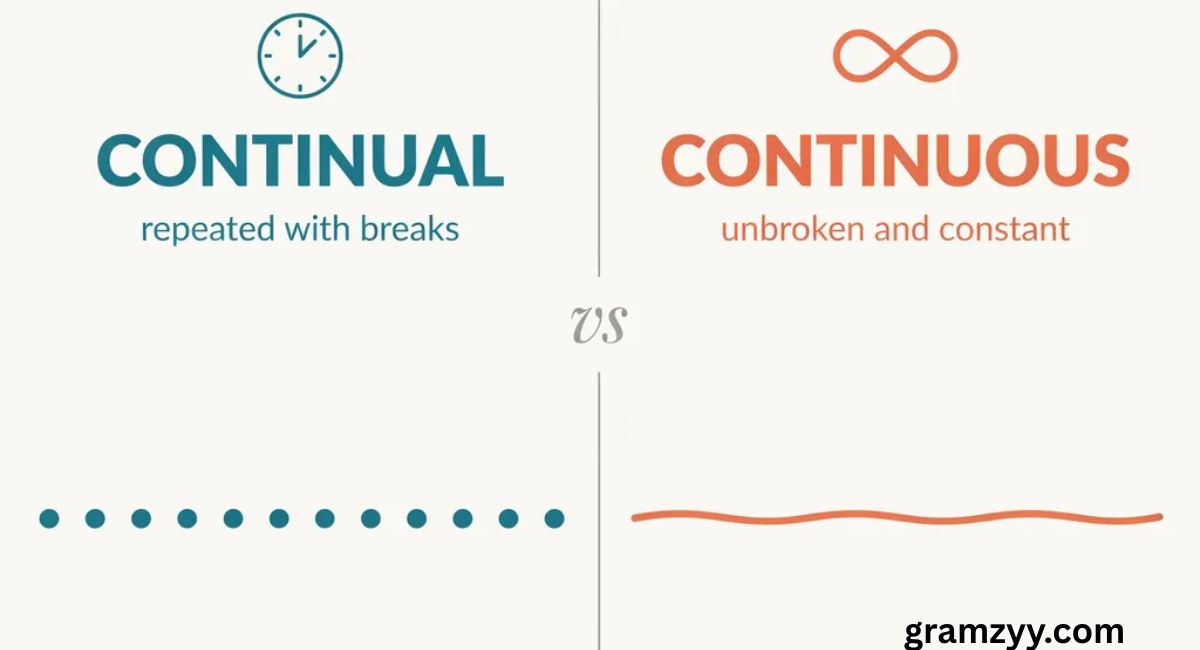
Continual vs continuous: If you’ve ever paused mid-sentence wondering whether to write continual or continuous, you’re not alone. These two words look similar, sound similar, and both describe things that go on over time — yet choosing the wrong one can quietly undermine your writing’s precision. The good news? Once you understand the core difference, you’ll never second-guess yourself again.
Quick Answer: Continual describes something that happens repeatedly but with breaks in between. Continuous describes something that happens without any interruption at all. Think of continual rain as frequent showers, and continuous rain as a downpour that never stops.
Why Do Writers Struggle With Continual vs Continuous?
The confusion is understandable — and it has deep roots. Both words come from the same Latin ancestor, continuus, meaning “joining together” or “uninterrupted.” They share the same prefix, nearly the same spelling, and describe overlapping ideas. Even experienced writers reach for the wrong one.
There’s also a formality trap. Many writers assume continuous sounds more polished or official, so they default to it in professional writing — often when continual is actually correct. The result is a word choice that sounds elevated but carries the wrong meaning.
Understanding the distinction matters most in technical, scientific, and academic writing, where precision is non-negotiable. In casual speech, the boundary blurs and most listeners won’t notice. But in published work, the difference is real.
Where Did Continual and Continuous Come From?
The Earlier Word: Continual
Continual arrived in Middle English around the early 14th century — roughly 1340 — borrowed from the Old French continuel, which itself came from Latin continuus. For several centuries, it was the only word doing this job. Writers used continual to describe both things that repeated and things that never stopped. Medieval and Renaissance texts show this flexible, all-purpose usage without any distinction.
The word’s early meaning was, paradoxically, “proceeding without interruption” — which is what continuous means today. Context did the heavy lifting; readers understood from surrounding words whether the action was unbroken or merely frequent.
The Newcomer: Continuous
Continuous didn’t enter English until the mid-17th century, with the earliest recorded use dating to 1673. It appeared first in technical and scientific contexts — botanists used it to describe plants whose parts were in immediate connection, and optical writers applied it to unbroken beams of light. Only in the 18th century did it enter general usage.
Once both words existed side by side, writers and grammarians began assigning them separate lanes. By the mid-19th century, the distinction we follow today was widely recommended: continuous for unbroken duration, continual for recurring frequency. English has a habit of doing this — keeping both a French-derived word and a Latin-derived word and assigning each a slightly different role.
See also: Back to Square One: Meaning, Usage, and Examples
How Do You Use Continual vs Continuous in Different Situations?
Here’s the clearest summary before we dive into context-specific usage:
| Word | Key Idea | Interruptions? | Example |
|---|---|---|---|
| Continual | Repeated, recurring | Yes — stops and starts | continual interruptions |
| Continuous | Unbroken, nonstop | No — never pauses | continuous background noise |
Formal and Technical Writing
In formal and technical contexts, the distinction carries real weight. Medical professionals, engineers, and scientists rely on precise language where word choice changes meaning.
- “Continuous monitoring” means a device that never stops recording — every second, no gaps. A heart monitor must be continuous.
- “Continual monitoring” would mean checking in repeatedly, with breaks between checks — which is something quite different in a clinical setting.
Other technical examples:
- The pump delivers a continuous flow of coolant. (No interruption allowed.)
- The software requires continual updates to stay secure. (Updates happen repeatedly, not without stopping.)
Getting this wrong in a technical manual or medical document isn’t just a grammar error — it’s a clarity failure.
Academic and Professional Writing
Academic writing calls for careful word selection, and reviewers notice imprecision. Use the following guide:
- Her continual attempts to replicate the results eventually succeeded. (She tried repeatedly, with gaps between attempts.)
- The experiment required continuous observation over a 48-hour period. (No one could step away from watching.)
- The company faced continual pressure from shareholders. (Pressure came in waves, not as a single unbroken force.)
A useful self-check: ask whether the action or condition could logically pause. If yes, use continual. If it must never pause, use continuous.
Casual and Everyday Writing
In everyday writing — social media, personal emails, blog posts — the distinction is less enforced, and native speakers often use the words interchangeably. However, applying the correct word still strengthens your writing.
- My neighbor’s dog makes a continual racket every evening. (It barks, stops, barks again.)
- There was a continuous buzz from the broken light fixture all night. (It never stopped.)
- She dealt with continual headaches throughout the winter. (They came and went.)
- The road noise was so continuous it felt like a wall of sound. (Never a moment of silence.)
Where Have Writers Used These Words in Classic and Modern Texts?
Classic Literature
Charles Dickens used continual with notable accuracy throughout his novels. In Bleak House (1853), he wrote of “continual fog” over London — fog that descended, lifted, and returned again. That’s precisely the intermittent behavior continual describes.
Victorian literature generally favored continual because continuous was still relatively new and uncommon. Writers of that era described “continual noise,” “continual anxiety,” and “continual interruptions” — all recurring experiences with natural pauses between them.
Charles Darwin, in On the Origin of Species, wrote: “In most cases the area inhabited by a species is continuous” — correctly using continuous to describe unbroken geographic territory without gaps.
Modern Technical and Scientific Writing
Contemporary scientific writing maintains a strict distinction. Research papers describe continuous variables in statistics (values with no gaps on a number line) versus continual refinement of a hypothesis (revisiting and revising over time). Medical literature distinguishes between continuous infusion (medication delivered without stopping) and continual assessment (regular check-ins with intervals).
The more technical and precise the field, the more carefully writers observe the difference.
See also: Having vs Having Had: Which Tense Is Correct?
What Words Mean the Same as Continual vs Continuous?
Words Similar to Continual
These synonyms capture the recurring-with-breaks meaning:
- Repeated — emphasizes the pattern of return
- Frequent — focuses on how often something happens
- Persistent — suggests the action keeps coming back despite obstacles
- Intermittent — explicitly signals on-and-off behavior
- Recurrent — used especially in medical or formal contexts
- Periodic — suggests regular intervals
Example: Her frequent/persistent/recurrent back pain made long trips difficult.
Words Similar to Continuous
These synonyms capture the unbroken, nonstop meaning:
- Uninterrupted — the most precise synonym
- Constant — implies steadiness without pause
- Unceasing — formal, often literary
- Nonstop — informal but clear
- Perpetual — suggests something without a foreseeable end
- Sustained — emphasizes maintained effort or state
Example: The machine produced an uninterrupted/constant/sustained hum.
Visualizing the Pattern
Picture a timeline:
- Continual: — ▬ — ▬ — ▬ — ▬ — (action with gaps)
- Continuous: ▬▬▬▬▬▬▬▬▬▬▬ (unbroken action)
This visual captures the distinction instantly. If you can draw a solid, unbroken line to represent the action, use continuous. If the line has gaps, use continual.
No Regional Differences
American English and British English treat these words identically. There are no spelling variations, no regional preferences, and no international differences in usage. Both formal British writing and formal American writing maintain the same distinction. Casual speakers on both sides of the Atlantic blur the boundary in the same way.
Common Mistakes When Using Continual vs Continuous
These are the errors that appear most often in edited and published writing:
- Using continuous when you mean continual — the formality bias mistake. Writers choose continuous because it sounds more impressive, even when the situation involves breaks. “Continuous interruptions during the meeting” is a contradiction — interruptions always involve pauses.
- Assuming they’re interchangeable — In formal writing, they are not. A distillation process that is continually monitored (checked at intervals) is very different from one that is continuously monitored (never unwatched).
- Misusing the adverb forms — Continually means repeatedly with breaks. Continuously means without stopping. These get swapped just as often as the adjective forms.
- Applying the wrong word to undesirable conditions — Style guides note that for ongoing negative experiences (pain, struggle, difficulty), continual is often preferable even when the condition feels unbroken, because it carries a slightly less absolute tone.
- Treating “constant” as a direct synonym for both — Constant sits closer to continuous, but it also implies uniformity of degree, not just duration. Use it carefully.
Tips for Using Continual vs Continuous Correctly
Real-World Editing Experience
Editors working on technical manuscripts and academic papers report that continuous is overused — writers reach for it as a default when continual would be more accurate. A good editorial habit: whenever you write continuous, stop and ask whether the action truly never pauses. If it pauses at all, switch to continual.
In journalism and business writing, continual is frequently the correct choice for describing organizational processes, negotiations, improvement efforts, and pressures — because these almost always involve stops and starts, reviews and revisions.
Memory Tricks That Work
Trick 1 — The Infinity Loop: The letters “ouo” in continuous can visually suggest an infinity symbol (∞). Infinity means never-ending. Continuous = never-ending.
Trick 2 — The Break Test: Ask yourself: Can this action stop and still be described this way? If yes, use continual. If stopping would contradict the description, use continuous.
Trick 3 — The Synonym Swap: Replace your word with repeated. If it still makes sense, use continual. Replace it with nonstop. If that fits better, use continuous.
Trick 4 — The River vs the Rain: A river flows continuously — it doesn’t stop. Rain during rainy season falls continually — it comes and goes. Nature gives you two perfect reference points.
See also: Nor in Sentences: Meaning, Rules, and Examples
Conclusion
The difference between continual and continuous comes down to one question: does the action stop? Continual means it happens repeatedly but takes breaks. Continuous means it runs without any pause at all.
In casual conversation, the line blurs and few people notice. But in professional, academic, technical, and scientific writing, the distinction matters — and readers who know their grammar will notice when you get it right. The good news is that once this clicks, it’s an easy rule to apply.
Use continual for frequent, recurring actions with natural breaks. Reserve continuous for processes that genuinely never stop. Your writing will be more precise, more credible, and more readable for it.
FAQs
What is the simplest way to remember the difference between continual and continuous?
Continual = repeated with breaks (like interrupted rain showers); continuous = never-stopping (like a river that always flows).
Can continual and continuous be used interchangeably?
Not in formal or technical writing. In casual speech, many people treat them as synonyms, but professional contexts require the precise distinction.
Which is correct — “continual improvement” or “continuous improvement”?
Both are used, but with different meanings. Continuous improvement (as in Lean or Kaizen methodology) refers to an ongoing, never-pausing process. Continual improvement implies regular, repeated efforts with cycles and pauses between them.
What is the adverb form of continual and continuous?
Continually (repeated with breaks) and continuously (without stopping). The same distinction applies to the adverb forms.
Is “continuous monitoring” or “continual monitoring” correct in medicine?
Continuous monitoring is correct when a device records data without stopping (e.g., a heart monitor). Continual monitoring suggests regular check-ups with gaps — a very different standard of care.
Does “continual” always involve breaks?
Yes, by modern standard usage. Continual implies a recurring pattern that stops and restarts, no matter how frequently the action occurs.
Are there regional differences in how these words are used?
No. American English and British English apply the same distinction. There are no spelling or usage differences across English-speaking regions.