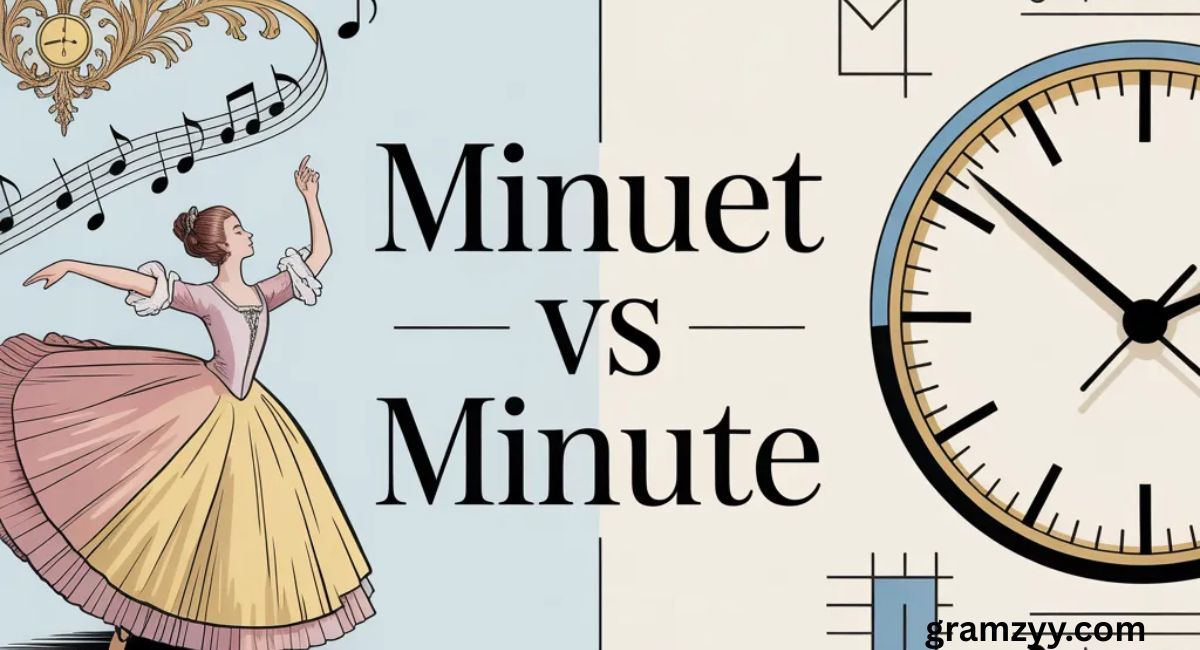
Minuet vs minute : Quick Answer: A minuet is a slow, elegant Baroque-era dance performed in 3/4 time, rooted in 17th-century French aristocracy. A minute is either a unit of time equal to 60 seconds, or an adjective meaning extremely small. They share visual similarity but have zero etymological connection, completely different pronunciations, and exist in entirely separate semantic worlds.
Why Minuet vs Minute Trips People Up
At first glance, minuet and minute look almost like twins. One extra letter — that trailing e — separates them on the page. In conversation, they can sound deceptively close. That combination of near-identical spelling and similar phonetics makes this pair a classic stumbling block, not just for English learners, but for fluent writers too.
Add to that the fact that minute itself carries two completely different meanings depending on how you stress it, and you have a recipe for genuine linguistic confusion. Understanding this trio — two meanings of minute plus minuet — is the goal of this guide.
The Core Concepts: Definitions and Meanings of Minuet vs Minute
What Is a Minuet?
A minuet is a slow, stately couple dance that dominated European ballrooms from roughly 1650 to 1750. Its name derives from the French menuet, meaning fine, delicate, or small — a reference to the short, precise steps characteristic of the form.
Musically, a minuet is written in 3/4 time (three beats per measure), giving it that characteristic lilting, graceful rhythm. Beyond the ballroom, the minuet became a structural pillar of classical composition — composers routinely embedded it as a movement within sonatas, suites, and symphonies.
Part of speech: Noun Pronunciation: MIN-yoo-et (three syllables)
What Is a Minute?
Minute is a more complex word because it wears two separate meanings depending on pronunciation:
1. Minute (noun/time) — MIN-it A unit of time equal to 60 seconds, or 1/60th of an hour. Used universally in scheduling, measurement, and everyday conversation.
2. Minute (adjective/size) — my-NYOOT Meaning extremely small, tiny, or requiring meticulous attention to detail. Common in scientific, academic, and formal writing contexts.
Also read : A CHIP OFF THE OLD BLOCK Definition & Meaning
Etymology and Evolution
| Word | Language of Origin | Root Meaning | First Recorded Use |
|---|---|---|---|
| Minuet | French (menuet) | Fine, delicate, small | ~1670 (Baroque France) |
| Minute (time) | Latin (pars minuta prima) | First small part | Medieval Latin (14th century) |
| Minute (tiny) | Latin (minutus) | Made small, diminished | 15th century |
Though both words share a distant kinship with the Latin minutus (meaning small), their developmental paths diverged completely. Minuet evolved through French courtly culture and music theory. Minute traveled through medieval timekeeping — the “first small division” of an hour. By the time English absorbed both words, they had become entirely independent terms with no meaningful overlap.
Grammatical Function and Mechanics
Understanding the grammar of each word prevents errors in formal writing, journalism, and academic prose.
Minuet functions exclusively as a noun:
- It names a dance form
- It names a musical composition or movement
It does not function as a verb, adjective, or adverb.
Minute is more grammatically flexible:
- Noun: “The meeting lasted forty minutes.”
- Adjective (tiny): “She examined the minute fractures under magnification.”
- Plural noun (meeting records): “The secretary read the minutes of the last session.”
This grammatical versatility is part of what makes minute tricky — even if you know the word, the correct pronunciation depends entirely on how it’s being used in the sentence.
Contextual Examples: Standard Usage of Minuet vs Minute
Minuet in Context
- “The quartet opened with a minuet by Haydn before moving into the allegro.”
- “She practiced the minuet for weeks ahead of the period-costume gala.”
- “Mozart’s Don Giovanni features a minuet played onstage during the first act.”
- “The third movement of the sonata is a stately minuet and trio.”
Minute (Time) in Context
- “I’ll call you back in five minutes.”
- “The surgery lasted two hours and forty-three minutes.”
- “The train departs at 9:47 — to the minute.”
Minute (Tiny) in Context
- “The forensic team identified minute traces of accelerant at the scene.”
- “Her analysis revealed minute variations in the protein structure.”
- “He paid attention to minute details that others overlooked entirely.”
Also read : Sorry for Bothering You vs Sorry to Bother You: Which Is Correct?
Alternative Usage and Nuance
Meeting Minutes
One easily overlooked sense of minute is its plural form as a noun meaning the official record of a meeting. “The board approved the minutes from last quarter’s session.” This usage has nothing to do with time or size — it refers to a written summary of proceedings, derived from the Latin phrase minuta scriptura (small writing).
Metaphorical Minuet
In literary and journalistic prose, minuet sometimes appears metaphorically to describe any carefully choreographed back-and-forth exchange:
- “The two diplomats engaged in a careful minuet of concessions and demands.”
- “Their courtship was a minuet — elegant, measured, and full of unspoken rules.”
This metaphorical use works precisely because the minuet is culturally understood as formal, deliberate, and precise.
Professional vs Academic Contexts
In professional writing — business correspondence, legal documents, journalism — minute in both its time and size senses appears constantly. Minuet almost never appears unless the content is specifically about music, history, or culture.
In academic writing, the adjective form of minute (my-NYOOT) is especially common in scientific and analytical contexts: “minute cellular variations,” “minute distinctions in argument,” “minute but measurable changes in temperature.”
Key rule: In any professional or academic document, if you’re tempted to write minuet and the topic has nothing to do with music or dance — stop. You almost certainly mean minute.
Literary Usage and Cultural Impact
Famous Examples in Literature and Music
- J.S. Bach’s Minuet in G (from the Notebook for Anna Magdalena Bach) is one of the most performed piano pieces in history, introducing millions of students to the form.
- Mozart’s Don Giovanni includes a live onstage minuet in Act I — one of classical opera’s most famous stage directions.
- Beethoven famously replaced the minuet with the scherzo in most of his symphonies, marking the end of the minuet’s dominance in serious composition.
- In Jane Austen’s novels, the minuet appears as social shorthand for aristocratic refinement and the formal rituals of courtship.
The minuet’s cultural weight comes from its associations: precision, elegance, hierarchy, and restraint. When writers invoke it — literally or metaphorically — those connotations come along for the ride.
Synonyms and Distinctions: Minuet vs Minute
| Feature | Minuet | Minute (time) | Minute (tiny) |
|---|---|---|---|
| Part of Speech | Noun | Noun | Adjective |
| Pronunciation | MIN-yoo-et | MIN-it | my-NYOOT |
| Domain | Music, dance, culture | Time, scheduling | Size, precision |
| Synonyms | Baroque dance, court dance | Second (×60), moment | Microscopic, minuscule, infinitesimal |
| Antonyms | — | Hour, day | Vast, enormous, colossal |
Regional Differences: US vs UK
Both American and British English use minute and minuet identically in meaning. The slight regional difference lies in pronunciation:
- US English: minute (time) → MIN-it; minute (small) → my-NOOT
- UK English: minute (time) → MIN-it; minute (small) → my-NYOOT (with a more prominent y glide)
For minuet, pronunciation is consistent across both dialects: MIN-yoo-et.
Common Mistakes and Corrections: Breakdown of the Top Errors
Error 1: Using Minuet When You Mean Minute
Incorrect: “The guests waited a minuet for the king to arrive.” Correct: “The guests waited a minute for the king to arrive.”
Error 2: Using Minute When You Mean Minuet
Incorrect: “The orchestra performed a beautiful minute by Mozart.” Correct: “The orchestra performed a beautiful minuet by Mozart.”
Error 3: Mispronouncing Minute (adjective)
Incorrect pronunciation: Saying MIN-it when meaning “tiny” Correct: my-NYOOT — “She made a my-NYOOT adjustment to the instrument.”
Error 4: Treating Minutes (meeting records) as time-related
“Let’s review last week’s minutes” does not mean the last 60 seconds — it refers to the official meeting record.
Also read : Die vs Dice — What’s the Difference?
Practical Tips and Field Notes
The Editor’s Field Note
After years of working with student essays and manuscripts, one pattern stands out: minuet typos almost always appear in one specific situation — when a writer is rushing and types the word phonetically, especially after working with classical music terminology. If your spell-checker doesn’t flag it (both are real words), the error slips straight through to the final draft.
Solution: Build context checks into your editing pass. Ask: Is this sentence about music or dance? If not, you almost certainly want minute.
Mnemonics and Memory Aids for Minuet vs Minute
Three mental anchors that actually work:
1. The M Rule
Minuet = Movement (dance) Minute = Measurement (time) or Minuscule (tiny)
2. The Letter Count Trick Minuet has 7 letters — more elaborate, like the dance itself. Minute has 6 letters — shorter, like a brief moment in time.
3. The French Connection If you remember that minuet came from French aristocratic culture, you’ll associate it with elegance and performance — not clocks.
Etymological Dive and Cognitive Linguistics
Why do these words feel so interchangeable to our brains? Cognitive linguistics offers a clear answer: phonemic overlap creates false semantic kinship.
When words sound similar, our brains build a weak associative link between them — even when context should override it. This is the same mechanism that produces confusion in pairs like affect/effect or principal/principle. The visual similarity of minuet and minute reinforces this false link, making the brain’s pattern-matching system work against accuracy rather than for it.
The cure is deliberate semantic anchoring — consciously associating each word with its domain (music vs. time vs. size) rather than relying on passive recognition. The mnemonics above do exactly that: they force an active category assignment every time you encounter the word.
Read it : ceremonial
Conclusion
Minuet vs minute are a textbook example of how English can ambush even careful writers. They share visual similarity, a faint phonetic resemblance, and a distant etymological ancestor — but their meanings, contexts, and grammatical roles are entirely distinct. Minuet belongs to the ballroom and the concert hall. Minute belongs to your calendar, your stopwatch, and your microscope.
Use the comparison table, lean on the mnemonics, and when in doubt — ask yourself: Is this sentence about Bach, or about being late to a meeting? The answer will point you to the right word every time.
FAQs
Are minuet and minute homophones?
Not exactly. They sound similar but not identical — minuet has three syllables (MIN-yoo-et) while minute has two (MIN-it). They are near-homophones, not true homophones.
Can minuet be used as a verb?
No. Minuet functions only as a noun in standard English usage.
Does minute always mean 60 seconds?
No. When pronounced my-NYOOT, it functions as an adjective meaning extremely small or precise, with no connection to time.
What are the minutes of a meeting?
The official written record of what was discussed and decided — derived from the Latin minuta scriptura (small writing), not from the unit of time.
Why did Beethoven stop using the minuet in his symphonies?
Beethoven replaced the minuet with the faster, less formal scherzo in most of his mature symphonies, reflecting the shifting cultural values of the early Romantic era away from aristocratic formality.
Is minuet used in modern music?
Rarely in popular music, but it survives in classical performance, music education, and neoclassical compositions. The form also lives on metaphorically in literary and journalistic writing.
What is the easiest mnemonic for remembering the difference?
Minuet = Movement. Minute = Measurement. Two M’s for each word’s core meaning.