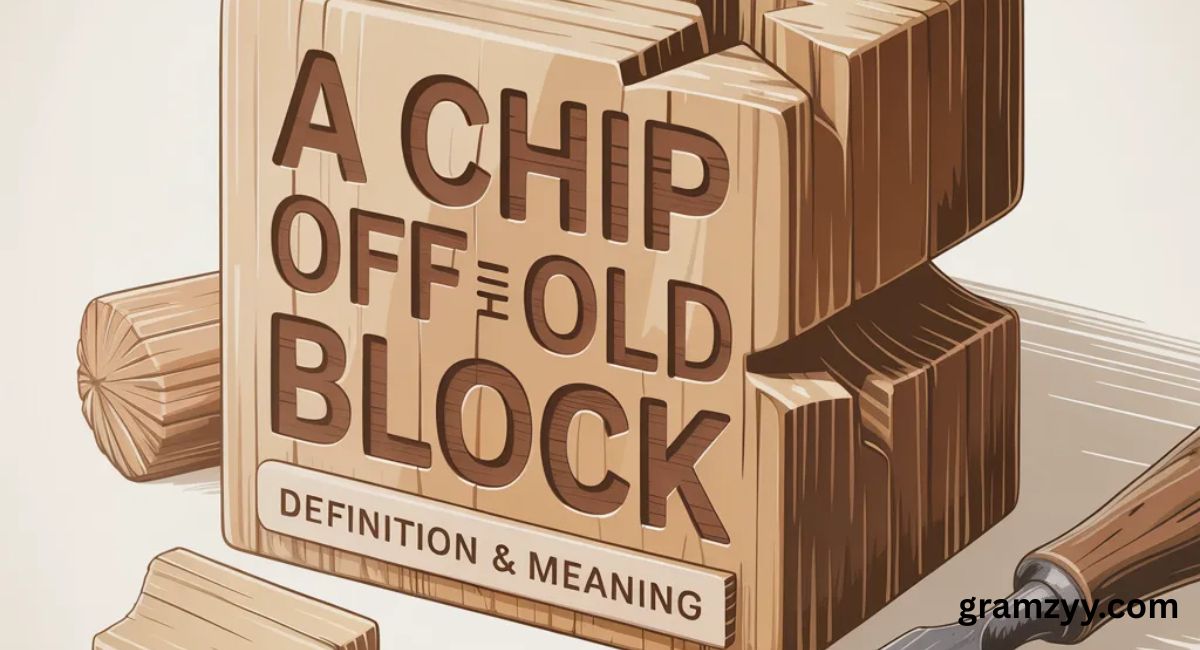
Have you ever watched a child walk, talk, or laugh exactly like their parent and thought wow, that’s uncanny? The English language has a perfect idiom for that moment: “a chip off the old block.” It’s warm, it’s vivid, and it has been capturing the essence of family resemblance for centuries.
What Does “A Chip Off the Old Block” Mean?
“A chip off the old block” is an English idiom that describes a person — usually a child — who closely resembles one of their parents in personality, behavior, talent, or physical appearance.
Quick Definition: A person who shares similar traits, mannerisms, or abilities with their parent, much like a wood chip shares the same grain and composition as the larger block it was cut from.
Cambridge Dictionary defines it as “someone who is very similar in character to their father or mother.” Collins Dictionary explains it as someone who is “just like one of their parents in character or behavior.”
The phrase carries an affectionate or admiring tone in most contexts. Someone saying “She’s a chip off the old block” is usually giving a compliment about a child who inherited the best qualities of a parent.
The Literal vs. Figurative Meaning
Understanding the idiom starts with its literal roots.
| Level | Meaning |
|---|---|
| Literal | A small piece chipped from a wooden or stone block shares the same material, grain, and texture as the larger source. |
| Figurative | A child inherits the same traits, habits, or talents as a parent — like a “chip” from a “block.” |
The power of this idiom lies in how perfectly the image maps onto reality. Just as you can’t chip a piece of oak and get pine, a child shaped by a parent’s influence tends to reflect that same “material” — in values, personality, or skills.
Also read : Sorry for Bothering You vs Sorry to Bother You: Which Is Correct?
Origin and History: Where Did This Phrase Come From?
The history of this idiom stretches back to ancient Greece.
Ancient Roots (c. 270 BC)
The earliest known version of this concept appears in the writings of Theocritus, a Greek poet from Sicily. In his Idylls (c. 270 BC), he used the phrase “chip-o’-the-flint” — referring to a fragment of flint carrying the same qualities as the larger stone. This is widely considered the conceptual grandfather of the modern idiom.
17th-Century English Literature
The phrase took its recognizable English form in the early 1600s:
- 1621 — Bishop Robert Sanderson wrote in his Sermons: “Am not I a child of the same Adam… a chip of the same block, with him?” The phrase was originally “chip of the same block,” emphasizing shared origin.
- 1627 — The anonymous play Dick of Devonshire used: “Why may I not be a chip of the same blocke out of which you two were cut?”
- 1642 — John Milton wrote in An Apology: “How well dost thou now appeare to be a Chip of the old block.” Milton’s version is the first to use “old block” — shifting the focus to generational inheritance.
The Modern Form Emerges
The preposition quietly changed from “of” to “off” over time. The current phrasing — “a chip off the old block” — appeared in an 1870 Ohio newspaper and was formally entered into the Oxford English Dictionary in 1929, cementing it as the standard form we use today.
How to Use “A Chip Off the Old Block” Correctly
This idiom works best in casual, conversational contexts — between family members, friends, or colleagues who know each other well. It can feel out of place in formal academic writing or professional reports. Literary contexts are an exception.
Everyday Sentence Examples
- “Have you seen how Jake handles himself on the basketball court? He’s a chip off the old block — his dad played in college too.”
- “She inherited her mother’s sharp wit and quick temper. A real chip off the old block.”
- “Meeting Tom’s son was surreal. Same laugh, same gestures — a true chip off the old block.”
- “My grandfather was a carpenter, my father was a carpenter, and now I build furniture on weekends. Guess I’m a chip off the old block.”
- “People keep telling me I argue exactly like my mother. Apparently, I’m a chip off the old block whether I like it or not.”
Can It Be Used Negatively?
Yes — context matters. If the “old block” had unflattering qualities, the phrase can carry a subtle negative meaning:
- “He’s as stubborn and short-tempered as his father — a chip off the old block, unfortunately.”
The idiom itself is neutral; the tone is set entirely by what qualities are being compared.
Grammatical Notes: Why You Can’t Change This Phrase
Linguists classify “a chip off the old block” as a frozen nominal phrase — meaning its internal structure is locked. You cannot modify it without breaking it.
- ❌ “a chip off the older block” — sounds wrong immediately
- ❌ “chips off the old blocks” — meaningless
- ✅ “She’s the chip off the old block in that family” — acceptable (swapping “a” for “the” in specific contexts)
This syntactic rigidity is what separates true idioms from regular metaphors. Metaphors are flexible; idioms freeze at a specific moment in linguistic history and resist change.
Also read : Cartel vs Mafia
Synonyms and Related Expressions
When you want variety or a fresh way to express the same idea, these alternatives work well:
| Expression | Key Nuance |
|---|---|
| The spitting image of | Focuses primarily on physical resemblance |
| Like father, like son | Highlights behavior or values passed between generations |
| The apple doesn’t fall far from the tree | Often implies that character is shaped by upbringing |
| A splitting image | Emphasizes close visual similarity |
| Cut from the same cloth | Suggests shared values or character between any two people |
| Born with it in the blood | Emphasizes inherited natural talent |
Key difference: “A chip off the old block” can refer to appearance, personality, and talent. Phrases like “the spitting image” focus mostly on looks.
Common Mistakes to Avoid
1. Mixing up “of” and “off” The modern standard is “a chip off the old block.” While historical texts used “chip of the old block,” today’s usage firmly prefers “off.”
2. Using it in overly formal writing This idiom belongs in conversational or creative writing. In academic papers, legal documents, or formal speeches, opt for plain language instead.
3. Applying it too broadly The phrase works best for parent-child resemblances. Using it for distant relatives or unrelated people can feel forced or confusing.
4. You can say “Both boys are chips off the old block” for multiple people, but do not change the phrase’s internal structure.
Practical Tips for Writers
- Use it for emotional impact. This idiom lands best in personal essays, family narratives, or character descriptions where you want to quickly communicate deep resemblance.
- Pair it with specifics.Instead of saying “He’s a chip off the old block,” add the resemblance: “He’s a chip off the old block — same quiet dedication, same stubborn streak.” This makes the idiom feel earned, not lazy.
- Subvert it for humor or irony. Writers can play with reader expectations: “Everyone called him a chip off the old block. Nobody mentioned the block had a few cracks.”
Also read : Die vs Dice — What’s the Difference?
Conclusion
“A chip off the old block” is one of those idioms that earns its place in the language. It packs a complete observation about heredity, identity, and family connection into just seven words. The phrase began in craftsmen’s workshops thousands of years ago, was refined by poets and bishops in the 1600s, and remains common in everyday speech today.
Use it when one sentence needs to show that a person is like their parent in every important way.. Just keep it conversational, anchor it with specific traits, and let the imagery do its quiet, satisfying work.
Read it : psycholinguistics
FAQs
What does “a chip off the old block” mean?
It means a person, usually a child, closely resembles a parent in personality, behavior, talent, or appearance — just like a wood chip shares the same nature as the block it came from.
Where did the phrase “a chip off the old block” originate?
The concept dates back to ancient Greek poet Theocritus (c. 270 BC), with the modern English form solidified through 17th-century writers like Robert Sanderson (1621) and John Milton (1642).
Can you use “chip off the old block” for a daughter?
Yes, absolutely. While historically used more for sons resembling fathers, the idiom is fully applicable to daughters and mothers as well.
Can this idiom be used in formal writing?
No. It fits casual conversation and creative writing better. For formal documents or academic work, use plain language to describe family resemblance.