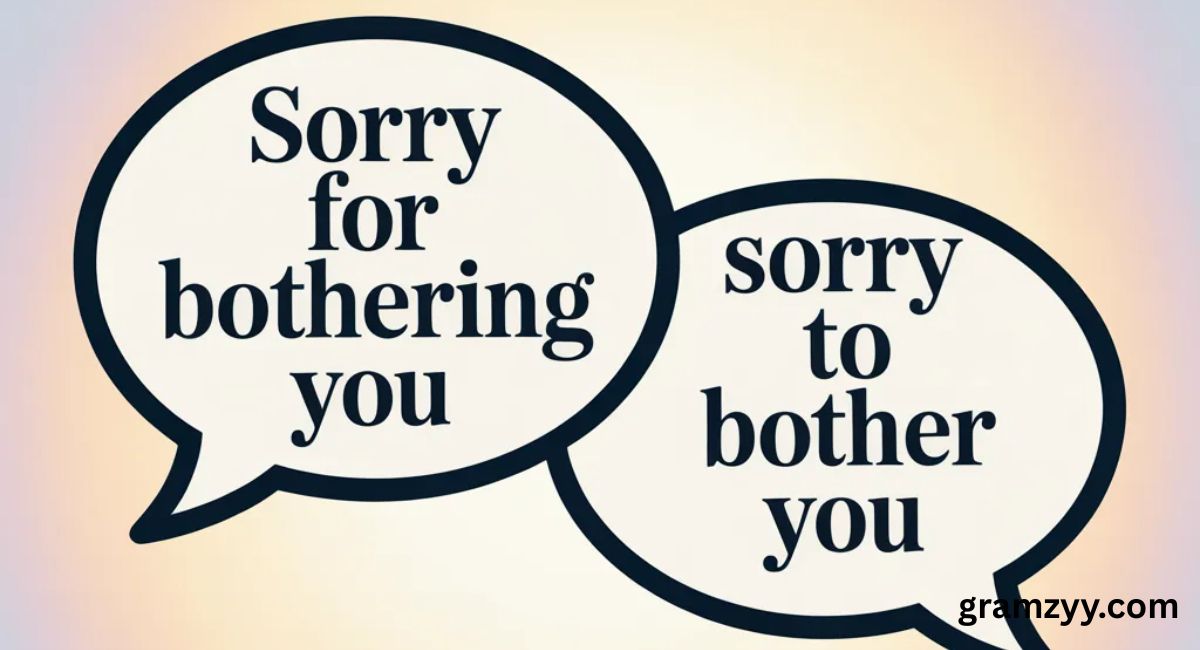
Sorry for bothering you vs sorry to bother you You’re drafting a work email. You need to interrupt a busy colleague. You type “Sorry for bothering you…” — then pause. Should it be “Sorry to bother you” instead? Or does it even matter?
It does matter, and you’re not alone in wondering. These two phrases appear almost identical, yet native English speakers subconsciously notice the difference. The good news: both are grammatically correct. The key is knowing when to use each one, and that comes down to a single, simple concept — timing.
What’s the Difference Between These Phrases?
At the heart of this comparison is a grammar distinction between an infinitive and a gerund.
- “Sorry to bother you” uses the infinitive form (to + bother). Infinitives point toward an upcoming or intended action.
- “Sorry for bothering you” uses the gerund form (bothering = verb acting as a noun). Gerunds refer to an action that has already taken place or is ongoing.
In plain terms: one phrase looks forward, the other looks back.
The golden rule: Use “Sorry to bother you” before the interruption. Use “Sorry for bothering you” after the interruption.
That one rule solves about 90% of the confusion.
A Side-by-Side Comparison
| Feature | Sorry to Bother You | Sorry for Bothering You |
|---|---|---|
| Verb form | Infinitive (to + verb) | Gerund (verb + -ing) |
| Timing | Before the interruption | After the interruption |
| Direction | Forward-looking (proactive) | Backward-looking (reflective) |
| Tone | Polite, anticipatory | Apologetic, regretful |
| Best for | Starting requests, emails, conversations | Follow-ups, closings, acknowledgements |
| Example | “Sorry to bother you, do you have a minute?” | “Sorry for bothering you earlier with that question.” |
When Should You Use Each Phrase?
When to Use “Sorry to Bother You”
Use this phrase before you make a request or start an interruption. It signals that you’re aware you might be taking someone’s time, and you want to acknowledge that upfront — like knocking before entering a room.
Common situations include:
- Starting a cold email or message to someone new
- Approaching a busy colleague with a quick question
- Reaching out to a manager for the first time about an issue
- Interrupting someone mid-task to ask for help
Examples:
- “Sorry to bother you, but could you take a look at this report?”
- “Sorry to bother you on the weekend — I had a quick question about tomorrow’s meeting.”
- “Sorry to bother you again, but I’m still waiting on the approval.”
When to Use “Sorry for Bothering You”
Use this phrase after you have already interrupted or inconvenienced someone. It acknowledges the disruption that already occurred and expresses genuine regret for it.
Common situations include:
- Closing an email after asking multiple questions
- Apologizing for a previous message or follow-up
- Wrapping up a call where you know you took someone’s time
- Reflecting on having contacted someone too often
Examples:
- “Sorry for bothering you with so many follow-ups this week.”
- “Thanks for your patience — sorry for bothering you about this.”
- “I realized it was your day off. Sorry for bothering you.”
Also read : Die vs Dice — What’s the Difference?
How Do You Use These Apologies in Writing?
Correct Usage Examples
The following examples show each phrase used in the right context:
- ✅ “Sorry to bother you, but can I ask a quick question?” — interruption hasn’t happened yet; infinitive is correct.
- ✅ “Thanks for your time. Sorry for bothering you with this.” — the interruption is complete; gerund is correct.
- ✅ “Sorry to bother you during office hours, but I had a concern about the assignment.” — proactive, before the ask.
- ✅ “Sorry for bothering you earlier — I had the wrong file.” — reflective, after the fact.
Incorrect Usage Examples
These are the errors most people make without realizing it:
- ❌ “Sorry to bothering you” — never mix the infinitive marker to with a gerund. Choose one structure.
- ❌ “Sorry for bother you” — missing the gerund ending; always use bothering after the preposition for.
- ❌ “Thanks for your time. Sorry to bother you with this.” — using the forward-looking phrase at the end of an email doesn’t make sense grammatically or contextually.
- ❌ “Sorry to bothered you” — mixing tenses incorrectly; stick to the infinitive base form.
Context Variations
The same phrase can shift in formality depending on how it’s framed:
| Context | Recommended Phrase | Example |
|---|---|---|
| Formal email to a client | Sorry to bother you | “Sorry to bother you — I wanted to follow up on our proposal.” |
| Closing a long email thread | Sorry for bothering you | “Sorry for bothering you with so many messages.” |
| Text to a colleague | Sorry to bother you | “Sorry to bother you — quick question!” |
| After a long call | Sorry for bothering you | “Sorry for bothering you for so long.” |
| Very formal/written apology | Sorry to have bothered you | “Sorry to have bothered you with this matter.” |
Note: “Sorry to have bothered you” is a third, more formal variation using the perfect infinitive. It suggests the action is fully complete and carries a slightly more distant tone. Use it in formal written communication or when you want to sound especially polished.
Common Mistakes People Make
Even fluent English speakers slip up with these phrases. Here are the most frequent errors and how to fix them:
1. Using “for bothering” before the interruption happens Many people think of the disturbance they’re about to cause and reach for “for bothering.” But since the disruption hasn’t occurred yet, the infinitive “to bother” is the correct choice.
2. Confusing verb forms Phrases like “sorry for bother you” or “sorry to bothering you” are grammatically wrong. Remember: after for, always use a gerund (-ing). After to, always use the base verb infinitive.
3. Over-apologizing Using “sorry” in every other sentence can actually undermine your credibility in professional settings. If you’re not genuinely interrupting anyone, you don’t need an apology at all. Instead, consider:
- “I wanted to check in on…” (confident, direct)
- “I’d appreciate your input on…” (professional, respectful)
- “Thank you for your time — I had a question about…” (gratitude replaces apology)
4. Using these phrases in truly casual conversations With close friends or family, these phrases can sound stiff and overly formal. A simple “Hey, got a sec?” is often more natural.
Also read : Gluing vs. Glueing
Which Phrase Sounds More Polite?
Both phrases are equally polite — but they create slightly different impressions:
- “Sorry to bother you” sounds confident and considerate. You’re acknowledging the potential interruption while still moving forward. It doesn’t carry the weight of real guilt.
- “Sorry for bothering you” sounds more apologetic and reflective. It acknowledges that something already happened and shows genuine regret.
In most professional communication — emails, meetings, calls — “Sorry to bother you” tends to be the preferred opener because it maintains a forward momentum. Overusing “Sorry for bothering you” in every email can make you sound overly submissive or unsure of yourself.
The Chicago Manual of Style and plain language guidelines both emphasize clarity over emotional padding. A confident, polite tone serves you better in professional settings than repeated apologies.
How Do You Remember Which to Use?
Here’s a simple mental checklist you can use every time:
Ask yourself: Has the interruption already happened?
- ❌ No → Use “Sorry to bother you” (before the act)
- ✅ Yes → Use “Sorry for bothering you” (after the act)
Or think of it this way:
- “To bother” = about to
- “For bothering” = already done
One more memory trick: the word “for” often signals reflection on the past in English (“Thanks for helping,” “Sorry for being late”). So “sorry for bothering” naturally fits past actions. The word “to” signals intention or future direction — so “sorry to bother” looks ahead.
Also read : Predicate Nominative — The Clear Rule
Helpful Alternatives to Both Phrases
Sometimes, the best move is to skip the apology altogether. Here are confident, polite alternatives that work well in professional communication:
| Instead of… | Try… |
|---|---|
| “Sorry to bother you, can I ask?” | “I had a quick question — do you have a moment?” |
| “Sorry for bothering you so much” | “Thank you for your patience with my follow-ups.” |
| “Sorry to bother you again” | “Following up on my previous message…” |
| “Sorry to bother you, I just need…” | “I’d appreciate your input on something.” |
Swapping apologies for expressions of gratitude often sounds more professional and leaves a stronger impression.
Read it : demonstrate
Conclusion
Both “sorry for bothering you vs sorry to bother you“ are grammatically correct but they’re not interchangeable. The difference is timing. Use the infinitive form (to bother) before you interrupt someone, and the gerund form (for bothering) after the interruption has already taken place.
Sorry for bothering you vs sorry to bother you This distinction might seem small, but it shapes how your message is received. The right phrase at the right moment signals emotional intelligence, social awareness, and genuine respect for others’ time all of which matter enormously in professional communication.
When in doubt, remember: before the act = “to bother,” after the act = “for bothering.” That’s all you need.
FAQs
Is “sorry for bothering you” grammatically correct?
Yes, it is perfectly grammatically correct. It uses the gerund form (bothering) after the preposition for, which is standard English grammar.
Is “sorry to bother you” grammatically correct?
Yes. It uses the infinitive form (to bother), which correctly expresses a polite, forward-looking intention before an interruption.
Can I use “sorry for bothering you” at the start of an email?
Technically, if you’re opening an email (meaning the “bother” hasn’t happened yet), “sorry to bother you” is more precise. However, in casual usage, many native speakers use either phrase at the start without issue. sorry for bothering you vs sorry to bother you
What does “sorry to have bothered you” mean?
It’s a more formal, past-tense variation indicating the interruption is fully over. It sounds polished but slightly distant — best reserved for formal written correspondence.
Is “sorry for bother you” correct?
No. This is grammatically incorrect. After the preposition for, you must use the gerund form: “sorry for bothering you.”
Which phrase is more professional in emails?
“Sorry to bother you” is generally preferred at the start of professional emails. It sounds direct and polite without being overly self-deprecating. sorry for bothering you vs sorry to bother you
Should I always apologize when reaching out to someone?
Not necessarily. If the request is routine or collaborative, expressing gratitude (“Thank you for your time”) or being direct (“I had a question about…”) often works better than leading with an apology.
What is the difference between “sorry to bother you” and “sorry to disturb you”?
Both mean essentially the same thing. “Disturb” tends to sound slightly more formal and implies a stronger interruption, while “bother” is more conversational and widely used in everyday professional contexts. sorry for bothering you vs sorry to bother you