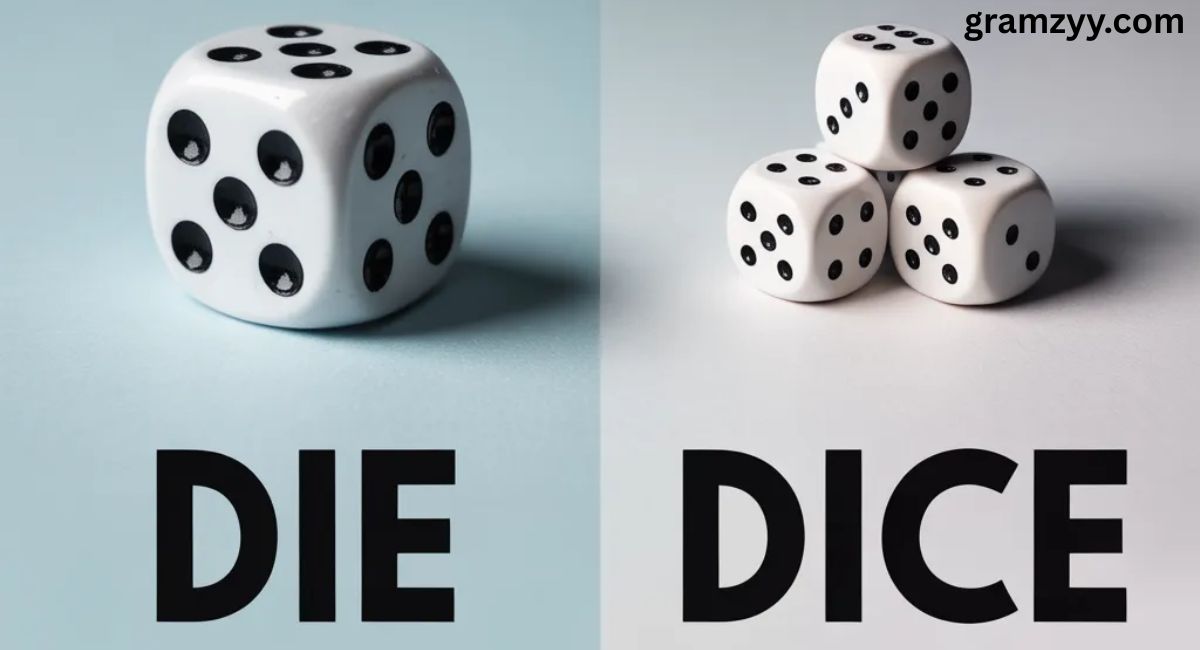
Die vs Dice : If you’ve ever sat down at a board game and heard someone say “pass me a dice,” you probably didn’t think twice. But grammar-minded folks at the table definitely noticed. The distinction between die and dice is one of those small English quirks that trips up native speakers and learners alike. So what’s the real difference — and does it still matter?
Quick Answer: Die vs Dice at a Glance
| Term | Form | Meaning | Example |
|---|---|---|---|
| Die | Singular | One six-faced cube used in games | “Roll the die once.” |
| Dice | Plural | Two or more six-faced cubes | “Shake the dice in your hand.” |
| Dice (informal) | Singular/Plural | Used for both in casual speech | “Hand me a dice.” (informal) |
The traditional grammar rule is straightforward: one die, two dice. But as with many English words, actual usage has evolved — and the story behind these two words is more fascinating than you might expect.
Why Do People Mix Up Die and Dice?
The confusion is completely understandable. Most games — Monopoly, Yahtzee, craps, backgammon — use two dice by default. Players almost never need a single one. Because “dice” is heard and spoken so much more often than “die,” people naturally start using “dice” for everything, singular included.
There’s also the simple fact that “a die” sounds odd to modern ears. It feels almost archaic, like something out of a Shakespeare play. So speakers replace it with the more familiar “a dice,” which sounds natural even if it bends the rules.
Another source of confusion: die has other common meanings. It means “to stop living,” or it can refer to a tool used in manufacturing (a die-cast mold, for example). When someone says the word “die” out of context, listeners don’t always connect it to a game piece.
Also read : Spatter or Splatter Difference
Where Did Die and Dice Come From?
The Journey from Latin to English
Both words trace their roots to the Latin word datum, the past participle of dare, meaning “to give.” Ancient Romans used datum in the gaming sense — a die represents what fate “gives” you when you throw it. The phrase captures the randomness at the heart of dice games.
Latin passed this word to Old French as dé (singular) and dés (plural). When Norman French speakers conquered England in 1066, they brought their vocabulary with them. English absorbed these gaming terms around the 14th century, with early spellings that varied wildly — dee, dy, die all appeared in manuscripts of the era.
By the 15th century, the singular die and plural dice had settled into fairly consistent use. Geoffrey Chaucer’s manuscripts reference dice games, and by the 1500s the distinction was firmly established in written English.
How Gaming Changed the Words
Here’s where things get interesting. Because most popular games use two dice rather than one, the plural form dominated everyday speech for centuries. The singular “die” became a word people rarely needed to say aloud. Over time, it started to feel unusual — even incorrect.
This shift reflects what linguists call descriptive grammar winning over prescriptive grammar. Rules say one thing; people say another. And eventually, even dictionaries had to catch up:
- Oxford English Dictionary now notes that “dice” functions as both singular and plural in standard English.
- Merriam-Webster lists “dice” as an acceptable singular form, particularly in informal use.
- Cambridge Dictionary defines dice as referring to “one or more small cubes,” acknowledging the practical reality of everyday speech.
The die/dice evolution mirrors other irregular plural patterns in English — the same ancient sound shift that gave us mouse/mice and foot/feet.
How Do You Use Die vs Dice in Different Situations?
Formal and Academic Writing
In research papers, textbooks, probability problems, and published academic work, the traditional distinction still holds. Mathematics and statistics texts, in particular, rely on precision. You’ll regularly see sentences like:
- “If you roll one die, the probability of landing on any given face is 1 in 6.”
- “Each die in the set is perfectly balanced.”
Using “die” for singular in these contexts signals careful, precise writing. It’s the standard that editors and academics expect.
Gaming and Casual Contexts
In everyday conversation — at game nights, in gaming forums, in casual chat — “dice” as singular is now so common that correcting it can feel pedantic. Saying “pass me a dice” is understood immediately by everyone in the room.
Casual writing, social media, blog posts, and informal emails follow the same pattern. The singular “die” is optional territory here; most readers won’t notice either way.
Professional Gaming and Instructions
Official rulebooks and professional game design occupy a middle ground. Many still use “die” and “dice” correctly to maintain clarity:
- “Each player rolls two dice at the start of their turn.”
- “If a die lands off the table, roll it again.”
Clear instructions matter in these settings, and preserving the singular/plural distinction removes any ambiguity.
Also read : To Early or Too Early: Which One Is Correct?
Where Have Writers Used These Words Throughout History?
Classic Literature and Famous Phrases
Few phrases pack more historical weight than “the die is cast” — alea iacta est in Latin. Julius Caesar reportedly said this as he crossed the Rubicon river in 49 BC, committing himself to civil war and a decision that could not be undone. The phrase has survived more than two thousand years and remains in everyday English use as a metaphor for an irreversible choice.
Shakespeare used both “die” and “dice” correctly in his plays, reflecting the grammatical standards of the 16th century. The precision of Elizabethan English on this point stands in contrast to how casually modern speakers treat the distinction.
Another common phrase — “loaded dice” — suggests cheating or unfair advantage. It appears both in literal gaming contexts and as a figurative expression, as in “the system is playing with loaded dice.”
Modern Writing Patterns
Modern fiction writers tend to follow the speech patterns of their characters. A narrator describing a casino scene might write “a single die rattled in the cup” for precision, while a character speaking in dialogue might say “grab a dice from the box” to sound natural and contemporary.
The gap between written and spoken English has never been wider on this particular word pair.
What Words Are Similar to Die and Dice?
Comparing to Other Irregular Plurals
The die/dice pattern isn’t unique in English. Several other words follow irregular plural rules, often because they were borrowed from other languages:
| Singular | Plural | Origin |
|---|---|---|
| Die | Dice | Old French / Latin |
| Mouse | Mice | Old English |
| Foot | Feet | Old English |
| Tooth | Teeth | Old English |
| Ox | Oxen | Old English |
| Cactus | Cacti | Latin |
| Datum | Data | Latin |
Notice that datum and data come from the same Latin root as die and dice. Both pairs involve the word “datum” — and both have the same modern problem, where the plural (data, dice) is now often used as singular in everyday speech.
American and British Differences
There is no significant difference between American and British English on this particular point — both traditionally follow the one die / two dice rule, and both have seen the same drift toward “dice” as singular in casual use. Some British style guides are slightly more conservative about preserving formal grammar rules, but in practice the variation is minimal.
Also read : Dammit vs Damnit: Which Spelling Is Correct?
Common Mistakes When Using Die vs Dice
Watch out for these frequently seen errors:
- “A dice” — Technically incorrect in formal writing; use “a die.”
- “Dies” — This is not the plural of the gaming die. Dies is either a verb (“he dies”) or a manufacturing term (multiple cutting tools). Never use it as a plural for game pieces.
- “Dices” — This is the third-person singular of the verb to dice (as in cooking: “she dices the onion”). It is never the plural of the noun die.
- Confusing the manufacturing die — In engineering and manufacturing, a die is a tool used to cut or shape material. Its plural is dies, not dice. Context tells you which meaning applies.
Tips for Using Die vs Dice Correctly
Memory Tricks
A few simple mental shortcuts can help you get this right every time:
- Count the letters, count the cubes. “Die” has 3 letters → 1 cube. “Dice” has 4 letters → more than 1. Short word, single object.
- Think of “mice.” Mouse → Mice. Die → Dice. Same pattern, same ancient sound shift.
- The formal rule is always safe. When in doubt — especially in writing — use die for one and dice for more than one. No one will ever criticize you for being correct.
- Context check. Formal writing? Use the traditional rule. Casual chat? Either works, but know which one is technically right.
When to Bend the Rules
Language is living. If you’re writing dialogue for a character who would never say “hand me the die,” don’t force it. Realism in voice matters. The key is being intentional knowing the rule well enough to break it deliberately, rather than breaking it by accident.
FAQs
What is the correct singular form of dice?
Die is the grammatically correct singular form. One gaming cube = one die.
Can “dice” be used as singular?
In casual speech and informal writing, yes it’s now widely accepted. In formal, academic, or professional contexts, stick with “die” for singular.
What is the plural of “die” in manufacturing?
In engineering and tool-making, the plural of die is dies, not dice. The two words are unrelated beyond sharing a spelling.
Is “a dice” grammatically correct?
Technically, no — “a dice” is informal. The correct formal phrase is “a die.” However, major dictionaries now recognize “dice” as an acceptable singular in everyday usage.
Why does “dice” feel more natural than “die”?
Because most games use two dice, the plural form is heard far more often. Over time, the singular “die” faded from everyday use, making “dice” feel like the default form.
What does “the die is cast” mean?
It means a decision has been made that cannot be reversed. The phrase originates from Julius Caesar’s crossing of the Rubicon in 49 BC and has been in use ever since.
Conclusion
The difference between die vs dice comes down to a simple grammar rule with a very long history: die is singular, dice is plural. That rule has held firm in formal writing for centuries, even as casual speech has increasingly treated dice as a catch-all for both forms.
For anyone writing academically, professionally, or with an eye for precision, knowing and applying this distinction is a small but meaningful marker of grammatical care. For everyone else at the game table, in casual emails, in everyday conversation “dice” for singular is universally understood and increasingly accepted.
Either way, now you know the difference. So the next time someone corrects you mid-game, you can explain exactly why both usages exist and then get back to rolling.