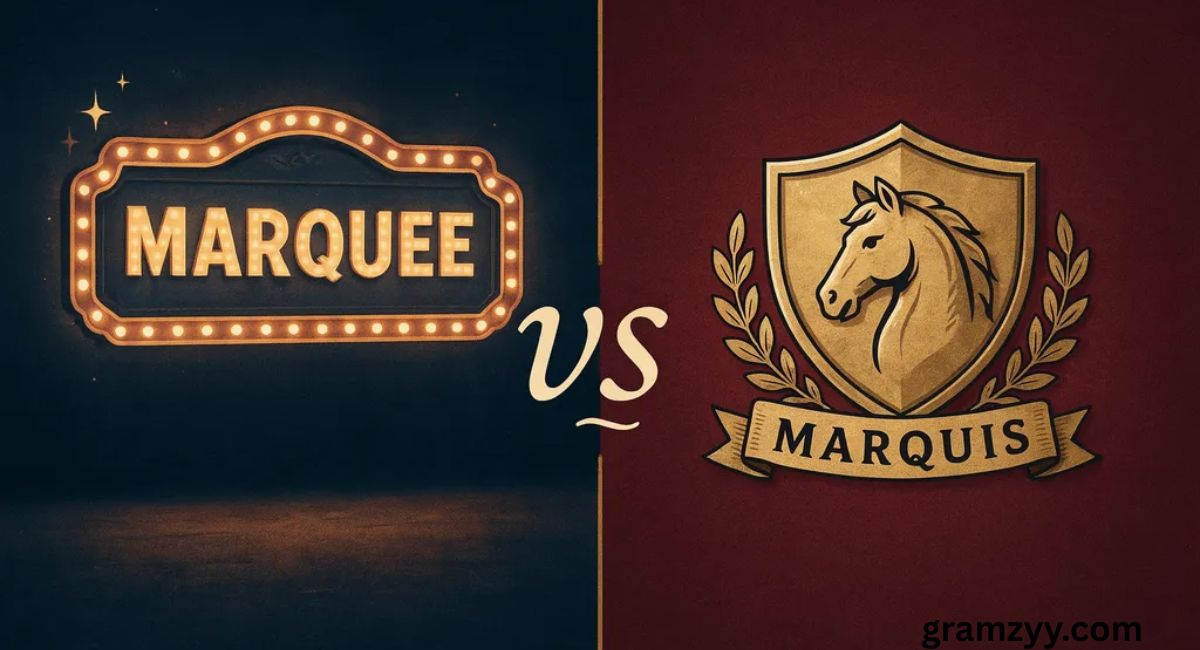
If you’ve ever typed one of these words and second-guessed yourself mid-sentence, you’re not alone. Marquee vs marquis are homophones — they sound identical when spoken aloud — yet they carry completely different meanings, histories, and grammatical roles. One belongs to theater signs and wedding tents; the other to medieval noblemen and European peerage. Mixing them up in professional or academic writing can quietly undermine your credibility.
This guide breaks both words down fully: their definitions, etymologies, usage patterns, regional variations, and the memory tricks that will keep them straight for good.
Why Do These Words Trip Up Your Brain?
The core problem is phonological identity. Both words are pronounced the same way: /mɑːrˈkiː/. When you hear the word spoken, your brain has no auditory signal to separate them — only context and visual memory can do that. Native speakers make this error regularly in speech-to-text software, autocorrect, and rushed typing.
What makes it worse is that the two words aren’t random coincidences. They share a common ancestor. Both descended from the same Old French root, then split across seven centuries into two entirely separate concepts. Your instinct to confuse them is, in a strange way, etymologically justified.
Core Concepts and Historical Evolution
Before getting into examples, it helps to understand what each word actually means at its core.
| Feature | Marquee | Marquis |
|---|---|---|
| Part of Speech | Noun (also adjective) | Noun |
| Primary Meaning | Large tent or theater sign | Noble title, below duke |
| Register | Modern, commercial | Historical, aristocratic |
| Regional Spelling | Consistent worldwide | Marquess in British English |
| Metaphorical Use | Yes (“marquee player”) | Rarely |
Etymology and Old French Border Terminology
The word marquis stems from the Old French term marchis, meaning “border ruler,” derived from marche, meaning “frontier.” The title was adopted into English during the Middle Ages and incorporated into the hierarchy of noblemen, ranking just below a duke and above a count.
The word marquee followed a stranger path. Around the 1680s, the English borrowed the French word marquise — the feminine form of marquis — which referred to a linen canopy placed over an officer’s tent to distinguish it from others. English speakers mistook the word as a plural and anglicized it as marquee. By 1812, the term referred to large wooden structures erected for temporary events. The theater-entrance canopy meaning appeared by 1912 in American English.
In short: one word stayed noble, the other became a tent — all because of a mistranslation.
Grammatical Mechanics and Homophonic Orthographic Divergence
Marquee functions primarily as a noun but also serves as an adjective in modern usage:
- Noun: “We held the reception under a marquee.”
- Adjective: “She’s the marquee attraction of the season.”
Marquis functions exclusively as a noun — it names a person or title, nothing more:
- Noun: “The marquis presided over the estate.”
Writers who reach for “marquis player” or “marquis event” are making a category error — the noble title doesn’t carry adjectival force. That role belongs exclusively to marquee.
Also see : Day Off vs Off Day — Meaning, Usage & Examples
How Context Determines Meaning: Practical Examples
Context is your most reliable guide. Ask yourself: am I describing something physical or promotional? Or am I referring to a person with a hereditary rank?
Formal and Professional Usage
In business writing, marquee signals prominence and star power:
- “The company signed a marquee partnership with a Fortune 500 firm.”
- “Their marquee product launches every spring to enormous fanfare.”
In historical and academic writing, marquis names rank and lineage:
- “The Marquis de Lafayette crossed the Atlantic to support the American Revolution.”
- “The estate had been in the marquis’s family for three generations.”
Style guides including APA, MLA, and Chicago do not prefer one spelling over the other — they simply require contextual accuracy. Using marquis in a business context or marquee in a genealogical text is a factual error, not a stylistic preference.
Conversational and Informal Contexts
In casual American English, marquee has evolved well beyond its literal meaning. Saying “She’s a marquee name in tech” signals that she’s high-profile — a name displayed in lights, so to speak. This metaphorical usage feels contemporary and media-influenced.
Marquis, by contrast, rarely appears in casual speech unless discussing history or reading historical fiction. “The Marquis of Queensberry Rules” governs boxing — a phrase preserved because the historical figure codified the sport’s modern rules.
The Error Pattern: Why People Mix Them
Errors follow predictable patterns. Writers who encounter marquee in a sports context (“marquee signing”) sometimes overgeneralize and begin spelling the nobility title as marquee, writing “the marquee received guests at the palace.” The reverse happens less often, since marquis appears less frequently in everyday modern writing.
Even grammar tools like Grammarly and Microsoft Word occasionally suggest marquis when marquee is correct, because both are legitimate words and context-sensitivity in autocorrect remains imperfect. Always double-check historical vs. modern context manually.
See also : Finger in the Dike
Literary and Cultural References: How Writers Use These Words

Historical Usage in Classic Texts
Marquis appears throughout classical European literature and historical documents. The Marquis de Sade lent his name to the psychological concept of sadism. The Marquis de Lafayette became a celebrated figure in both French and American revolutionary history. In Dickens’s A Tale of Two Cities, the Marquis Evrémonde embodies aristocratic cruelty — a character whose title is inseparable from his social power and moral corruption.
These literary uses reinforce a key point: marquis carries weight. It signals rank, inherited authority, and historical context. Placing it in a modern commercial setting would feel jarring.
Modern Application Across Media
In contemporary journalism, entertainment, and sports writing, marquee dominates:
- Sports: “The team’s marquee signing drew tens of thousands of new supporters.”
- Entertainment: “The festival’s marquee headliner sold out the venue within hours.”
- Technology: In early web development, the HTML
<marquee>tag created scrolling text on webpages. While modern standards discourage its use, the term still appears in discussions about legacy code, expanding the word’s reach into digital communication.
Synonyms, Variations, and Linguistic Neighbors
Semantic Neighbors and Their Distinctions
Understanding the synonyms for each word sharpens your usage instincts:
Synonyms for marquee (noun):
- Canopy — architectural or sheltering context
- Awning — smaller, typically permanent structures
- Pavilion — more formal outdoor structure
- Signboard — specifically for advertising purposes
- Banner — promotional or decorative display
Synonyms for marquis (noun):
- Marquess — British English spelling
- Nobleman — general aristocratic rank
- Peer — member of the British peerage
- Lord — informal or general address
Visualizing the Etymology Split
Both words share a single ancestor — the Old French marchis — before diverging:
Old French: marchis ("border ruler")
        │
        ├──► marquis  →  Hereditary noble title (preserved meaning)
        │
        └──► marquise (French feminine form)
                  │
                  └──► marquee  →  Military tent → Event tent → Theater sign
The story begins with the Frankish marca, a Germanic loan into Latin meaning “boundary” or “borderland.” Old French adopted marchis around 1200 CE to describe a governor who defended unstable frontiers. The title ranked above regular counts because border defense carried higher military and political stakes.
Regional Spelling Variations
In Great Britain and Ireland, the nobility title is most commonly spelled marquess, while marquis is the French-influenced spelling preferred in France, the United States, and much of continental Europe. Both refer to the same hereditary rank, just above a count or earl and just below a duke. Marquee, by contrast, shows no regional spelling variation — all English-speaking countries use the same form for tents and theater signs.
See also : Bespeckled vs Bespectacled
Common Mistakes: Where Writers Go Wrong
Here are the most frequent errors — and how to correct them:
| ❌ Incorrect | ✅ Correct | Why |
|---|---|---|
| “She’s a marquis athlete.” | “She’s a marquee athlete.” | Marquis is a noble title, not an adjective |
| “The marquee accepted guests.” | “The marquis accepted guests.” | A canopy cannot accept guests |
| “The marquee of Queensberry Rules” | “The Marquis of Queensberry Rules” | Refers to a historical nobleman |
| “A beautiful outdoor marquis” | “A beautiful outdoor marquee” | The tent is spelled marquee |
| “A marquee ranked above an earl” | “A marquis ranked above an earl” | Nobles use marquis, not marquee |
The most dangerous error is the adjectival misuse: writing marquis player, marquis event, or marquis attraction. Only marquee carries adjectival force in contemporary English.
Practical Tips and Field Notes
The Editor’s Field Note
Experienced copy editors use a simple two-second check before finalizing either word:
- Is this a person with a noble title? → Use marquis (or marquess for British texts).
- Is this a physical structure — tent, canopy, theater sign? → Use marquee.
- Is this an adjective describing prominence? → Use marquee (it’s the only one that works as an adjective).
- Is this a historical or genealogical document? → Marquis. Every time.
When in doubt, swap in a synonym. If “nobleman” fits, write marquis. If “big tent” or “high-profile” fits, write marquee.
Mnemonics and Memory Aids
Two quick tricks that actually stick:
- The “E” trick: marquEE ends in double-E, just like theaterE nearly does. Both relate to entertainment and events. If you’re talking about a show, a tent, or a spotlight — reach for the word with two E’s.
- The “S” trick: marquisS shares a letter cluster with aristocraS… aristocracy. The silent S at the end signals something old, formal, and European — just like the title itself.
A third option: picture a marquee sign glowing above a theater entrance. Big, bright, public. Now picture a marquis in a candlelit medieval hall. One is modern and commercial; the other is ancient and aristocratic. Let the image do the work.
FAQs
Is marquee ever used as an adjective?
Yes — marquee commonly functions as an adjective in modern English to mean high-profile or prominent, as in “a marquee signing” or “a marquee event.” Marquis never takes this adjectival role. (marquee vs marquis)
What is the difference between marquis vs marquess?
Both refer to the same noble rank; marquess is the British English spelling, while marquis is preferred in French, American, and continental European contexts.
Can marquee refer to a person?
Informally, yes — calling someone “a marquee name” means they are a prominent or well-known figure, but this is metaphorical, not literal. (marquee vs marquis)
Does marquis have a female equivalent?
In French, the female title is marquise. In English, the wife or widow of a marquis holds the title marchioness.
Why do autocorrect tools confuse these words?
Because both are correctly spelled English words, autocorrect cannot distinguish them by spelling alone — only human judgment and context can separate them reliably. (marquee vs marquis)
Conclusion
Marquee vs marquis are a fascinating pair: born from the same Old French root, separated by centuries of linguistic drift, and reunited only by the accident of identical pronunciation. Marquee belongs to the world of events, entertainment, and prominence. Marquis belongs to history, nobility, and European aristocracy. They may sound alike, but their meanings live in entirely different worlds.
marquee vs marquis The fastest way to get this right, every single time: ask whether you’re describing a structure or a spotlight — or a nobleman. One answer calls for double E. The other calls for a silent S. With a little practice, the distinction becomes instinctive, and your writing becomes that much more precise.