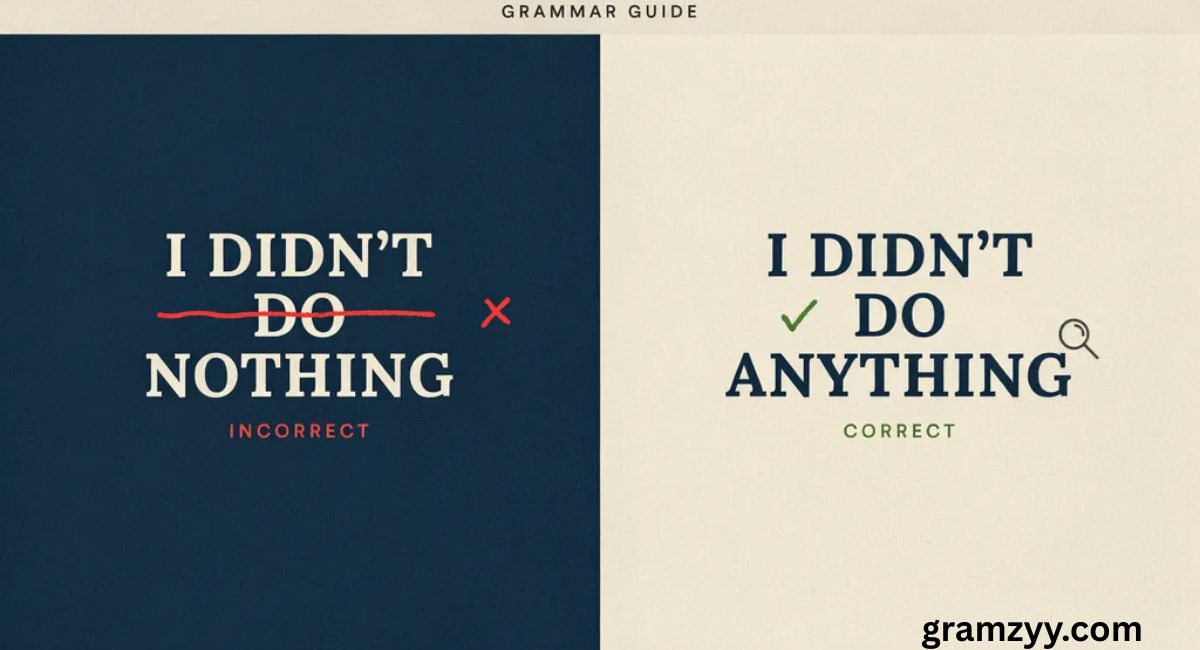
i didnt do nothing or i didnt do anything: You’ve probably heard both phrases — in movies, arguments, casual conversations, maybe even your own speech. But when someone blurts out “I didn’t do nothing!”, are they saying it right? The answer matters more than you’d think, especially in formal writing, job interviews, and academic settings.
The short answer: “I didn’t do anything” is correct in standard English. “I didn’t do nothing” is a grammatical error known as a double negative — and while it’s widely used in everyday speech and certain dialects, it doesn’t belong in formal writing.
Let’s break down exactly why, when each version appears, and how to remember the rule permanently.
Why Is “I Didn’t Do Anything” Correct?
In standard English grammar, a sentence only needs one negative element to express a negative idea. When you say “I didn’t do anything,” the word didn’t (a contraction of did not) is already doing the job of making the sentence negative. The word anything is what grammarians call an indefinite pronoun — it’s neutral by nature, and it pairs correctly with a negative verb.
The structure works like this:
| Sentence Part | Word Used | Role |
|---|---|---|
| Auxiliary verb | didn’t (= did not) | Carries the negation |
| Object/pronoun | anything | Neutral indefinite pronoun |
| Result | I didn’t do anything | Single, clear negative meaning |
This construction is clean, clear, and universally understood. It follows the standard grammar rule: one negative per clause.
Compare:
- ✅ “I didn’t do anything.” → Correct. One negative (didn’t), one neutral pronoun (anything).
- ❌ “I didn’t do nothing.” → Incorrect in standard English. Two negatives (didn’t + nothing).
What Are Double Negatives?
A double negative occurs when two negative words appear in the same clause. In the sentence “I didn’t do nothing,” both didn’t and nothing are negative words — and that’s the problem.
The most frequently used negative words in English include:
- no, not, nothing, never, nobody, nowhere, neither, none, no one
- Words with hidden negative meanings: hardly, scarcely, barely
When two of these appear together in a single clause, the sentence becomes a double negative. In standard English, this is considered a grammatical error because two negatives technically cancel each other out, reversing the intended meaning.
Think of it this way: If someone says “I didn’t do nothing,” the literal grammatical interpretation is “I did something.” That’s the opposite of what the speaker meant.
Of course, in real-life conversation, no one actually interprets it that way. Context and tone carry the intended meaning. But in writing or formal speech, the ambiguity remains a problem.
The Grammar Rule Explained
Standard English follows what linguists call the single negation rule: use only one negative word per clause.
This rule comes from prescriptive grammar — the set of formal rules taught in schools and used in professional writing. Here’s how the rule plays out with common negative pairs:
| ❌ Double Negative (Nonstandard) | ✅ Correct Single Negative |
|---|---|
| I didn’t do nothing. | I didn’t do anything. |
| She didn’t say nothing. | She didn’t say anything. |
| He doesn’t know nothing. | He doesn’t know anything. |
| They didn’t go nowhere. | They didn’t go anywhere. |
| I haven’t seen nobody. | I haven’t seen anybody. |
Notice the pattern: wherever you have a negative verb (didn’t, doesn’t, haven’t), you replace the second negative word (nothing, nowhere, nobody) with its any- equivalent (anything, anywhere, anybody).
The “Any-” Swap Rule
A simple trick to fix double negatives is what you could call the “any-” swap:
- Identify the negative verb (didn’t, won’t, haven’t, can’t, etc.)
- Replace the second negative noun/pronoun with its any- form:
- nothing → anything
- nobody → anybody
- nowhere → anywhere
- never → ever
This instantly removes the double negative without changing the intended meaning.
See also: Brite vs Bright: What’s the Difference?
When Should You Use Each Form?
Use “I Didn’t Do Anything” In:
- Academic writing — essays, research papers, assignments
- Professional communication — work emails, reports, cover letters
- Job interviews — spoken and written responses
- News articles and journalism
- Formal presentations and speeches
- Standardized tests and exams (incorrect grammar will cost points)
In every one of these settings, double negatives are penalized or viewed negatively. Teachers, editors, and employers associate correct grammar with clarity and professionalism. Using “I didn’t do anything” signals that you understand and respect those standards.
Where “I Didn’t Do Nothing” Appears
Despite being nonstandard, “I didn’t do nothing” is deeply rooted in:
- African American Vernacular English (AAVE) — where double negatives function as negative concord, reinforcing the negative rather than canceling it
- Southern American English dialects
- Some British regional dialects (the same structure appears in Chaucer’s Canterbury Tales)
- Casual, informal conversation
- Song lyrics, film dialogue, and creative writing when a character’s voice calls for it
In these contexts, the double negative isn’t a mistake — it’s a feature of the dialect. Linguists call this negative concord, meaning multiple negative words work together to express a single, stronger negation. Languages like Spanish, French, Italian, and Russian actually require this structure. English dialects that use it are following a long, legitimate linguistic tradition.
The key point: dialect use ≠ ignorance. It’s a matter of register — knowing which form fits which situation.
Examples in Context
Correct Usage Examples
These sentences follow standard grammar and are appropriate in all contexts:
- “I didn’t do anything wrong — you can check the records.”
- “She didn’t say anything during the entire meeting.”
- “The experiment didn’t reveal anything unexpected.”
- “I haven’t seen anybody near the building this morning.”
- “He did nothing to provoke the argument.” (Here, nothing is used correctly because there’s no second negative verb.)
Incorrect Usage Examples (Double Negatives)
These sentences contain double negatives and are nonstandard in formal English:
- ❌ “I didn’t do nothing wrong.”
- ❌ “She didn’t say nothing during the meeting.”
- ❌ “He doesn’t know nothing about it.”
- ❌ “They didn’t go nowhere after school.”
- ❌ “I haven’t barely started.” (Barely has a negative element — haven’t makes it a double negative.)
See also : Adamance Meaning, Usage, and Examples
Context Variations
It’s worth noting that not all double negatives are errors. Some are intentional and acceptable in formal English when used for rhetorical effect:
| Double Negative | Intended Meaning |
|---|---|
| “That’s not uncommon.” | It actually happens fairly often. |
| “This is not unexpected.” | We more or less expected this. |
| “There’s no reason not to try.” | You should definitely try. |
In these cases, two negatives genuinely do create a softened positive — and this construction is standard in formal writing. The difference is intent and structure. These examples don’t involve indefinite pronouns like nothing or nobody; they pair not with a negative prefix (un-, in-) on an adjective, which is a completely different grammatical move.
Common Mistakes with Negative Constructions
Beyond “I didn’t do nothing,” here are other double negative errors that trip people up:
- Hardly/Scarcely/Barely + not
- ❌ “I haven’t hardly eaten today.”
- ✅ “I have hardly eaten today.”
- These three words already carry a negative meaning, so adding not creates a double negative.
- Never + not
- ❌ “She didn’t never call me back.”
- ✅ “She never called me back.”
- Without + nothing
- ❌ “He left without saying nothing.”
- ✅ “He left without saying anything.”
- Can’t + nothing
- ❌ “I can’t find nothing in this drawer.”
- ✅ “I can’t find anything in this drawer.”
How Can You Remember the Right Form?
Three memory strategies that actually work:
1. The “One Negative Per Clause” Rule Think of each clause as a glass — it holds exactly one negative. The verb (didn’t, won’t, can’t) fills that glass. Once it’s full, you switch to the neutral any- form for everything else.
2. The Math Trick (with a Caveat) Two negatives = a positive in math. “I didn’t do nothing” = “I did something.” So if the math-logic result sounds wrong, fix the sentence. (Just remember: this is a helpful shortcut, not a perfect linguistic law — dialects don’t follow algebraic rules.)
3. The Formal Writing Test Before submitting any piece of writing, ask: Would this appear in a news article or textbook? If the sentence has didn’t/haven’t/won’t + nothing/nobody/nowhere, it would not — so change the second negative to its any- equivalent.
Conclusion
i didnt do nothing or i didnt do anything: The choice between “I didn’t do nothing” and “I didn’t do anything” comes down to context and purpose. In standard English — the form used in schools, workplaces, exams, and professional writing — “I didnt do anything” is the correct choice. It avoids the confusion created by pairing two negative words in the same clause.
“I didn’t do nothing” isn’t meaningless or uneducated in the right context — it reflects a valid grammatical pattern found in multiple English dialects with deep historical roots. But in formal settings, it creates ambiguity and signals a lack of grammatical awareness to readers who judge by standard rules.
The takeaway is practical: know your audience, know the setting, and when in doubt, go with “I didn’t do anything.” It’s clear, correct, and universally accepted.
FAQs
Is “I didn’t do nothing” ever grammatically acceptable?
Yes — in informal speech, casual conversation, and dialects like AAVE or Southern American English, it’s widely used and understood. In formal writing or professional settings, it is not accepted. (i didnt do nothing or i didnt do anything)
What is a double negative in grammar?
A double negative is when two negative words (like didn’t and nothing) appear in the same clause, which technically reverses the intended meaning in standard English.
Can I say “I did nothing” instead of “I didn’t do anything”?
Absolutely. “I did nothing” is grammatically correct because it uses only one negative word (nothing) with no negative verb. It means exactly the same thing as “I didn’t do anything.”
Why do people say “I didn’t do nothing” if it’s wrong?
Many people grow up hearing it in everyday conversation, music, or regional dialects. It feels natural because the meaning is intuitively clear, even if the grammar is nonstandard.
Does “I didn’t do nothing” mean “I did something”?
Technically, by standard grammar rules, yes — two negatives cancel out and imply a positive. But in real conversation, no one interprets it that way. Context and shared understanding override literal grammar in spoken language.
What words should I avoid using with “didn’t” to prevent a double negative?
Avoid pairing didn’t with: nothing, nobody, nowhere, never, neither, no one, none, hardly, scarcely, or barely.(i didnt do nothing or i didnt do anything)
What is negative concord?
Negative concord is a linguistic feature in some dialects where multiple negative words reinforce — rather than cancel — a single negative meaning. It is standard in Spanish, French, and many English dialects, though not in formal standard English.