Two words. Same letters. Completely different meanings. Most English speakers use “day off” vs “off day” without a second thought — until they land in an awkward sentence that confuses a colleague or makes a formal email sound strange. Whether you’re a native speaker brushing up on grammar or a learner trying to crack English idioms, understanding this distinction can sharpen your communication in both professional and everyday contexts.
This guide breaks down the meaning, grammatical structure, real-world examples, and common mistakes around both phrases — so you’ll never mix them up again.
Why Do These Two Phrases Trip Up Your Brain?
The confusion is almost poetic: both phrases use the exact same two words — day and off — just in reverse order. Your brain processes them as near-identical, so context has to work overtime to sort out meaning.
Here’s the core difference in a single line:
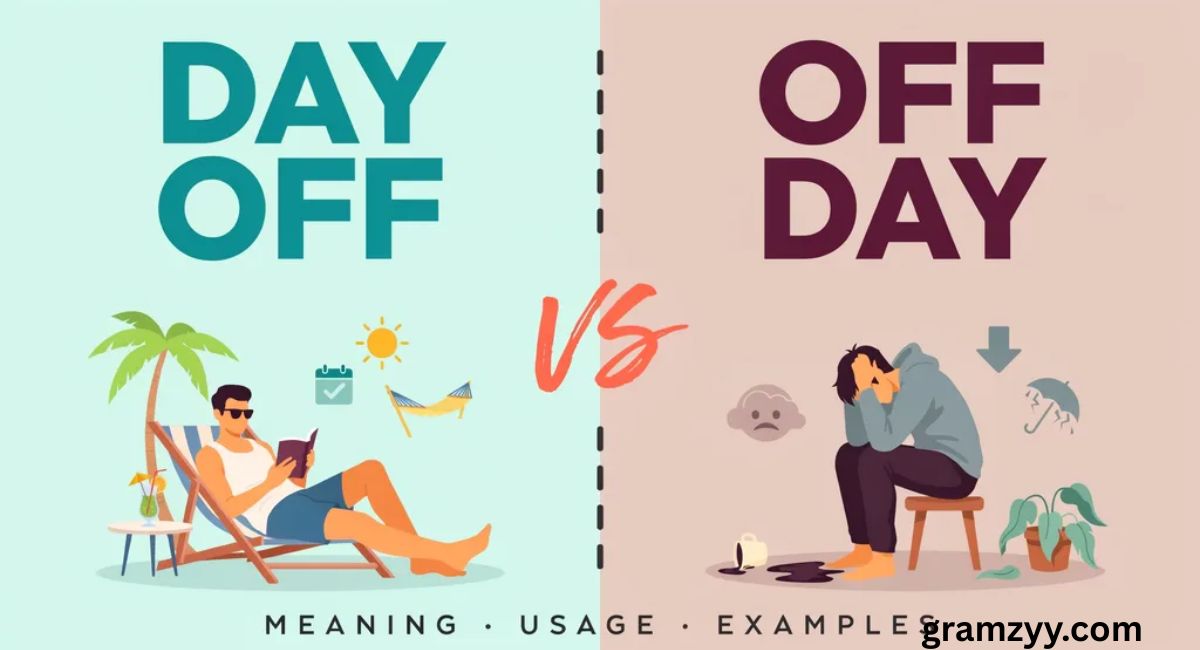
Day off = a planned break from work or responsibilities. Off day = an unplanned day when nothing goes right.
That’s it. One flip of word order, and you’ve gone from “I’m relaxing at home” to “I can’t seem to do anything right today.” The stakes in professional communication are real. Telling your manager you’re “having an off day” in a leave request form, for example, says the opposite of what you mean.
See also : Adamance Meaning, Usage, and Examples
Historical Evolution and Core Concepts
Etymology and Germanic Compound Formation
The word “off” traces back to Old English of, meaning “away from,” and is closely related to Dutch af, German ab, and Old Norse af — all sharing the same Proto-Germanic root. In early Germanic languages, word order was grammatically rigid: a modifier placed after a noun typically indicated separation or removal, while a modifier placed before a noun emphasized quality or character.
That’s why “day off” literally emerged as “a day away from work” — the postpositive “off” signals removal from obligation. Meanwhile, “off day” developed later, borrowing from patterns where a prepositive adjective colors the noun with a qualitative judgment. An “off” day isn’t a day removed from anything; it’s a day that feels wrong.
Grammatical Mechanics and Attributive Adjective Phrases
This is where the real grammar lives.
In “day off”:
- Day is the head noun
- Off functions as a postpositive modifier (an adverb/adjective placed after the noun)
- The phrase operates as a countable noun: you can have one day off, two days off, three days off this month
In “off day”:
- Off is a prepositive attributive adjective modifying day
- The entire phrase describes a day characterized by poor performance, low energy, or general dysfunction
- It’s more abstract — you don’t “schedule” an off day the way you schedule a day off
The Golden Rule: When “off” follows the noun, it signals a break. When “off” precedes the noun, it signals a breakdown.
How These Phrases Work in Real Contexts
Formal Academic and Professional Usage
In professional and HR settings, “day off” is the correct and expected phrase. It appears in employment contracts, scheduling software, leave request forms, and workplace policy documents.
✅ Correct examples:
- “The employee requested a day off on Friday for a medical appointment.”
- “Each team member is entitled to ten paid days off per year.”
- “I’ll be taking a day off next Monday — I’ve already cleared it with HR.”
“Off day” has no place in formal leave requests or scheduling. If you write “I need an off day on Thursday,” your HR team will wonder whether you’re calling out sick or admitting in advance that you plan to underperform.
Casual Conversational Contexts
In everyday speech, “off day” shines. It carries emotional nuance — it’s what people say when they want to acknowledge struggle without committing to a full explanation.
✅ Common uses:
- “Sorry if I seemed distant — I was just having an off day.”
- “Even the best athletes have off days.”
- “The whole team had an off day during that presentation.”
Notice also the article choice: because “off” starts with a vowel sound, you’ll always say an off day, never “a off day.” This is a small but telling error that marks non-native speakers.
The Nuance Trap: When Both Sound Wrong
There’s one tricky zone: describing a day off that also happens to go badly. Consider:
“I had a day off yesterday, but it turned into a bit of an off day — nothing I planned worked out.”
Both phrases fit in the same sentence because they refer to two separate things: the scheduled absence (day off) and the quality of that time (off day). Once you see them as describing different dimensions — schedule vs. performance — the fog clears permanently.
Day Off and Off Day in Literature
Classic Literature
Classic American writers rarely used the shortened modern forms, preferring more elaborate constructions. However, the underlying concepts appear throughout 19th-century fiction. In works exploring labor and rest — think Twain, Melville, or Dickens — characters’ unscheduled breaks from routine (proto “days off”) and their inexplicably poor days (proto “off days”) are recurring narrative beats. The phrases as we know them crystallized in 20th-century American English, accelerated by industrialization and the standardization of the workweek.
Modern Stylistic Usage
Contemporary writers use both phrases deliberately. “Day off” tends to appear in plotlines involving rest, escape, or autonomy. “Off day” surfaces in moments of self-reflection, failure, or humanizing vulnerability. Sportswriters have long leaned on “off day” to soften a star player’s poor performance without diminishing their overall reputation — it’s a gracious phrase that implies the bad performance is the exception, not the rule.
See also : What Does “Talking Out of the Side of Your Mouth” Mean?
Synonyms and Distinguishing the Phrases
Semantic Neighbors and Alternatives
| Phrase | Closest Synonyms | Tone |
|---|---|---|
| Day off | Rest day, free day, holiday, vacation day, leave day | Positive / Neutral |
| Off day | Bad day, rough day, down day, slump day | Negative / Sympathetic |
Visualizing the Difference
| Feature | Day Off | Off Day |
|---|---|---|
| Planned? | Yes | No |
| Who controls it? | You (or your employer) | Circumstances / mood |
| Connotation | Positive — rest, freedom | Negative — struggle, underperformance |
| Grammar role | Noun phrase | Noun phrase (attributive adjective + noun) |
| Example | “I’m taking a day off.” | “I’m having an off day.” |
| Plural form | Days off | Off days |
| Used in HR/formal docs? | Yes | No |
Regional Variations: US vs UK
Both phrases are used on both sides of the Atlantic, but with slight tonal differences:
- American English tends to use “day off” for any non-working day, including holidays: “Monday’s a day off — it’s Labor Day.”
- British English uses “day off” similarly but also uses “day out” to mean a leisure trip, which can cause confusion for learners. An “off day” in British English carries the same meaning as in American English — a day of poor performance or low energy.
Common Mistakes People Make
Getting these phrases wrong is extremely common, even among fluent speakers. Here are the top errors:
- Using “off day” in leave requests ❌ “I’d like to take an off day on Friday.” ✅ “I’d like to take a day off on Friday.”
- Using “day off” to describe poor performance ❌ “I had a day off at the meeting — I couldn’t think straight.” ✅ “I had an off day at the meeting — I couldn’t think straight.”
- Wrong article with “off day” ❌ “I’m having a off day.” ✅ “I’m having an off day.” (Remember: “off” starts with a vowel sound.)
- Writing “day-off” as one hyphenated word ❌ “She took a day-off.” (as a standalone noun) ✅ “She took a day off.” (Hyphenation is only acceptable as a compound modifier before a noun: “a day-off request.”)
- Assuming both mean the same thing in context ❌ “Even the best surgeons have a day off.” (implies they take a vacation mid-procedure) ✅ “Even the best surgeons have an off day.”
Practical Tips and Field Notes
The Editor’s Field Note
Before publishing any professional communication, run a quick mental check:
- Am I talking about a scheduled absence? → Use day off
- Am I talking about poor performance or low mood? → Use off day
- Is the word “off” before or after “day”? The position tells you the meaning.
In emails and formal documents, when in doubt, replace both phrases with more explicit language: “I will not be in the office on Thursday“ or “I was not performing at my usual standard today.” Clarity always wins.
Mnemonics and Memory Aids
Struggling to remember which is which? Try these:
- “Day OFF = Off from work” — the “off” at the end means you’ve stepped off the work treadmill.
- “OFF Day = Off your game” — the “off” at the front colors the whole day as dysfunctional.
- Think of a light switch: Day off = the work switch is OFF. Off day = your performance switch is OFF.
- Associate the word order with control: when you control the day (planned break), “off” comes at the end. When the day controls you (bad day), “off” comes first and hits you before you’re ready.
See also : Patron vs Benefactor: Understanding the Difference
Conclusion
“Day off” vs “off day” are a masterclass in how word order shapes meaning in English. One phrase is about freedom — a planned, chosen break from work. The other is about struggle — an unplanned day when nothing clicks. Use “day off” in scheduling, HR communications, and any context involving rest or absence. Reserve “off day” for moments of honest self-reflection, empathy, or sports commentary.
The next time you draft a leave request or text a friend to explain why you were quiet today, you’ll know exactly which phrase to reach for. (day off vs off day)
FAQs
Is “off day” negative?
Yes, “off day” carries a mildly negative connotation — it describes a day of lower-than-usual performance or mood, though it’s sympathetic rather than harsh.
Can you say “I need an off day”?
Technically grammatical, but this sounds unnatural. If you mean a break, say “I need a day off.” “Off day” isn’t something you request — it just happens. (day off vs off day)
Is “days off” or “day offs” the correct plural?
Always “days off.” The noun being pluralized is day, not off, so only day takes the plural -s.
Can a day off turn into an off day?
Absolutely — and this is a great way to remember both phrases. “I had a day off, but it ended up being an off day too — nothing went as planned.” (day off vs off day)
Is “off day” informal?
It’s informal but widely understood and acceptable in both casual and semi-professional contexts. Avoid it in formal HR documents or legal language. (day off vs off day)
Do British and American English use these phrases differently?
Mostly the same, though British English also uses “day out” for leisure trips, which “day off” doesn’t cover. “Off day” means the same in both dialects.(day off vs off day)