it is must vs it is a must : If you have ever typed “it is must” in an email and second-guessed yourself, you are not alone. This tiny grammar question trips up millions of English learners and even some native speakers every single day. The good news? The answer is clear, simple, and easy to remember once you understand why one form works and the other does not.
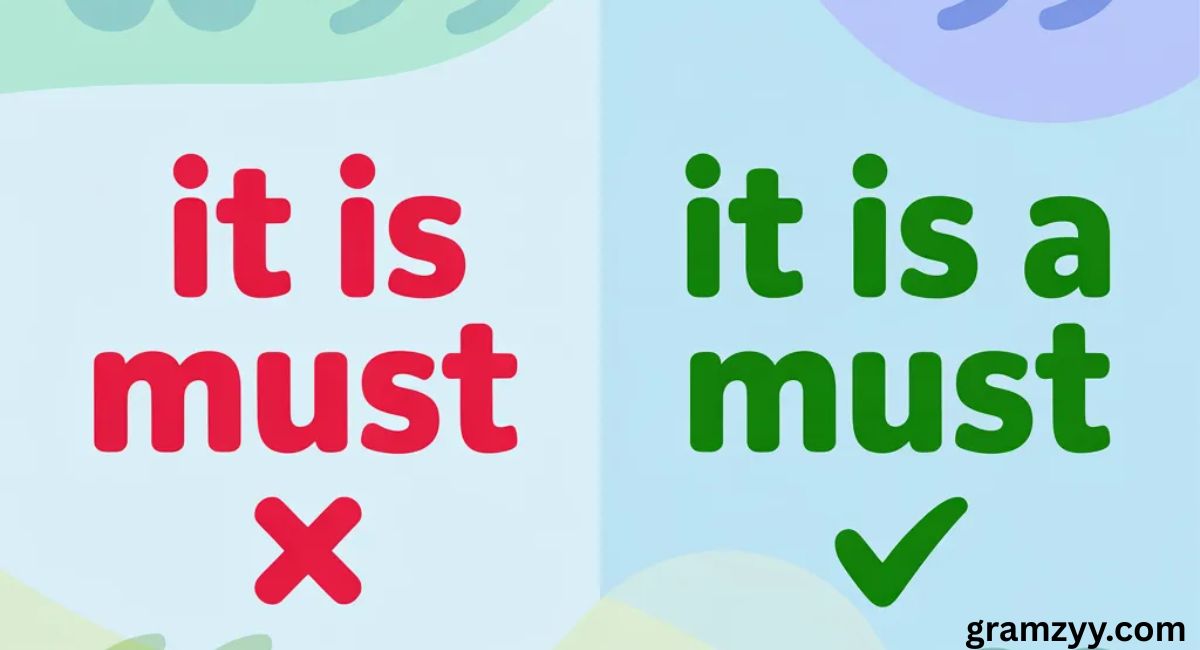
Quick answer: “It is a must” is grammatically correct. “It is must” is incorrect in standard English.
Let us break it all down — the meaning, the grammar rule, real examples, common mistakes, and how to remember the right form forever.
What Does “It Is a Must” Mean?
The phrase “it is a must” means something is absolutely essential, necessary, or cannot be skipped. It is a concise, natural way of saying that something deserves serious attention or priority.
Think of “a must” the same way you would think of “a requirement” or “a necessity.” You are naming the thing — calling it essential.
Examples of meaning in context:
- Sunscreen at the beach is a must. (= You should not skip it.)
- Learning grammar is a must for professional writing. (= It is essential.)
- This movie is a must for any film lover. (= Don’t miss it.)
The phrase can apply to objects, habits, experiences, and actions. It is versatile, expressive, and completely acceptable in both spoken and written English.
Also read : Playing Catch Up: Meaning, Usage, and Real-Life Examples
Why Is “It Is Must” Wrong?
This is where grammar comes in. To understand why “it is must” fails, you need to know the two roles the word must can play in a sentence.
Must as a Modal Verb
When “must” is used as a modal verb, it expresses obligation or necessity. Modal verbs never take an article before them.
- You must finish your homework.
- She must attend the meeting.
In these sentences, “must” is helping the main verb. No article is needed or allowed here.
Must as a Noun
Here is where things get interesting. “Must” can also function as a noun — meaning something that is required or essential. When a word functions as a singular countable noun in English, it needs an article like a, an, or the before it.
So when you say “it is a must,” the word “must” is functioning as a noun. It names the concept of something essential. Without the article “a,” the sentence is structurally incomplete — like saying “it is requirement” instead of “it is a requirement.”
In short: “It is must” drops the article that the noun form of “must” requires. That omission makes the sentence grammatically broken.
Comparison Table: It Is Must vs It Is a Must
| Feature | It Is Must | It Is a Must |
|---|---|---|
| Grammatically correct? | ❌ No | ✅ Yes |
| Article used? | No | Yes (“a”) |
| Role of “must” | Unclear / broken | Noun |
| Sounds natural to native speakers? | No | Yes |
| Used in formal writing? | No | Yes |
| Common among learners? | Yes | Yes |
“It Is a Must” in Real Sentences
Seeing the phrase in real, natural contexts helps the rule stick. Here are varied examples across different settings.
Correct Usage Examples
- Professional: “Proofreading your resume is a must before submitting any job application.”
- Travel: “Visiting the old city quarter is a must if you ever come to Lahore.”
- Health: “Staying hydrated during summer is a must, especially for children.”
- Education: “Understanding sentence structure is a must for strong academic writing.”
- Tech: “Backing up your data regularly is a must for every laptop user.”
- Cooking: “Fresh herbs are a must in this recipe — dried ones won’t do the trick.”
Notice the pattern: in every sentence, “a must” follows the verb “is” and functions like a noun phrase. You could replace it with “a necessity” and the sentence would still work perfectly.
Also read : What Is a City Slicker? Explained with Real Examples
Incorrect Usage Examples
| Incorrect ❌ | Correct ✅ |
|---|---|
| It is must that you attend. | It is a must that you attend. |
| Sunscreen is must in summer. | Sunscreen is a must in summer. |
| Patience is must for teachers. | Patience is a must for teachers. |
| This book is must for students. | This book is a must for students. |
| It is must to bring your ID. | It is a must to bring your ID. |
The incorrect versions all share one flaw: they drop the article “a” before the noun “must.” This makes each sentence sound unfinished and unnatural to any fluent English speaker.
Context Variations: When and Where to Use “It Is a Must”
The phrase adapts naturally across many contexts, but its tone can shift depending on where you use it.
Casual / Everyday Speech
In conversation and informal writing, “it is a must” feels natural and energetic. People use it to make quick, emphatic recommendations.
“If you’re in Rome, trying authentic pasta is a must!”
Professional / Business Writing
In workplace emails or reports, the phrase is acceptable but some editors prefer more precise alternatives like “essential,” “mandatory,” or “required.”
“Completing the compliance training by Friday is a must for all team members.”
Academic Writing
In academic papers, “it is a must” may feel too informal. It is better to replace it with “essential,” “necessary,” or “required.”
Instead of: Grammar accuracy is a must in academic writing. Prefer: Grammar accuracy is essential in academic writing.
Advertising and Marketing
In product copy and marketing, “a must” carries persuasive weight. It sounds bold and confident.
“This skincare kit is a must for every morning routine.”
Common Mistakes with “It Is Must” vs “It Is a Must”
Several patterns lead people to use the wrong form. Recognizing them helps you avoid repeating the error.
1. Direct translation from other languages Many languages — including Urdu, Hindi, Arabic, and others — do not use articles the way English does. Speakers often translate ideas directly and drop the “a” without realizing it.
2. Speaking too fast In fast speech, the article “a” can get swallowed. People hear the shortened version and assume that is how it is written too.
3. Confusing modal verb and noun uses Someone who knows “you must go” is correct may assume “it is must” follows the same logic. But the structures are completely different.
4. Social media and informal digital writing Poor grammar spreads fast online. Seeing “it is must” repeated across posts and comments makes it look normal — even when it is not.
Also read : Sorry for Bothering You vs Sorry to Bother You: Which Is Correct?
How Do You Remember the Right Form?
Here are a few practical memory tricks that actually work.
The Substitution Test
Replace “must” with “requirement”:
- “It is a requirement” ✅ — then “it is a must” ✅
- “It is requirement” ❌ — then “it is must” ❌
If the word “requirement” needs “a” before it, so does “must.”
Think Noun = Article
Ask yourself: Is “must” naming something here? If yes, it is a noun. Nouns need articles. Add “a.”
Say It Out Loud
Read both versions aloud. “It is must” will feel clipped and abrupt. “It is a must” flows naturally. Trust your ear.
Is “It Is a Must” Formal or Informal?
This is a fair question. The phrase sits comfortably in informal to semi-formal territory. It works well in:
- Everyday conversation
- Blog posts and articles
- Emails between colleagues
- Travel and lifestyle writing
- Product descriptions and marketing
It may feel too casual for:
- Academic research papers
- Legal documents
- Highly technical reports
In those contexts, swap it out for: essential, mandatory, required, necessary, indispensable, non-negotiable, or compulsory.
Synonyms for “It Is a Must”
When you want variety without losing the meaning, these alternatives work well:
| Synonym | Example |
|---|---|
| Essential | “Proofreading is essential before submission.” |
| Necessary | “A valid ID is necessary at the gate.” |
| Mandatory | “Safety training is mandatory for all staff.” |
| Compulsory | “Attendance is compulsory for all students.” |
| Non-negotiable | “Honesty is non-negotiable in this workplace.” |
| Indispensable | “A good dictionary is indispensable for writers.” |
| Required | “A signature is required on this form.” |
Conclusion
The difference between “it is must” vs “it is a must” comes down to one small word — the article “a” — but that one word makes all the difference in grammar, clarity, and credibility. When “must” acts as a noun, it follows the same rule as every other singular countable noun in English: it needs an article.
Use “it is a must” every time. It is the only grammatically correct form in standard English, recognized across both American and British usage. Whether you are writing a professional email, a travel blog, or a social media post, this simple rule will keep your writing sharp and natural.
And if you ever forget — just try replacing “must” with “requirement.” If that sentence needs “a,” yours does too.
FAQs
Is “it is must” ever acceptable in English?
No. “It is must” is grammatically incorrect in standard English. It is occasionally seen in informal regional speech but should be avoided in writing. (it is must vs it is a must)
Why do so many people say “it is must” incorrectly?
Most errors come from direct translation habits from languages that do not use articles, or from hearing fast, informal speech where the article gets dropped. (it is must vs it is a must)
Can I say “this is a must” instead of “it is a must”?
Yes, absolutely. “This is a must” is equally correct and often sounds more direct and emphatic.
Is “a must” formal or informal?
It is semi-formal. works well in everyday and professional writing but may be too casual for academic or legal documents. (it is must vs it is a must)
What is the plural form — can I say “these are musts”?
Yes, “musts” is the plural form of the noun. “These items are musts for your camping trip” is grammatically correct.
Can grammar tools catch the “it is must” error?
Yes. Tools like Grammarly and Microsoft Editor typically flag “it is must” as incorrect and suggest adding the article “a.”( it is must vs it is a must)
Is “must-have” the same as “a must”?
They are similar in meaning but used differently. “A must-have” is a compound noun or adjective. You can say “this is a must-have gadget” but not “it is must-have.”
What is the best alternative to “it is a must” in academic writing?
Use “it is essential,” “it is necessary,” or “it is required” — these carry the same weight with a more formal tone.(it is must vs it is a must)