Have you ever heard someone called a “city slicker” and wondered exactly what it means — or why it sounds slightly like an insult? You are not alone. This old American expression has been around for over a century, and it still pops up in conversation, fiction, and film today. Whether you want to use it correctly, understand it in context, or simply satisfy your curiosity, this guide has you covered.
What Does City Slicker Mean?
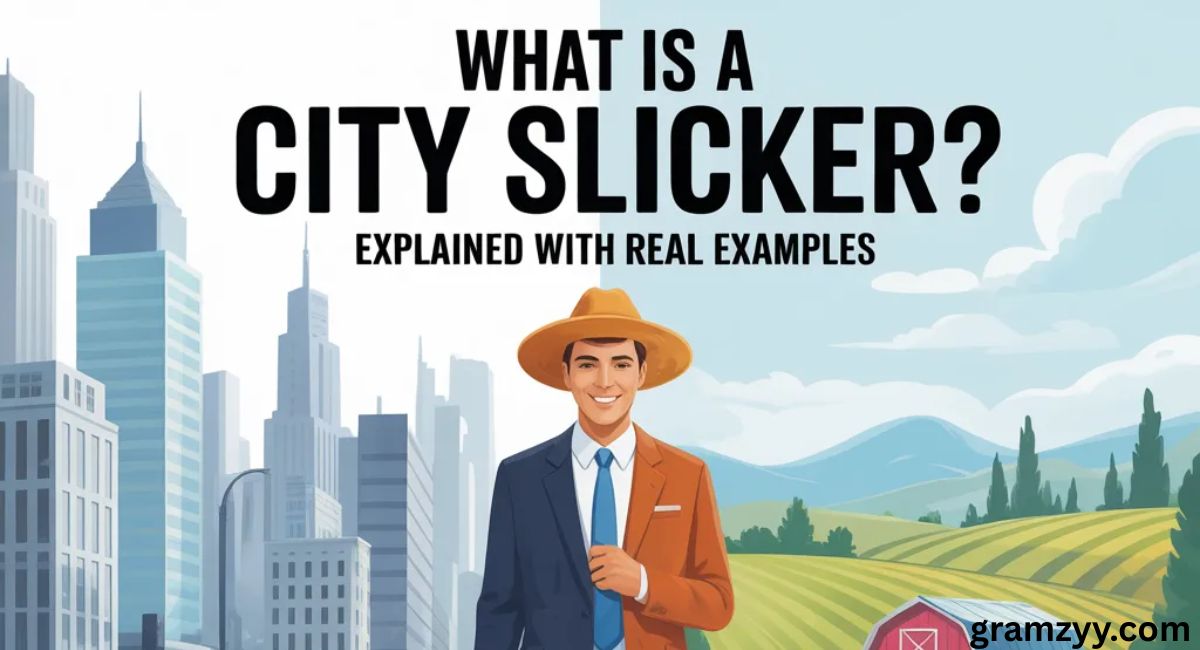
A city slicker is a person who has grown up in or spent most of their life in an urban environment, and who carries the polished, fast-paced habits that city life produces. The phrase typically implies that this person is sophisticated and street-smart within city limits — but noticeably out of place in a rural or country setting.
The term does more than just say “someone from the city.” It layers in a second meaning: the person may come across as overly smooth, clever, or even a little slippery in personality — hence the word slick. Depending on who uses it and how, that quality can sound like a compliment or a quiet put-down.
Quick Definition: A city slicker is an urban dweller who is polished, socially confident, and comfortable in fast-paced environments — but often unfamiliar with country life, manual labor, or rural self-sufficiency.
Where Did City Slicker Come From?
Origins and Etymology
The phrase belongs to American colloquial English. Its roots trace back to the late 19th century, when rapid industrialization created a visible gap between city dwellers and rural communities. As cities grew, so did the cultural friction between urban and country lifestyles.
The word slick carried the sense of being smooth, sharp, or cleverly persuasive — sometimes in a way that felt untrustworthy. Add city in front of it, and you get a label for someone who uses urban polish and fast talk rather than honest hard work. Rural communities, who often prized physical labor and self-reliance, used the phrase to express both suspicion and mild contempt toward city visitors.
Timeline of the Term
| Period | Development |
|---|---|
| Late 1800s | First mentions in American newspapers; urban-rural divide sharpens |
| ~1916 | Earliest documented use of “city slicker” as a phrase |
| 1918 | Silent film The City Slicker releases, featuring an urban dandy in a rural town |
| 1920s | Phrase gains wide popularity as an American colloquialism |
| 1991 | Comedy film City Slickers brings the term back into mainstream pop culture |
| Today | Still used in casual speech, fiction, and humor — often with affection or irony |
How This Usage Has Changed
When the phrase first appeared, it almost always carried negative connotations. Rural speakers used it to suggest that city people were smooth talkers who could not be fully trusted — clever with words, but short on grit.
Over time, the tone softened. By the mid-20th century, the phrase was more often used for light teasing than genuine criticism. Today, it can function in three distinct ways depending on context:
- Mildly derogatory — when a country person mocks an urbanite’s lack of practical skills
- Neutral or descriptive — when someone is simply being identified as urban and unfamiliar with rural life
- Playful or affectionate — when friends tease each other about lifestyle differences without real hostility
The broader cultural shift toward globalization has also blurred the line between urban and rural identities, which is why the phrase sounds a little dated to modern ears — and why that datedness can itself become part of its charm in storytelling.
Also read : As Evidenced By or As Evident By: Which Is Correct?
How Do Writers Use “City Slicker” in Practice?
Correct Usage Examples
These sentences show how the phrase is properly applied:
- “The rancher shook his head at the city slicker who had shown up in loafers to mend a fence.”
- “She was a born city slicker — happiest on a crowded subway platform, completely lost on a hiking trail.”
- “His expensive watch and tailored coat marked him as a city slicker the moment he stepped off the bus.”
- “The locals laughed when the city slicker tried to milk a cow for the first time.”
- “He called the new mayor a city slicker, implying the man had no idea what small-town life actually felt like.”
In each case, the phrase signals urban background + unfamiliarity with rural life, with a tone that ranges from amused to dismissive.
Incorrect Usage Examples
Here is where writers sometimes go wrong:
| Incorrect Use | Why It’s Wrong | Correct Approach |
|---|---|---|
| “She is a city slicker because she uses a smartphone.” | Smartphone use is universal, not urban-specific | Use only when the contrast with rural life is clear |
| “The city slicker loved hiking and camping every weekend.” | Contradicts the phrase’s core meaning | Use urban adventurer or simply describe the character |
| “He was such a city slicker at the tech conference.” | No rural-urban contrast present | Drop the phrase; it adds nothing here |
| “City slickers are all dishonest.” | Overstates the negative meaning as an absolute | The phrase implies perception, not proven fact |
The key rule: city slicker only works when the urban-rural contrast is present and relevant.
Context Variations
The same phrase lands differently depending on who is speaking and in what setting:
- Fiction and Western novels: The city slicker often plays the “fish out of water” character — an urbanite who stumbles into a rural world and must adapt or fail. This creates natural story tension.
- Political speech: The term sometimes appears in populist rhetoric, where rural identity is contrasted with a disconnected urban elite. Used this way, it can carry sharper political weight.
- Comedy: The phrase thrives in humor, especially in setups where an overdressed, over-confident urbanite meets the unglamorous reality of farm life.
- Casual conversation: Between friends, it is usually lighthearted — a way of teasing someone who does not know how to start a campfire or refuses to get their shoes muddy.
What Are the Common City Slicker Mistakes?
Even confident writers misuse this phrase. Here are the most frequent errors:
Mistake 1: Using It Without the Rural Contrast
The phrase needs a country/city tension to function. Without that contrast, the expression loses its meaning entirely.
Mistake 2: Treating It as Purely Negative
Modern usage is far more flexible. Calling someone a city slicker today can be fond or funny rather than hostile. Misreading the tone leads to writing that feels off.
Mistake 3: Applying It to Any Urban Person
The phrase implies a certain visible urbanism — polish, inexperience outdoors, reliance on modern conveniences. Not every person from a city fits that profile.
Mistake 4: Using It in Formal Writing
In academic papers, news articles, or professional reports, the phrase sounds too casual and loaded. Save it for dialogue, fiction, or informal commentary.
Also read : Oeuvre Meaning, Pronunciation, and How to Use It
Memory Tricks That Stick
Struggling to remember when to use city slicker correctly? Try these:
- The Mud Boots Test: If the person in your sentence would show up to a farm wearing the wrong shoes and not know why — that is your city slicker.
- The Slick Association: Remember that slick = smooth + clever + possibly untrustworthy. If all three elements fit your character, the phrase works.
- The Fish Out of Water Rule: City slicker is at its best when someone is clearly in the wrong environment. No wrong environment, no city slicker.
- The Tone Check: Before using the phrase, ask yourself — am I teasing, insulting, or simply describing? The answer shapes how the phrase reads to your audience.
City Slicker vs. Similar Terms
| Term | Meaning | Key Difference |
|---|---|---|
| City slicker | Polished urban dweller, often out of place rurally | Implies smooth personality + rural contrast |
| Yuppie | Young urban professional, career-focused | About ambition and class, not rural contrast |
| Urbanite | Neutral word for a city resident | No personality implication whatsoever |
| Metrosexual | Fashion-conscious urban man | Focuses on style and grooming only |
| Country bumpkin | Unsophisticated rural person | Opposite end of the same spectrum |
Conclusion
The phrase city slicker packs a surprising amount of meaning into two words. It conjures a specific type — polished, urban, confident in concrete and crowds, but noticeably out of step the moment the pavement ends. Born from the friction between American city and country life in the late 1800s, the term has traveled from genuine suspicion to gentle humor over the decades.
Use it when the context calls for that urban-rural contrast. Avoid it in formal writing or when the setting does not involve any country-versus-city dynamic. And when you hear it, pay attention to the tone — that word slick has always carried two sides, and the speaker usually knows which one they mean.
Read it : stereotype
FAQs
Is “city slicker” an insult?
It can be, but it is not always. The phrase ranges from playful teasing to genuine criticism depending on who uses it and in what context.
Where did the term city slicker originate?
It is an American expression that dates to around 1916, rooted in the cultural tension between rapidly growing cities and rural communities during the era of Western expansion.
Can a city slicker learn rural skills?
Absolutely. The label describes a starting point, not a fixed identity — many urban people adapt to country life with time and experience.
Is city slicker still commonly used today?
Less so than in past decades, but it still appears in casual conversation, humor, fiction, and political commentary, often with a nostalgic or ironic tone.
What is the opposite of a city slicker?
The most common opposite is a country bumpkin or hick — terms for someone from a rural area who is unfamiliar with city life and customs.
Can city slicker be used as a compliment?
Yes, in some contexts it implies sophistication, street smarts, and social polish — qualities that can be genuinely admired rather than criticized.
How is city slicker different from “urbanite”?
Urbanite is a neutral, descriptive term for any city resident. City slicker adds a layer of personality the smoothness, the confidence, and the implied gap between city knowledge and country know-how.