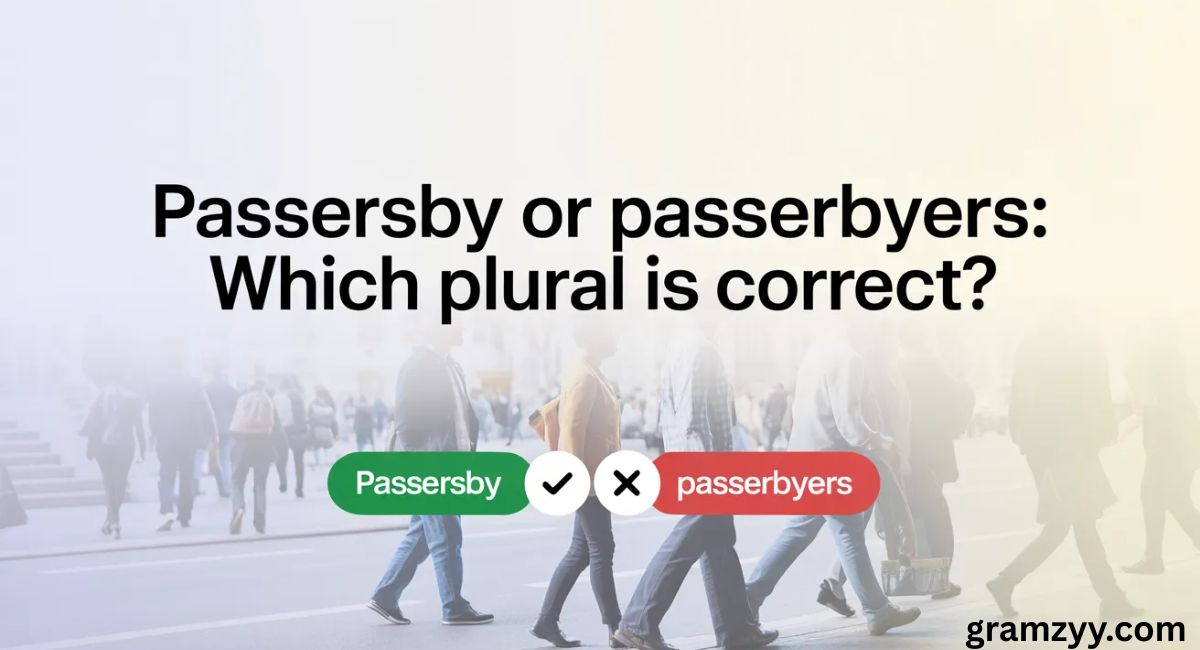
If you’ve ever typed the word passersby or passerbyers to wonder whether it looks right — you’re in good company. Native speakers, professional writers, and ESL learners all stumble over this word. Should it be passersby, passerbys, or passerbyers? The answer is definitive, and understanding why will help you never second-guess it again.
What Is the Correct Plural of Passerby?
The correct plural of passerby or passersby — and only passersby. Neither passerbys nor passerbyers exists as an accepted form in any major English dictionary, including Merriam-Webster, the Oxford English Dictionary, and Cambridge Dictionary.
When you refer to more than one person walking past a location, you write:
“Several passersby witnessed the accident.”
That’s it. Simple, but it feels strange to many people — and there’s a clear grammatical reason why.
Why Is “Passerbyers” Wrong?
Passerbyers is what linguists call hypercorrection — when someone over-applies a rule and ends up with something grammatically wrong.
Here’s the logic that leads people astray: passerby ends in -by, so they think of it like a verb phrase — someone who passes by — and try to make a person-word out of it: passer-by-er. Then they pluralize it: passerbyers. It feels logical, but it breaks the actual rules of English compound nouns.
Passerbyers is wrong for two reasons:
- By is a preposition, not a verb stem you can attach -er to.
- The word passerby is already a complete noun — adding -er is grammatically redundant.
No style guide, dictionary, or grammar authority recognizes passerbyers as correct. If you use it in formal or professional writing, it will mark you as unfamiliar with compound noun grammar.
Also read : “So Do I” vs “So Am I”: How to Choose the Right Form
How Do Compound Nouns Form Plurals?
To understand passersby, you need to understand the rule for compound noun pluralization.
In English, when a compound noun is made of a main noun + modifier or preposition, you pluralize the main noun (the head noun), not the whole word.
The Head Noun Rule
The head noun is the word that carries the core meaning of the compound. In passerby:
- Passer = the person (the noun, the head word)
- By = showing direction of movement (a preposition, not the head)
So when you make passerby plural, you pluralize passer → passers, giving you passersby.
This is called internal pluralization, and it follows a consistent pattern across English.
Compound Noun Plural Comparison Table
| Singular | Correct Plural | Incorrect Plural |
|---|---|---|
| passerby | passersby | ~~passerbys~~ / ~~passerbyers~~ |
| mother-in-law | mothers-in-law | ~~mother-in-laws~~ |
| attorney general | attorneys general | ~~attorney generals~~ |
| chief of staff | chiefs of staff | ~~chief of staffs~~ |
| editor-in-chief | editors-in-chief | ~~editor-in-chiefs~~ |
| passer-by (hyphenated) | passers-by | ~~passer-bys~~ |
The pattern is clear: the noun gets the plural marker; the modifier stays fixed.
As Grammarly’s grammar guide confirms, “because a mother-in-law is primarily a mother, this word is pluralized as mothers-in-law. Similarly, box office becomes box offices, passerby becomes passersby.”
Examples Using Passersby Correctly
Seeing the word used in real sentences is one of the best ways to lock it into your memory. Below are correct and incorrect usage examples across different writing contexts.
Correct Usage Examples
- News reporting: “Several passersby called 911 after witnessing the collision at the intersection.”
- Literary/narrative: “The busker smiled as passersby tossed coins into his open guitar case.”
- Legal writing: “Eyewitness accounts from three passersby were submitted as evidence.”
- Academic writing: “The study observed the behavior of passersby at a busy urban crosswalk.”
- Casual/conversational: “Passersby stopped to look at the street mural before hurrying on.”
Incorrect Usage Examples
| ❌ Incorrect | ✅ Correct |
|---|---|
| Several passerbyers saw the fire. | Several passersby saw the fire. |
| Two passerbys helped her up. | Two passersby helped her up. |
| A group of passerbyer stopped. | A group of passersby stopped. |
Context Variations
Hyphenated form: Passers-by (with a hyphen) is also acceptable, especially in British English and older texts. Both passersby and passers-by are correct — the unhyphenated form is now standard in American English.
Possessive form: When showing ownership by passersby, write passersby’s:
Common Plural Formation Mistakes
The confusion around passersby is part of a broader pattern of mistakes people make with compound noun plurals. Here are the most common errors — and how to fix them.
Mistake 1: Adding -s to the Last Word
Most English plurals follow the simple rule: add -s to the end. This works about 95% of the time (cats, boxes, cars). The problem is that compound nouns don’t always follow this pattern. Writers who default to this rule end up with passerbys or mother-in-laws — both wrong.
Fix: Identify the head noun first, then add -s to that word only.
Mistake 2: Treating Prepositions as Nouns
In passerby, by is a preposition. In mother-in-law, in-law is a prepositional phrase. Neither takes the plural marker. Only the noun does.
Mistake 3: Confusing Verb Phrases with Compound Nouns
Some people process passerby as a verb phrase (someone who passes by) and try to create a new noun (passer-by-er, then passerbyers). This ignores the fact that passerby is already an established compound noun with its own plural rule.
Mistake 4: Inconsistent Hyphen Use
Both passerby and passer-by are accepted spellings. The plurals are passersby and passers-by respectively. Mixing them (passer-bys, passerby’s as a plural) creates errors.
Also read : Playing Catch Up: Meaning, Usage, and Real-Life Examples
Memory Tricks for Compound Noun Plurals
Learning the rule once is helpful. Having a trick to remember it is better.
Trick 1: “Who Are They?”
Ask yourself: Who are these people, fundamentally? With passersby, they are passers (people who pass). With mothers-in-law, they are mothers. The noun that answers the “who” question is the one you pluralize.
Trick 2: The Mothers-in-Law Method
Most people already know that the plural of mother-in-law is mothers-in-law (not mother-in-laws). Apply the exact same logic to passerby: the noun comes first, so the noun gets the -s.
Mother-in-law → Mothers-in-law Passerby → Passersby
Same rule. Same pattern.
Trick 3: Break It Down
When in doubt, mentally separate the compound:
- passer + by
- passer → passers
- passers + by = passersby
This takes two seconds and gives you the correct answer every time.
Trick 4: Think of Bryan Garner’s Ratio
Language authority Bryan Garner, in Garner’s Modern English Usage, estimates the ratio of passersby to passerbys at 199 to 1. The correct form dominates overwhelmingly — so when in doubt, go with the crowd and use passersby.
Read it : engulfed
Quick Reference Summary
| Question | Answer |
|---|---|
| Correct plural of passerby | passersby |
| Is “passerbyers” correct? | No — never correct |
| Is “passerbys” correct? | No — never correct |
| Is “passers-by” correct? | Yes — acceptable alternative |
| Which English variety uses passers-by? | Mainly British English / older texts |
| What rule does this follow? | Head noun pluralization |
Conclusion
The plural of passersby or passerbyers — always. passersby or passerbyers are both incorrect and do not appear in any reputable dictionary or style guide. The word follows the head noun pluralization rule that applies across compound nouns: you pluralize passer (the noun), not by (the preposition).
Once you understand this rule, it stops feeling like an exception and starts feeling logical. The same pattern shows up in mothers-in-law, chiefs of staff, and editors-in-chief. In every case, the main noun takes the -s.
Use passersby in your writing with confidence. It’s the only form that holds up in formal, academic, professional, and casual contexts alike.
FAQs
Is “passerbyers” ever correct in any variety of English?
No. Passerbyers is not recognized in American, British, Australian, or any other variety of standard English — it is always incorrect. (passersby or passerbyers)
Can I use “passers-by” instead of “passersby”?
Yes. Both forms are grammatically correct; passersby is preferred in modern American English, while passers-by is common in British English and older texts.
What is the singular form of “passersby”?
The singular is passerby — one person walking past a place. Drop the -s from passers, and by remains unchanged.
Is “passerby” one word or two?
Passerby is written as one word (closed compound) in modern American English. The hyphenated form passer-by is also acceptable, particularly in British English.
What is the difference between a passerby and a bystander?
A passerby is someone who is actively moving past a location. A bystander is someone standing nearby and observing an event — not necessarily in motion.
Why does English pluralize compound nouns this way?
English pluralizes the head noun (the word carrying core meaning) in compound structures. Since passer is the noun and by is a preposition, only passer receives the plural marker -s.
How common is the mistake “passerbys”?
Quite common it appears roughly once for every 25 correct uses of passersby, according to usage data from Grammarist. Its frequency has grown slightly in informal writing, but it remains unaccepted in formal contexts. (passersby or passerbyers)