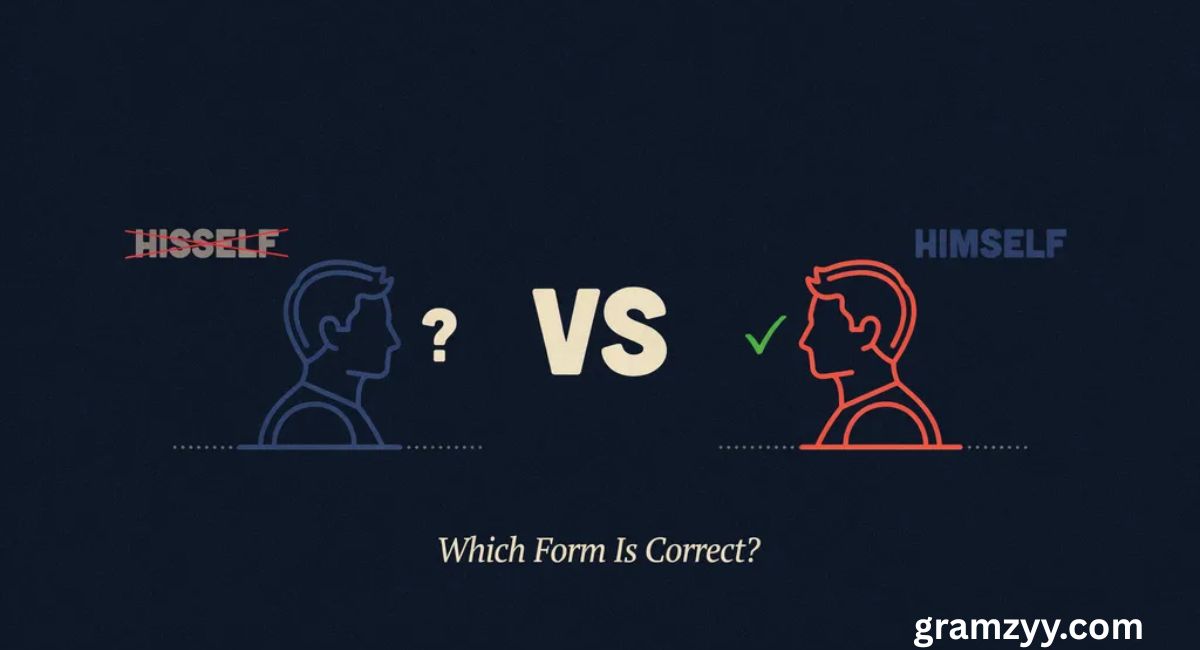
Hisself vs himself: If you’ve ever heard someone say “he did it all by hisself” and wondered whether that’s actually a real word, you’re not alone. This mix-up shows up in casual speech, regional dialects, and even in writing when people aren’t paying close attention. The short answer is that himself is the only grammatically correct form in standard English, while hisself is a nonstandard variant. But there’s more to the story than a simple rule — understanding why one form won out, and where the other still lingers, will help you use reflexive pronouns with confidence in any setting.
In this guide, we’ll break down what each word means, when (if ever) “hisself” is acceptable, and how to avoid mixing them up in your own writing.
What does “hisself” mean?
“Hisself” is a nonstandard reflexive pronoun built by combining the possessive pronoun his with self. It’s meant to function the same way “himself” does — pointing back to a male subject already mentioned in a sentence.
You’ll typically hear it in:
- Informal, spoken conversation
- Regional dialects, including Southern American English and Appalachian English
- Older or historical texts, where pronoun forms hadn’t yet standardized
Grammatically, though, “hisself” doesn’t fit the pattern that English reflexive pronouns follow. Every other reflexive pronoun in the language (himself, herself, myself, themselves) is built from an object pronoun plus “self” — not a possessive one. That mismatch is exactly why “hisself” is flagged as incorrect in modern grammar.
Is “hisself” correct in standard English?
No. “Hisself” is not accepted in standard, formal English. Major dictionaries classify it as dialectal or nonstandard, meaning it exists in everyday speech but has no place in professional, academic, or business writing.
Here’s why it breaks the rule:
| Pronoun type | Subject | Object | Reflexive form |
|---|---|---|---|
| Standard | he | him | himself |
| Nonstandard | he | his | hisself |
Reflexive pronouns are always built from the object form of a pronoun — “him,” not “his.” That’s why “himself” fits the pattern used by “myself,” “yourself,” “herself,” and “themselves,” while “hisself” breaks it.
That said, “hisself” isn’t meaningless slang — it has a long history. It likely emerged through folk etymology, when speakers assumed reflexive pronouns should follow the possessive pattern (his, mine, yours) rather than the objective one. Over time, “himself” became the standard while “hisself” survived mainly in spoken dialects.
When should you use “himself”?
Use “himself” any time you need a third-person singular masculine reflexive or emphatic pronoun. There are two main situations:
- Reflexive use — when the subject performs an action on himself.
- He taught himself how to cook.
- He hurt himself while hiking.
- Emphatic use — when “himself” adds emphasis to a noun or pronoun already in the sentence, rather than showing an action reflecting back.
- The manager himself approved the request.
- He himself admitted the mistake.
In both cases, “himself” refers back to a male subject that’s already been mentioned — a person, or sometimes an animal.
Examples of “hisself” and “himself”
Correct usage
- He introduced himself to the new team.
- The boy fixed his bike himself.
- She said the coach himself called the play.
- He looked at himself in the mirror before leaving.
Incorrect usage
- ~~He introduced hisself to the new team.~~
- ~~The boy fixed his bike hisself.~~
- ~~He did it all by hisself.~~
- ~~He blamed hisself for the mistake.~~
Context variations
| Context | Recommended form | Notes |
|---|---|---|
| Formal writing (essays, reports, emails) | himself | Only acceptable option |
| Academic or business communication | himself | “Hisself” reads as a grammar error |
| Everyday spoken conversation | himself (preferred) | “Hisself” may appear in casual regional speech |
| Fiction dialogue or character voice | either | “Hisself” can capture dialect or personality |
| Song lyrics, folk speech, historical quotes | either | Reflects authentic regional or period speech |
Common mistakes with “hisself” and “himself”
Even confident writers slip up occasionally. Watch out for these:
- Using “hisself” out of habit. Many people pick it up from hearing it in conversation and don’t realize it’s nonstandard.
- Assuming spellcheck will catch it. Some basic text editors don’t flag “hisself” as an error, which can create a false sense of security.
- Writing dialect speech outside of dialogue. “Hisself” can work for a fictional character’s voice, but it shouldn’t appear in your narration, descriptions, or non-fiction writing.
- Confusing “himself” with “him self” (two words). “Himself” is always one word — never separate it, and never write “hisself” thinking it’s simply a casual spelling of the same thing.
- Forgetting that possessive pronouns don’t form reflexives. “His” plus “self” feels logical, but English reflexive pronouns are built from object pronouns, not possessive ones.
How do you remember the difference?
A few simple tricks can help the correct form stick:
- Match the pattern. Line up “myself,” “yourself,” “herself,” and “themselves” — all are built from object pronouns (me, you, her, them). “Himself” follows that same pattern; “hisself” doesn’t.
- Think of the mirror rule. Reflexive pronouns “reflect” the action back onto the subject. A clean, standard reflection is “himself.” A distorted one is “hisself.”
- Ask: would I say “herself” as “hersself”? You wouldn’t, because “her” already functions as an object pronoun. That same logic rules out “hisself.”
- When in doubt, default to “himself.” It’s correct in every context — spoken, written, formal, and informal — so it’s always the safer choice.
Conclusion
Hisself vs himself: The rule here is straightforward: himself is correct, and hisself is not — at least not in standard English. “Hisself” survives as a piece of regional and historical dialect, and it can be a useful tool for writing authentic dialogue, but it has no place in formal writing, professional communication, or academic work. Once you understand that reflexive pronouns are built from object pronouns rather than possessive ones, the difference becomes easy to remember and even easier to apply correctly every time you write.
FAQs
Is “hisself” a real word?
It appears in some dictionaries as a dialectal or nonstandard variant, but it is not part of standard English grammar. (hisself vs himself)
Can I ever use “hisself” in writing?
Only in fiction dialogue or quoted speech meant to reflect a specific dialect or character voice — never in formal or professional writing.
Why do people say “hisself” instead of “himself”?
It likely comes from folk etymology, where speakers assumed reflexive pronouns should follow the possessive pattern, plus regional dialect habits passed down through speech.
Is “hisself” used in British or American English?
Neither considers it standard, though it appears occasionally in some U.S. Southern and Appalachian dialects, as well as older regional British speech. (hisself vs himself)
What’s the easiest way to remember which one to use?
Compare it to “herself” — you wouldn’t say “hersself,” so the same logic rules out “hisself.” Always default to “himself.” (hisself vs himself)