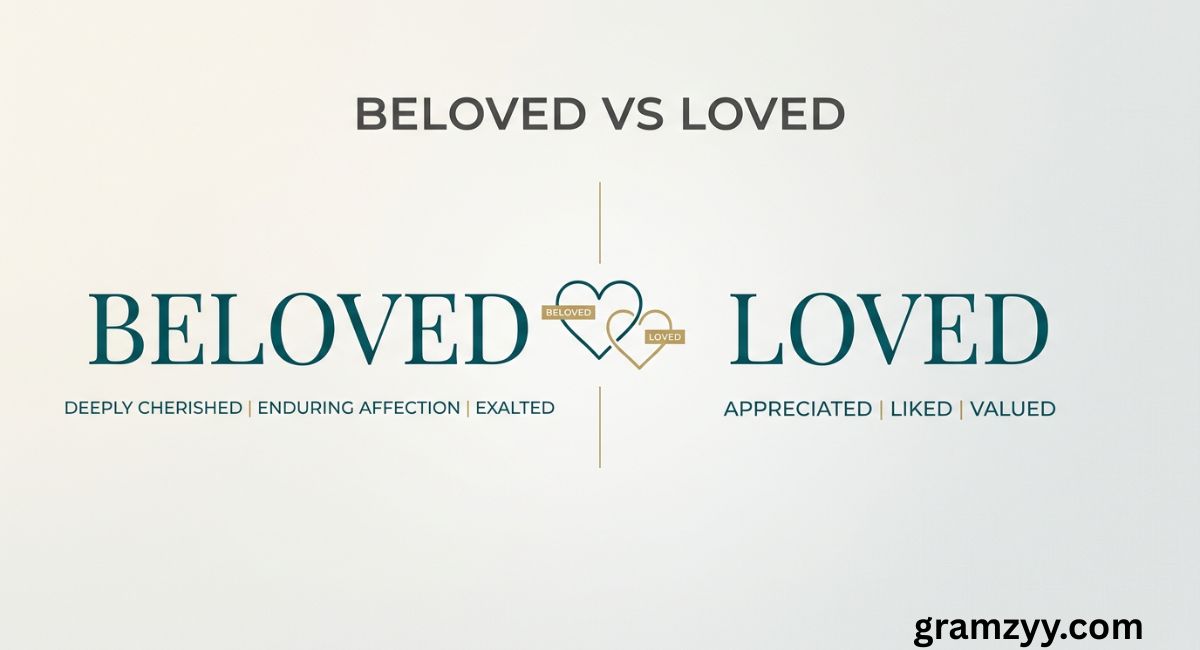
Choosing between “Beloved vs Loved” seems simple until you sit down to write a wedding toast, a eulogy, or even a casual text message. Both words express affection, but they don’t carry the same emotional weight, and using the wrong one can make your writing feel either overly dramatic or strangely flat.
This guide breaks down exactly when to use each word, backed by grammar rules, real examples, and practical editing tips so you never second-guess yourself again.
Quick Comparison
| Feature | Beloved | Loved |
|---|---|---|
| Part of speech | Adjective, sometimes noun | Verb (past tense), past participle, adjective |
| Emotional tone | Deep, reverent, formal | Warm, everyday, flexible |
| Typical use | Poetry, tributes, ceremonies | Conversation, casual writing, general statements |
| Placement | Usually before a noun (“my beloved sister”) | Usually after a verb (“she was loved”) |
| Frequency | Less common, reserved for special contexts | Very common in daily English |
Contextual Examples
Seeing both words in real sentences makes the difference click faster than any definition can.
- My beloved grandmother taught me how to bake bread.
- He loved spending weekends at the lake.
- The community mourned its beloved teacher.
- They loved each other for over fifty years.
- She is remembered as a beloved friend to everyone she met.
Notice how “beloved” tends to sit directly in front of a noun, almost like a badge of honor, while “loved” usually follows a subject and verb structure to describe an action or state.
Beloved vs Loved:
“Beloved” signals that someone or something holds a permanent, treasured place in your life or a community’s memory. “Loved” simply states that affection existed or exists, without implying the same lasting reverence.
Common Mistakes
Even confident writers slip up with these two words. Here are the errors that show up most often:
- Using “loved” before a noun. “My loved friend” sounds unnatural. Native speakers say “my beloved friend” or “my dear friend” instead.
- Overusing “beloved” in casual writing. Saying “I have a beloved sandwich” for lunch feels exaggerated and out of place.
- Forgetting subject-verb agreement. “She were loved” is incorrect; it should be “she was loved.”
- Treating “beloved” as a verb. Beloved cannot function as an action word. You can’t say “I beloved him”; you can only say “I loved him.”
- Missing tone cues in formal writing. Choosing “loved” in a eulogy or dedication can undersell the emotional weight the moment calls for.
Beloved vs Loved:
Most mistakes happen when writers swap the words without considering placement or formality. Beloved works as a standalone adjective before a noun; loved needs a helping verb or clear grammatical role to sound correct.
American vs British English Differences
Grammatically, both words behave the same way in American and British English. The real difference lies in frequency and stylistic preference.
- American English tends to favor “loved” in everyday speech and writing, even in moderately formal contexts.
- British English leans slightly more toward “beloved” in literary, journalistic, and obituary writing.
- Neither usage is a hard rule; it’s a stylistic tendency shaped by publishing conventions and cultural tone.
Beloved vs Loved:
British publications may describe a public figure as “the beloved author” more readily than American outlets, which often default to simpler phrasing like “the much-loved author.” Both are correct; the choice reflects house style more than grammar.
Idiomatic Expressions
Certain phrases have become fixed in English, and swapping the words in these idioms would sound off to a native speaker.
- “Dearly beloved” — a traditional opening line in wedding ceremonies and eulogies.
- “Beloved by all” — used to describe someone universally admired.
- “Loved and lost” — a common phrase about relationships or experiences that ended.
- “Well-loved” — describes something worn from frequent, affectionate use, like a well-loved book.
- “Loved ones” — a standard term for family and close friends, never replaced with “beloved ones.”
These set phrases don’t follow flexible rules; they’re memorized chunks of language, so it’s worth learning them as-is rather than trying to reconstruct the logic behind each one.
Practical Tips
Use this simple checklist before you commit to either word:
- Ask about permanence. If the affection is lasting and significant, lean toward beloved.
- Check the placement. If the word sits before a noun, beloved almost always fits better.
- Consider the setting. Formal speeches, eulogies, and literary writing favor beloved; casual conversation favors loved.
- Read it aloud. If it sounds like something you’d say to a close friend over coffee, use loved. If it sounds like something read at a memorial, use beloved.
- Don’t force elevation. Reserve beloved for moments that genuinely call for gravity, not for routine statements.
Revision and Grammar Checks
Before finalizing your writing, run through this quick editing pass:
- Search for every instance of “loved” placed directly before a noun and confirm it doesn’t sound forced.
- Confirm subject-verb agreement wherever “loved” appears as part of a passive construction (is loved, was loved, has been loved).
- Check that “beloved” isn’t accidentally used as a verb anywhere in your draft.
- Match the overall tone of your piece; a document heavy with formal language but only using “loved” may feel inconsistent.
- Read the piece aloud one final time to catch anything that feels grammatically correct but emotionally mismatched.
Grammar checking tools can catch spelling and basic syntax errors, but tone and word choice still require a human ear, especially with emotionally loaded words like these.
Conclusion
“Beloved vs Loved” both express affection, but they aren’t interchangeable. Loved is the workhorse of everyday English, describing affection in a simple, flexible way. Beloved is reserved for moments that call for reverence, permanence, and emotional weight, whether that’s a wedding, a eulogy, or a heartfelt tribute. Once you internalize the placement rules and tone differences, choosing between them becomes instinctive rather than a guessing game.
FAQs
Is “beloved” a stronger word than “loved”?
Yes. Beloved conveys deeper, more lasting affection, while loved is broader and can describe temporary or casual feelings.
Can “beloved” be used as a noun?
Yes, as in “he waited for his beloved,” meaning the person he loves.
Is it grammatically correct to say “my loved friend”?
No. The correct phrasing is “my beloved friend” or “my dear friend,” since “loved” doesn’t naturally precede a noun.
Do British and American English use these words differently?
The grammar is identical, but British English uses “beloved” slightly more often in formal and literary contexts.
What’s the difference between “loved” and “love” as a noun?
“Loved” is a verb form describing an action or state, while “love” as a noun refers to the emotion itself.
Can “beloved” ever sound too formal?
Yes. Using it in casual, everyday contexts can come across as exaggerated or overly dramatic.