Eaten vs Ate: If you’ve ever paused mid-sentence wondering whether to say “I ate” or “I have eaten,” you’re not alone. This tiny grammar decision trips up native speakers and English learners alike, and it happens more often than most people admit — in emails, essays, and everyday conversation.
The good news: the rule behind eaten vs ate is simple once it clicks. This guide breaks down the meaning, grammar, and real-world usage of both words so you never have to second-guess yourself again.
Why This Pair Confuses So Many
Both words come from the same irregular verb, eat, which is exactly why they get tangled up. Unlike regular verbs that simply add “-ed” to form the past tense, eat changes shape entirely — and it changes shape twice. That means there’s no “eated” to fall back on, and English learners can’t rely on the usual pattern-matching trick.
On top of that, both forms describe something that already happened, so the confusion isn’t about meaning — it’s about structure. Once you separate the grammar from the meaning, the fog clears fast.
Understanding The Core Concepts Of Eaten vs Ate
Definitions And Meanings
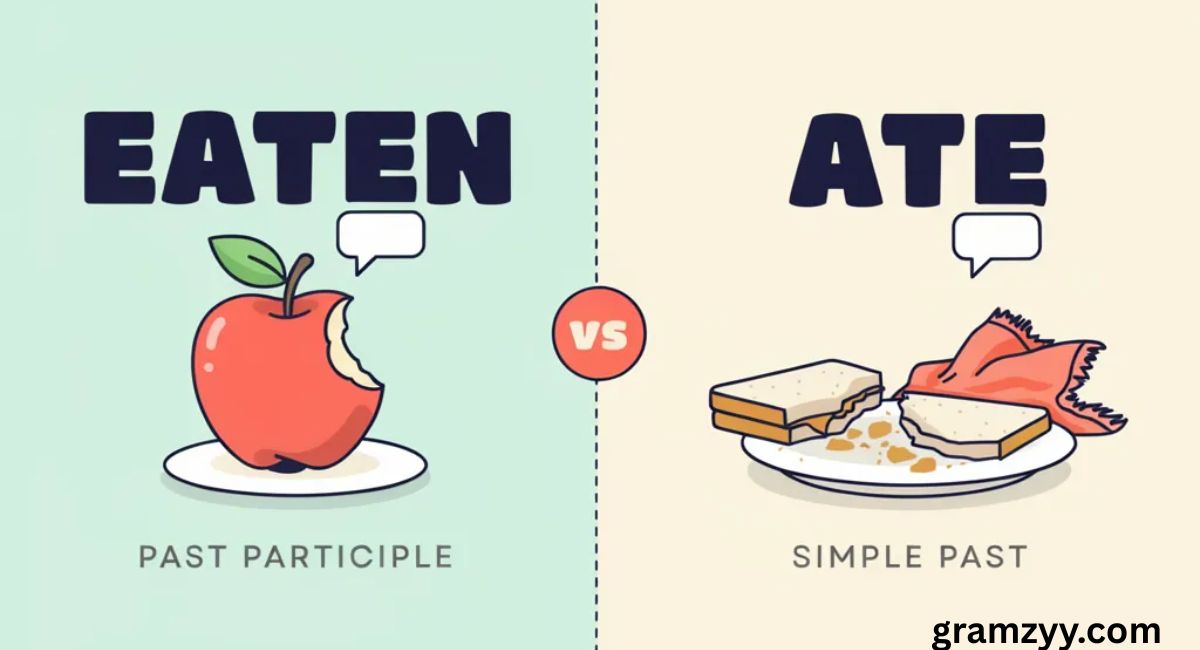
Ate is the simple past tense of eat. It describes a single, completed action that happened at a specific point in the past, and it stands on its own in a sentence.
- I ate breakfast at seven this morning.
- She ate the last slice of pizza.
Eaten is the past participle of eat. It never stands alone — it always needs a helping verb (also called an auxiliary verb) such as have, has, had, or will have. It’s used to build perfect tenses and passive voice constructions.
- I have eaten breakfast already.
- The cake was eaten before the party even started.
Etymology And Evolution
The verb eat traces back to the Old English word etan, part of a much older Germanic language family. Many high-frequency verbs in English kept two separate past forms instead of merging into one — a simple past form and a distinct participle form — and eat is one of them.
Over centuries, this pattern settled into the rule we use today: the simple past marks a finished action in time, while the participle pairs with a helper to show how that action connects to another moment, whether past, present, or future. This structure survived because it lets speakers be precise about when something happened relative to something else.
Grammatical Function And Mechanics
Here’s the quickest way to tell them apart:
| Feature | Ate | Eaten |
|---|---|---|
| Verb form | Simple past tense | Past participle |
| Needs a helping verb? | No | Yes (have/has/had/will have) |
| Used in | Simple past sentences | Perfect tenses, passive voice |
| Example | I ate lunch. | I have eaten lunch. |
| Stands alone? | Yes | Never |
A simple test: if you can naturally insert have, has, or had before the verb, you need eaten. If the sentence already sounds complete without a helper, you need ate.
Contextual Examples
Standard Usage Of Eaten vs Ate
Use ate when the sentence names or implies a specific, finished moment in time:
- We ate dinner at six o’clock.
- He ate an entire pizza last night.
- They ate sushi yesterday afternoon.
Use eaten whenever a helping verb is present:
- She has eaten here before.
- We had already eaten when they arrived.
- By noon, I will have eaten three meals.
Alternative Usage Or Nuance
The choice between the two isn’t only about time — it’s also about relevance. Ate simply reports an event. Eaten (in the present perfect) links that event to the present moment.
- I ate sushi in Tokyo. (a specific trip, a closed chapter)
- I have eaten sushi before. (general experience, still relevant now)
This is why “Have you eaten?” sounds natural as a present-moment question, while “Did you eat?” points at a specific occasion.
Passive And Participial Forms
Eaten also functions as an adjective-like participle in passive voice, where the subject receives the action instead of performing it:
- The sandwich was eaten within minutes.
- All the snacks have been eaten.
Ate never appears in passive constructions — that job belongs entirely to eaten.
Professional And Everyday Contexts
In workplace writing — reports, emails, minutes — eaten shows up in perfect-tense summaries: “The team had eaten before the meeting, so the discussion stayed focused.” In casual speech, ate dominates because people usually talk about specific moments: “I ate on the way here.”
Literary Usage And Cultural Impact
Examples In Literature
Writers use the two forms deliberately to control pacing and time. A simple past verb like ate moves a scene forward in a straightforward, linear way, dropping the reader directly into a single moment. A participle construction with eaten, on the other hand, lets an author fold time back on itself — hinting at something that happened earlier and still matters to the current scene. This layering is one reason perfect tenses appear so often in reflective or suspenseful narration, where what a character has or had done shapes what happens next.
Why We Struggle With Eaten vs Ate
Three habits cause most of the trouble:
- Helper omission — In fast, casual speech, people drop helping verbs and default to ate, even in spots where eaten is technically correct.
- Overgeneralization — Learners apply regular-verb logic (walk/walked/walked) to an irregular verb, assuming one past form should cover every situation.
- Sound familiarity — “I have ate” simply sounds fine to a lot of speakers because ate is used so much more often in daily conversation.
Synonyms, Antonyms, And Related Concepts
Close Synonyms And Distinctions
| Word/Phrase | Type | Notes |
|---|---|---|
| Consumed | Synonym (formal) | Works in both simple past and participle contexts |
| Devoured | Synonym (informal, intense) | Suggests eating quickly or eagerly |
| Dined | Synonym (formal) | Implies a sit-down meal |
| Fasted | Antonym | Refers to abstaining from food |
| Starved | Related, contrastive | Implies lack of food rather than consumption |
Regional Differences (US vs. UK)
Here’s some reassuring news: this is one grammar rule that doesn’t split along regional lines. Both American and British English follow the exact same pattern — ate for simple past, eaten for the participle. Style guides on both sides of the Atlantic agree, so there’s no need to adjust your usage based on audience location.
Common Mistakes And Corrections
Breakdown
| Incorrect | Correct | Why |
|---|---|---|
| I have ate breakfast. | I have eaten breakfast. | Perfect tense needs the participle. |
| She had ate before we arrived. | She had eaten before we arrived. | Past perfect requires “had eaten.” |
| The food was ate quickly. | The food was eaten quickly. | Passive voice requires “eaten.” |
| Did you eaten yet? | Did you eat yet? / Have you eaten yet? | “Did” already marks past tense; don’t pair it with a participle. |
| I eaten dinner already. | I have eaten dinner already. | Eaten can never stand alone without a helper. |
Practical Tips And Field Notes
The Editor’s Field Note
After years of marking up student papers and professional drafts, one pattern shows up again and again: writers who know the rule still slip into “have ate” when typing quickly, since it mirrors how the phrase sounds in casual speech. The fix is rarely a grammar lecture — it’s a quick find-and-replace habit. Scan your draft for “have ate,” “has ate,” and “had ate,” and swap them out. This trains the correct pattern into muscle memory faster than memorizing rules ever will.
Mnemonics And Memory Aids
- H-E Rule: Have → Eaten. Both start with a vowel-adjacent sound cue — pair them mentally.
- The Helper Test: If you can logically place have, has, or had in front of the verb, choose eaten. If not, choose ate.
- Stands Alone vs. Needs Help: Ate stands alone. Eaten always needs help.
Quick Editing Checklist
Before you hit publish or send, run through this list:
- [ ] Does the sentence contain a helping verb (have/has/had/will have)? → Use eaten.
- [ ] Does the sentence describe one specific, finished past moment with no helper? → Use ate.
- [ ] Is the sentence in passive voice (“was ___ by”)? → Use eaten.
- [ ] Did you accidentally pair “did” with “eaten”? → Fix it; use “eat” or “eaten” correctly, not both.
- [ ] Search your document for “have ate,” “has ate,” or “had ate” and correct every instance.
Conclusion
The difference between eaten and ate comes down to one question: is there a helping verb in the sentence? If yes, reach for eaten. If no, ate is your answer. Once you internalize this single test, the confusion disappears — and your writing and speech both gain a level of precision that readers and listeners notice, even if they can’t always explain why.
FAQs
Is “I have ate” grammatically correct?
No. The correct form is “I have eaten,” since perfect tenses always require the past participle, not the simple past.
Can “eaten” ever stand alone in a sentence?
No. Eaten always needs a helping verb such as have, has, had, or will have to function correctly.
When should I use “ate” instead of “eaten”?
Use ate when describing a single, finished action at a specific past time, with no helping verb involved.
Does British English use these words differently than American English?
No. Both American and British English follow the identical rule: ate for simple past, eaten for the past participle.
What’s a quick way to remember the difference?
If you can place “have,” “has,” or “had” before the verb, use eaten. Otherwise, use ate.
Is “eaten” used in passive voice?
Yes. Passive constructions like “The food was eaten quickly” always use eaten, never ate.