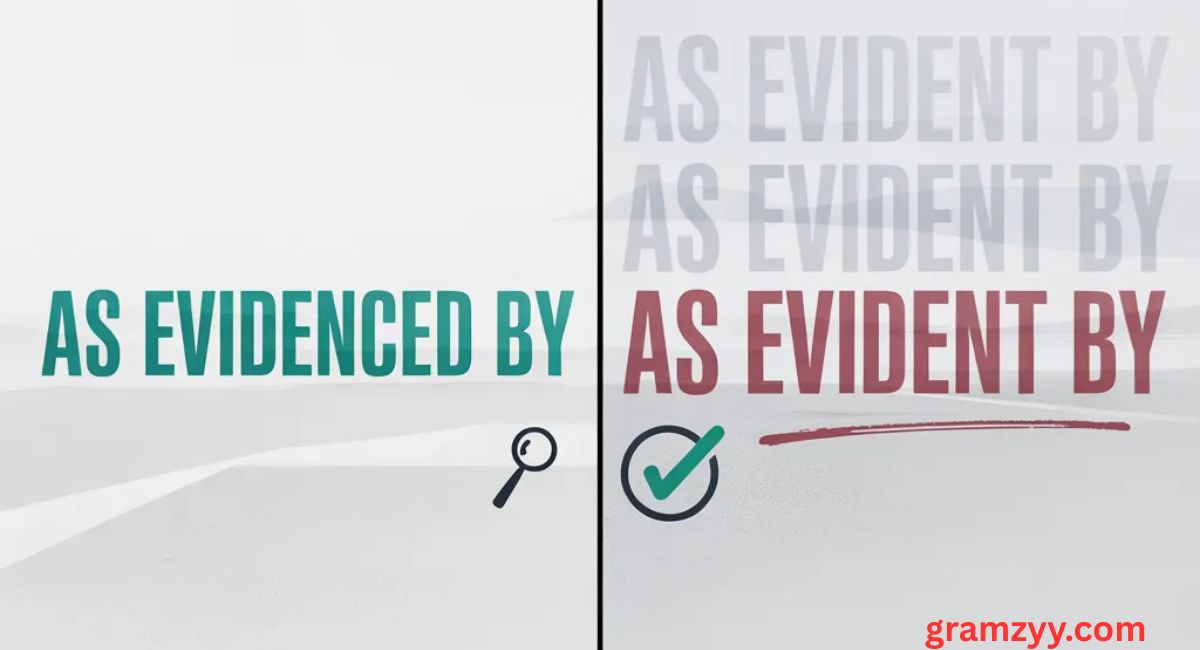
As evidenced by or as evident by is the grammatically correct phrase. “As evident by” is incorrect and should be avoided in all formal, academic, and professional writing. The difference comes down to one key rule: “by” requires a verb, and evidenced is a verb — while evident is only an adjective.
If you’ve ever typed “as evident by” and then paused to wonder whether that actually looks right — your instincts were good. This is one of the most common grammar mix-ups in formal English writing, and it trips up native and non-native speakers alike. The two phrases look nearly identical, but only one of them holds up under grammatical scrutiny.
In this guide, you’ll get a clear, no-nonsense explanation of why one is correct and one isn’t, along with real examples across different writing contexts and a memory trick that will make sure you never confuse them again.
The Real Difference Between “As Evidenced By” and “As Evident By”
At first glance, these two phrases seem interchangeable. Both are used to point to proof or support a claim. But grammatically, they are not the same — and the distinction matters a great deal in formal or academic writing.
| Phrase | Grammatically Correct? | Word Type | Used In |
|---|---|---|---|
| As evidenced by | ✓ Yes | Past participle (verb) | Academic, legal, professional writing |
| As evident by | ✗ No | Adjective | Should not be used |
| As is evident from | ✓ Yes | Adjective (with “is” + “from”) | Formal writing (alternative form) |
The core issue is that the preposition by must follow a verb — specifically a past participle — to form a grammatically complete clause. “Evidenced” is a past participle derived from the verb to evidence, meaning “to demonstrate” or “to prove.” “Evident,” on the other hand, is a pure adjective meaning “clear” or “obvious.” Adjectives don’t pair with by — they need a linking verb and a different preposition to work correctly.
Grammar Breakdown: Why “As Evidenced By” Works
To really understand why this phrase is correct, it helps to look at each component individually.
As
Introduces a comparison or subordinate clause — meaning “in the way that” or “just as.”
Evidenced
Past participle of the verb to evidence. It functions in passive voice: “is evidenced” → shortened to “evidenced.” It means “shown,” “proven,” or “demonstrated.”
By
A preposition that connects the passive verb to the source or agent — what is doing the proving.
So when you write “as evidenced by the data,” you are literally saying “as shown by the data” or “as demonstrated by the data.” The passive structure is entirely natural in formal English and is used widely in academic papers, legal documents, and research reports.
The phrase “as evident by” breaks down precisely at the preposition. The adjective evident does not accept by. In standard English, if you want to use this adjective, the correct construction is “as is evident from” — where is serves as the linking verb and from replaces by.
Also read : Oeuvre Meaning, Pronunciation, and How to Use It
Why Do People Say “As Evident By”?
This is a fair question. If the phrase is wrong, why does it appear so often — even in published writing?
There are a few reasons this mistake is so persistent:
- Familiarity of the adjective: “Evident” is a common, everyday word. Writers default to familiar vocabulary without checking whether it fits the grammatical structure.
- Sound similarity: “Evidenced” and “evident” sound almost identical when spoken quickly, especially in informal speech. The -ed ending often gets swallowed in conversation.
- Cognitive shortcuts: Under time pressure — drafting emails, writing reports — people instinctively reach for shorter, simpler forms. “Evident” feels lighter than “evidenced.”
- False analogy: Writers may subconsciously model the phrase on constructions like “as shown by” and assume any related word can substitute the same way.
- No immediate correction: Unlike a clear spelling error, spell-checkers often won’t flag “as evident by” — it looks like real English, even when it isn’t grammatically complete.
The bottom line: the error sounds plausible, which is exactly what makes it so easy to miss. But in professional or academic contexts, it can undermine the credibility of your writing.
Correct and Incorrect Usage Examples
Correct Usage
Here are examples of “as evidenced by” used correctly across different writing contexts:
✅ Academic
The treatment was effective, as evidenced by the reduction in patient symptoms over six weeks.
✅ Business
Customer satisfaction has improved significantly, as evidenced by a 22-point rise in our Net Promoter Score.
✅ Legal
The defendant had prior knowledge of the risk, as evidenced by internal communications from March 2024.
✅ Journalism
Public interest in the topic is growing, as evidenced by a threefold increase in search volume over the past year.
Incorrect Usage
Here are the same sentences written incorrectly — showing the mistake in practice:
❌ Wrong
The treatment was effective, as evident by the reduction in patient symptoms over six weeks.
❌ Wrong
Customer satisfaction has improved significantly, as evident by a 22-point rise in our Net Promoter Score.
❌ Wrong
The defendant had prior knowledge of the risk, as evident by internal communications from March 2024.
❌ Wrong
Public interest in the topic is growing, as evident by a threefold increase in search volume over the past year.
Also read : Receiver vs Reciever: Which Spelling Is Correct?
Context Variations
One useful thing to know is that “as evidenced by” fits comfortably across a wide range of writing registers — you don’t need to avoid it outside formal contexts. Below is how it adapts across different writing environments:
| Context | Example Sentence |
|---|---|
| Research Paper | The intervention produced measurable results, as evidenced by post-test scores. |
| Business Report | Revenue growth continued in Q3, as evidenced by the attached financial summary. |
| Professional Email | The project is on track, as evidenced by the milestones completed this month. |
| News Article | Voter turnout was high, as evidenced by record early-voting numbers in all five districts. |
| Casual Writing | He’s clearly a film fan, as evidenced by his wall of Blu-ray discs. |
Notice that even in casual writing, “as evidenced by” sounds natural and clear. It never feels out of place — it simply signals that what follows is proof of what came before.
Common Mistakes with “As Evidenced By”
Beyond the “evident vs. evidenced” confusion, there are a few other errors writers make with this phrase:
| Mistake | Wrong Version | Correct Version | Why It Matters |
|---|---|---|---|
| Using “evident” instead of “evidenced” | as evident by the results | as evidenced by the results | Adjective cannot follow “by” here |
| Using “from” with “evidenced” | as evidenced from the data | as evidenced by the data | “Evidenced” requires “by,” not “from” |
| Using “evident” with “by” instead of “from” | as is evident by the report | as is evident from the report | The adjective form needs “from” |
| Dropping the subject when using “evident” | as evident from… | as is evident from… | The linking verb “is” cannot be omitted |
The simplest rule to follow: if you’re using “by,” always write “as evidenced by.” If you want to use “evident,” rewrite the phrase entirely as “as is evident from.”
Alternatives to “As Evidenced By”
If you want to vary your writing and avoid repeating the same phrase, here are precise alternatives that carry the same meaning:
Synonymous Phrases:
- As shown by — the simplest and most widely understood substitute
- As demonstrated by — slightly more formal; good for research contexts
- As indicated by — useful when pointing to signs rather than hard proof
- As illustrated by — works well when using examples or case studies
- As confirmed by — appropriate when a second source validates the claim
- As is evident from — the correct adjective-based alternative
🔁
Quick test: Before using either phrase, substitute it with “as shown by.” If the sentence still reads correctly and means the same thing, then “as evidenced by” is the right choice — and you’ve confirmed the grammar works.
Also read : A CHIP OFF THE OLD BLOCK Definition & Meaning
Memory Tricks to Remember the Correct Form
Grammar rules stick better when you attach them to a memorable cue. Here are a few that work reliably:
- Think of the verb test: Ask yourself — “Can ‘by’ follow this word?” Only verbs can come before “by” in this structure. “Evidenced” is a verb. “Evident” is not. Simple.
- Replace with “shown”: Try swapping the phrase with “as shown by.” If it fits, your original sentence needs “evidenced,” not “evident.”
- The -ed ending is your signal: The past participle ending in “-ed” is what you need here. If you can say “it was evidenced,” you can say “as evidenced by.” You can’t say “it was evident by.”
- Pair adjectives with “from”: Remember this as a fixed rule: if you use evident (adjective), you must use from — “as is evident from.” If you use “by,” you must use evidenced (verb).
- The longer one is correct: Between “evident” and “evidenced,” the longer word with the -ed ending is the one that belongs in this phrase. A small but reliable cue.
FAQs
Is “as evident by” ever acceptable in informal writing?
No — it is grammatically incorrect in all registers, formal or informal. “As evidenced by” is always the right choice when “by” is used.
Can I say “as is evident from” instead?
Yes. “As is evident from” is grammatically correct and is an accepted alternative, where “evident” works as an adjective supported by “is” and paired with “from.”
What does “as evidenced by” mean?
It means “as shown by” or “as proven by” — it connects a claim to the supporting proof or data that follows.
Is “as evidenced by” passive voice?
Yes. It uses a passive participle construction (“is evidenced by”), which is perfectly standard and widely used in academic and professional writing.
What are some good synonyms for “as evidenced by”?
“As shown by,” “as demonstrated by,” “as illustrated by,” “as indicated by,” and “as confirmed by” all carry the same meaning and can be used interchangeably.
Does “as evidenced by” work in British and American English?
Yes — the phrase is grammatically standard in both US English and UK English. There is no regional variation in correct usage here.
Why don’t grammar checkers always catch “as evident by”?
Because the phrase contains real English words used in a plausible order. Most grammar tools check for spelling and obvious verb agreement errors, not subtle participle-adjective substitutions.
Conclusion
The answer is clear: “as evidenced by” is always correct, and “as evident by” is always wrong. The distinction comes down to the simple fact that “by” demands a verb — and “evidenced” is a verb while “evident” is only an adjective.
If you want to use the adjective form, the correct construction is “as is evident from” — with both a linking verb (“is”) and the preposition “from” replacing “by.”
These small grammar choices matter more than they might seem. In academic papers, business reports, and legal documents, using the correct phrase signals precision, professionalism, and command of the language. When your grammar supports your message, your writing earns the trust it deserves.
When in doubt, just substitute “as shown by.” If it works, write “as evidenced by.” It really is that simple.