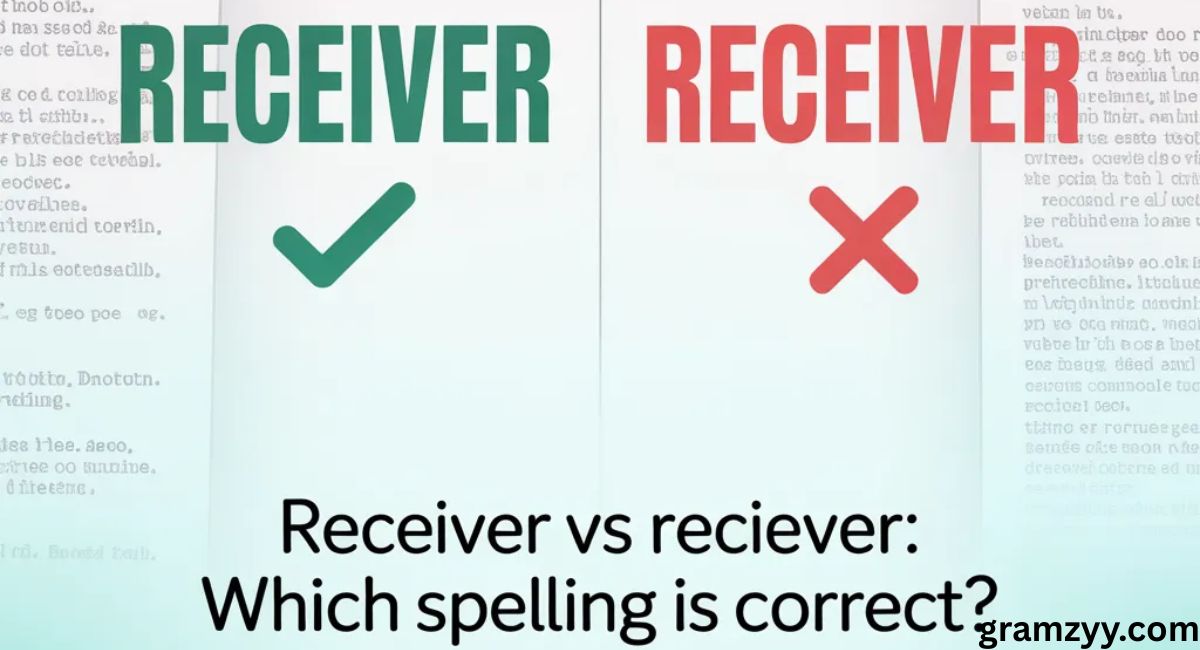
Receiver vs reciever : If you’ve ever typed “reciever” and then second-guessed yourself, you’re not alone. This is one of the most common spelling slip-ups in English and it catches even confident writers off guard. The short answer: receiver is always correct, and reciever is always a misspelling. No exceptions, no regional differences.
But knowing why matters just as much as knowing the rule. Once you understand the logic behind the correct spelling, you’ll never confuse the two again.
The Spelling Rule
The confusion around receiver vs reciever comes directly from a popular — but often misapplied — grammar rule you’ve likely heard in school:
“I before E, except after C.”
Most people remember the first half. Fewer remember the second. The word receiver follows the “except after C” part of that rule. After the letter C, the correct order is E-I, not I-E.
So the correct spelling is:
R – E – C – E – I – V – E – R
Break it down: re + ceive + r. The core of the word is “ceive” — the same unit you’ll find in receive, deceive, conceive, and perceive. Notice the pattern: after the C, it’s always EI.
Word Origin: Where Does “Receiver” Come From?
Understanding etymology can lock a spelling into memory. “Receiver” traces back to the Old French word receivre, which itself comes from the Latin recipere — meaning “to take back” or “to accept.” As the word evolved through Middle English, it retained its EI vowel pattern, giving us the modern spelling: receiver.
This is why no legitimate dictionary — whether Merriam-Webster, Oxford, or Cambridge — recognizes “reciever” as an accepted or alternate form. It simply does not exist as a valid English word.
Also read : To Early or Too Early: Which One Is Correct?
How to Use “Receiver” in Context
The word receiver is remarkably versatile. It shows up in sports, technology, law, business, and everyday conversation. Understanding these contexts reinforces not just the meaning, but the correct spelling.
Correct Usage
Here are real-world examples of receiver used correctly across different fields:
| Context | Example Sentence |
|---|---|
| Sports | “The wide receiver sprinted into the end zone to catch the game-winning pass.” |
| Technology | “The satellite receiver failed to pick up the signal during the storm.” |
| Legal/Finance | “The court appointed a receiver to manage the company’s assets after bankruptcy.” |
| Telecommunications | “He slammed the phone receiver down after the heated argument.” |
| Everyday Use | “She was the proud receiver of the Employee of the Year award.” |
Incorrect Usage
These sentences show “reciever” used incorrectly — a mistake any professional proofreader or spell-checker would catch immediately:
- ~~”The reciever dropped the pass in the final seconds.”~~
- ~~”Install the reciever near your television set.”~~
- ~~”The bankruptcy reciever submitted the final report to the court.”~~
Every one of these should use receiver — spelled R-E-C-E-I-V-E-R.
Context Variations
The meaning of receiver shifts slightly depending on its context, but the spelling never changes:
- In American football: a player, specifically a wide receiver, who catches passes thrown by the quarterback
- In electronics and communications: a device that picks up incoming signals — think radio receivers, satellite receivers, or AV receivers for home theater systems
- In law and finance: a person appointed by a court to manage assets during insolvency proceedings or legal disputes
- In telephony: the part of a phone handset pressed to the ear to hear the caller’s voice
- In general use: anyone or anything on the receiving end of something — a gift, an award, a message, or a package
Common Mistakes with Receiver vs Reciever
Despite being a simple spelling issue, “reciever” appears frequently in emails, social media posts, and even published articles. Here’s a breakdown of the most typical errors and where they tend to show up.
Top spelling errors people make:
- Writing “reciever” instead of “receiver” in emails and reports
- Typing “wide reciever” in sports writing or fantasy football posts
- Using “reciever” in electronics manuals or product descriptions
- Misspelling “receivership” as “recievership” in business documents
Why This Mistake Happens
There are a few specific reasons why “reciever” feels so natural to write — even when it’s wrong:
- The “I before E” rule is only half-remembered. People apply it without recalling the “except after C” clause. The brain defaults to the shorter, more familiar version of the rule.
- Phonetic confusion. When you say receiver out loud, the “ee” sound naturally suggests writing “ie” — the same sound pattern in words like believe, achieve, and relieve. The problem is that those words don’t follow a C, so the rule doesn’t apply.
- Fast typing and muscle memory. In casual writing, fingers move quickly. When you’re focused on content rather than mechanics, the wrong sequence of letters can slip through before your brain catches it.
- Auto-correct isn’t always reliable. While most spell-checkers do flag “reciever,” not every platform catches it in real time — especially in text messages, form fields, or older software.
Also read : Is “Hence Why” Grammatically Correct?
How to Remember the Correct Spelling
Memory tricks work far better than trying to recall abstract rules under pressure. Here are two proven techniques:
The “After C” Trick
Whenever you see the letter C followed by a vowel combination that makes an “ee” sound, write EI — not IE.
Think of it this way: C demands E first.
The same logic applies to the entire word family built around ceive:
- receive → receiver
- deceive → deceiver
- conceive → conceivable
- perceive → perception
Once you know how to spell receive, spelling receiver becomes automatic. Just add the -r suffix.
Quick Self-Check
Before finalizing any document, ask yourself these two quick questions:
- Does my word contain the letters C-E-I or C-I-E?
- If the C comes first, is E before I? ✅
If E comes before I after a C, you’re correct. If I comes before E after a C, stop — that’s the misspelling.
A simpler mental shortcut: think of the word “receive” first, then add “-r.” You almost certainly know how to spell receive already. Receiver is just receive + r.
Visualizing the Spelling Pattern
Sometimes a visual anchor is the most powerful memory tool. Picture the word broken into two familiar chunks:
re + ceive + r
The middle section — ceive — is the key. It’s the same “ceive” you use in perceive, deceive, and conceive. Every single one follows the same EI pattern after C.
You can also think of a simple decision tree:
- Does the word contain a C making an “ee” sound? → Use EI
- No C before the vowel pair? → Use IE
This visual approach — connecting receiver to the entire “ceive” family — is what professional editors and writers internalize over time, making correct spelling feel second nature.
Also read : Propose vs Purpose: Understanding the Difference
FAQs
Is “reciever” ever correct in any context?
No. “Reciever” is never correct not informally, not regionally, not in any professional or casual writing context. It is always a misspelling of “receiver.”
Does the spelling change in British vs American English?
No. Both British English and American English use the same spelling: receiver. There are no regional variations.
Can spell-check catch “reciever” automatically?
Yes, most standard spell-checkers flag “reciever” as an error and suggest “receiver.” However, it’s always best to proofread manually, especially in important documents.
How do I remember: is it “ei” or “ie” in receiver?
Think of the root word receive which you likely already know how to spell and simply add an “r.” Receiver = receive + r. (receiver vs reciever)
Does the spelling rule apply to “receivership” too?
Yes. “Receivership” follows the same pattern. The correct spelling is receivership, not “recievership.”
Why does “reciever” look so believable?
Because words like believer, achiever, and retriever all use “ie” and they sound similar. The difference is that none of those words contain a C before the vowel pair. Once there’s a C, the rule flips.
Is “wide reciever” acceptable in casual writing?
No. Even in informal or casual contexts social media, text messages, sports commentary the correct spelling is always “wide receiver.” Spelling rules apply regardless of tone or formality.(receiver vs reciever)
Conclusion
The bottom line is simple: receiver is the only correct spelling. “Reciever” is a misspelling caused by misapplying the “I before E” rule without remembering the “except after C” exception.
The word receiver appears in some of the most high-stakes writing environments legal documents, technical manuals, professional emails, and news articles. Using the wrong spelling in any of these contexts can quietly undermine your credibility, even if the rest of your writing is flawless.
The fastest way to lock in the correct spelling: remember receive, then add r. That one mental shortcut eliminates the confusion permanently. Whether you’re writing about a wide receiver in football, a satellite receiver in your living room, or a court-appointed receiver managing a company’s assets the spelling is always, without exception, R-E-C-E-I-V-E-R.