Thats or Thats If you’ve ever typed “thats great” and wondered whether the apostrophe matters it absolutely does. One version is a grammatically correct English contraction. The other is simply a spelling error. Understanding the difference helps you write more clearly, professionally, and confidently in every context, from casual texts to formal reports.
This guide covers everything you need to know: what the apostrophe in that’s actually does, when to use it, common mistakes to avoid, and a foolproof trick to get it right every single time.
That’s vs. Thats: The Quick Answer
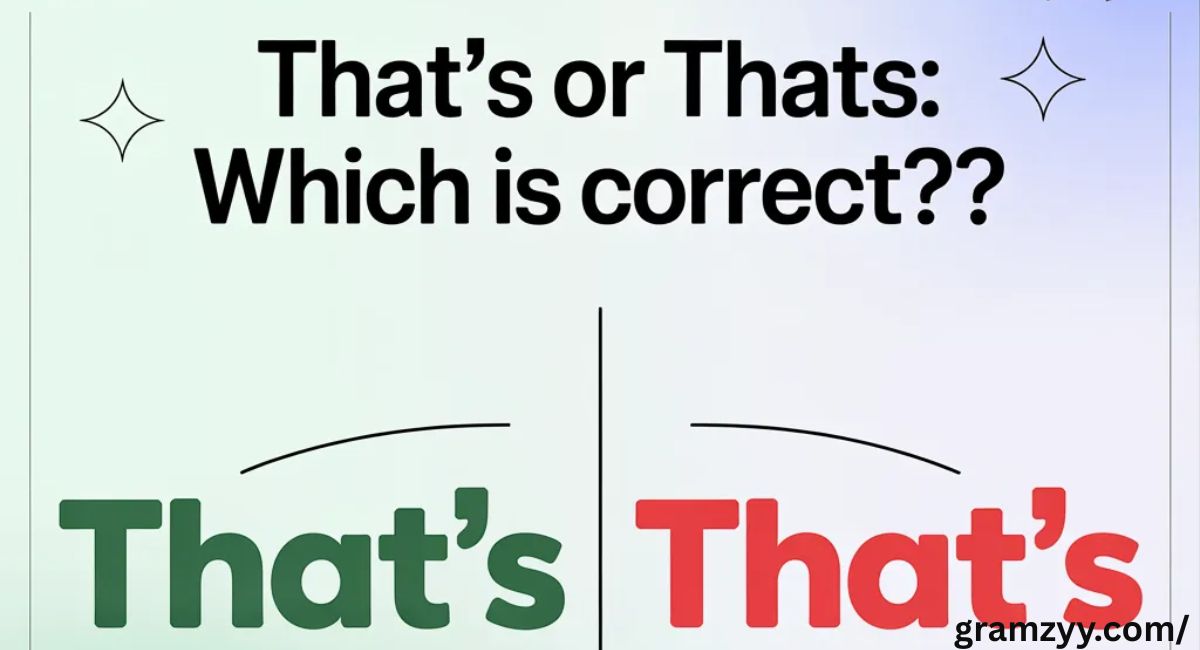
“That’s” is correct. “Thats” is not a word in standard English.
| Form | Correct? | Meaning |
|---|---|---|
| That’s | ✅ Yes | Contraction of that is or that has |
| Thats | ❌ No | Not a valid English word; a common typo |
The difference comes down to one small but powerful punctuation mark the apostrophe. Without it, the word has no grammatical standing in English. With it, the contraction carries clear meaning and correct structure.
What Does the Apostrophe in That’s Do?
The apostrophe in that’s performs a specific grammatical function: it signals that one or more letters have been removed when two words are joined together. This process is called contraction.
In that’s, the apostrophe replaces the letter “i” from the word is (or the letters “ha” from has in some uses). The apostrophe essentially holds a place, telling the reader: something was here, but it’s been shortened for ease and flow.
Think of how other common contractions work:
- I am → I’m
- You are → You’re
- It is → It’s
- That is → That’s
The pattern is consistent across all contractions in English. The apostrophe is never optional it’s a grammatical requirement that distinguishes a proper contraction from a misspelling.
That’s in Correct Usage
That’s can mean two different things depending on the sentence. Knowing both meanings makes you a sharper, more accurate writer.
That’s as a Contraction of “That Is”
This is by far the most common use. Here, that’s introduces a description, identification, or statement about something. You can test this by expanding the contraction: if replacing that’s with that is still makes sense, you’ve used it correctly.
Examples:
- That’s a clever solution. → That is a clever solution.
- That’s the reason I called. → That is the reason I called.
- That’s not what I meant. → That is not what I meant.
- That’s how it works. → That is how it works.
This usage appears equally in casual speech, professional emails, blog posts, and academic writing. It’s versatile, natural, and grammatically sound.
That’s as a Contraction of “That Has”
This usage is less obvious but equally valid. That’s can also stand for that has, but only when it’s followed by a past participle (a verb form like been, gone, changed, taken, caused). This construction typically forms the present perfect tense.
Examples:
- That’s been my experience. → That has been my experience.
- That’s changed everything. → That has changed everything.
- That’s taken a long time. → That has taken a long time.
- That’s caused a lot of confusion. → That has caused a lot of confusion.
Quick test: If the word following that’s is a past participle, it likely means that has. If it’s any other word a noun, adjective, or adverb it means that is.
See also: Mine As Well, Might As Well, or Mind As Well
Correct Usage Examples
Here’s how that’s looks across different writing styles and contexts:
Casual / Conversational:
- That’s hilarious I wasn’t expecting that at all.
- That’s all I needed to hear.
- That’s my favorite song of the year.
Professional / Workplace:
- That’s the approach the team has agreed on.
- That’s the final version attached for your review.
- That’s an excellent point worth exploring further.
Creative / Narrative Writing:
- “That’s the house I grew up in,” he whispered.
- She paused. “That’s exactly what I was afraid of.”
Formal / Academic:
Note: In highly formal academic writing, contractions are sometimes avoided entirely. In these cases, write out that is or that has in full. However, that’s remains grammatically correct even in formal contexts.
Incorrect Usage Examples
| ❌ Incorrect | ✅ Correct | Why It Matters |
|---|---|---|
| Thats a good idea. | That’s a good idea. | Missing apostrophe — not a valid word |
| Thats been handled. | That’s been handled. | Contraction requires apostrophe |
| Thats never been done. | That’s never been done. | Typo undermines clarity and professionalism |
| Thats the final answer. | That’s the final answer. | Apostrophe marks the missing letter “i” |
Every one of the incorrect examples above is simply a missing apostrophe usually the result of typing quickly, autocorrect failure, or phone keyboard habits bleeding into written work.
Context Variations
Informal Writing and Texting
In casual text messages or social media, you’ll frequently see thats without the apostrophe. While this is widespread, it’s still technically incorrect. It may be forgiven in a quick text between friends, but in any public-facing writing captions, posts, comments, or profiles the error is visible and can affect how your writing is perceived.
Formal and Professional Writing
In emails, reports, presentations, and professional correspondence, thats without the apostrophe signals carelessness. Correct grammar in professional settings builds trust and credibility. A single missing apostrophe may seem trivial, but repeated errors quietly damage your authority as a writer.
Academic Writing
In essays, research papers, and academic submissions, contractions are often avoided altogether in favor of their full forms (that is, that has). However, if contractions are permitted in your style guide, that’s with the apostrophe is always the only acceptable spelling.
One Rare Exception: Brand Names
There is one narrow context where thats without an apostrophe is technically “correct” when it appears in a proper brand name. Honda produced a compact kei car called the Honda That’s between 2002 and 2007. The branding deliberately omits the apostrophe as a stylistic choice. This is a brand naming decision, not a grammar rule, and it does not apply to everyday writing.
Common That’s Spelling Errors
Writers make a few recurring mistakes with this word. Knowing them helps you avoid them.
1. Dropping the apostrophe entirely The most common error. Fast typing on phones and keyboards often causes the apostrophe to disappear. The sentence still sounds correct when read aloud, so the mistake goes unnoticed.
2. Confusing it with a possessive form Some writers mistakenly assume thats is the possessive form of that, similar to John’s book or the company’s policy. In English, that does not take a possessive form this way. There is no such construction as “thats idea” to mean “the idea of that.” English simply doesn’t work that way.
3. Mixing up that’s / its / it’s Similar confusion arises with its vs. it’s:
- It’s = it is / it has (contraction — apostrophe required)
- Its = belonging to it (possessive — no apostrophe)
That’s follows the same logic as it’s — the apostrophe marks the contraction, not possession.
4. Over-correcting in formal writing Some writers, in an effort to sound formal, change that’s to thats thinking the apostrophe looks too casual. This is incorrect. The apostrophe is a grammatical requirement, not a stylistic flourish.
How to Remember the Apostrophe in That’s
You don’t need to memorize a long grammar rule. These two quick methods work every time:
Method 1: The Substitution Test
Replace that’s with that is (or that has) and read the sentence aloud.
- “That’s great!” → “That is great!” ✅ Makes sense → use that’s with apostrophe.
- “Thats great!” → No expansion possible ❌ → This signals a typo.
If the expanded version sounds natural, you need the apostrophe. If it doesn’t, reconsider your sentence structure.
Method 2: Picture the Missing Letter
The apostrophe in that’s stands in for the letter “i” from that is. Imagine a small gap where the “i” used to sit. The apostrophe is essentially a placeholder — a tiny marker that says “something was removed here.” Once you visualize it this way, the apostrophe becomes easy to remember.
Quick rule to keep handy:
That’s = That is / That has → always needs the apostrophe Thats = typo → never correct in standard writing
FAQs
Is “thats” ever correct?
No. “Thats” without an apostrophe is not a standard English word in any context. The only narrow exception is when it appears as part of a registered brand name (such as Honda That’s), which follows branding rules, not grammar rules.
Can “that’s” be used in formal writing?
Yes. “That’s” is grammatically correct in formal writing. However, some style guides and academic disciplines prefer the full forms that is or that has in formal contexts to avoid contractions altogether.
What does the apostrophe in “that’s” replace?
The apostrophe replaces the letter “i” from that is, or the letters “ha” from that has, depending on the context of the sentence.
How do I know if “that’s” means “that is” or “that has”?
Check the word that follows. If it’s a past participle (such as been, gone, changed, taken), then that’s means that has. In all other cases, it means that is.
Why do people type “thats” without the apostrophe?
Almost always it’s a typing error rather than a grammar misunderstanding. Fast typing, phone keyboards, and autocorrect tools frequently drop the apostrophe without the writer noticing. A quick read-through before sending or publishing will catch it every time.
Does “thats” appear in any dialect of English?
Not in any standard or recognized dialect. You may see it in informal internet slang or rapid texting, but it has no standing in standard written English regardless of region or dialect.
Conclusion
The answer is clear: that’s with the apostrophe is always correct. Thats without an apostrophe is always a mistake in standard English, whether you’re writing a text, an email, a blog post, or a report.
The apostrophe does important work. It marks the missing letter, signals a contraction, and tells your reader that that is or that has has been shortened for natural flow. One small punctuation mark carries all of that meaning and leaving it out quietly damages the clarity and credibility of your writing.
Next time you type that’s, remember the substitution test: expand it to that is or that has. If the sentence still makes sense, you’ve used it correctly. If it doesn’t, revisit the sentence. It’s a two-second check that guarantees accuracy every time.
Master the small details, and your writing takes care of itself.