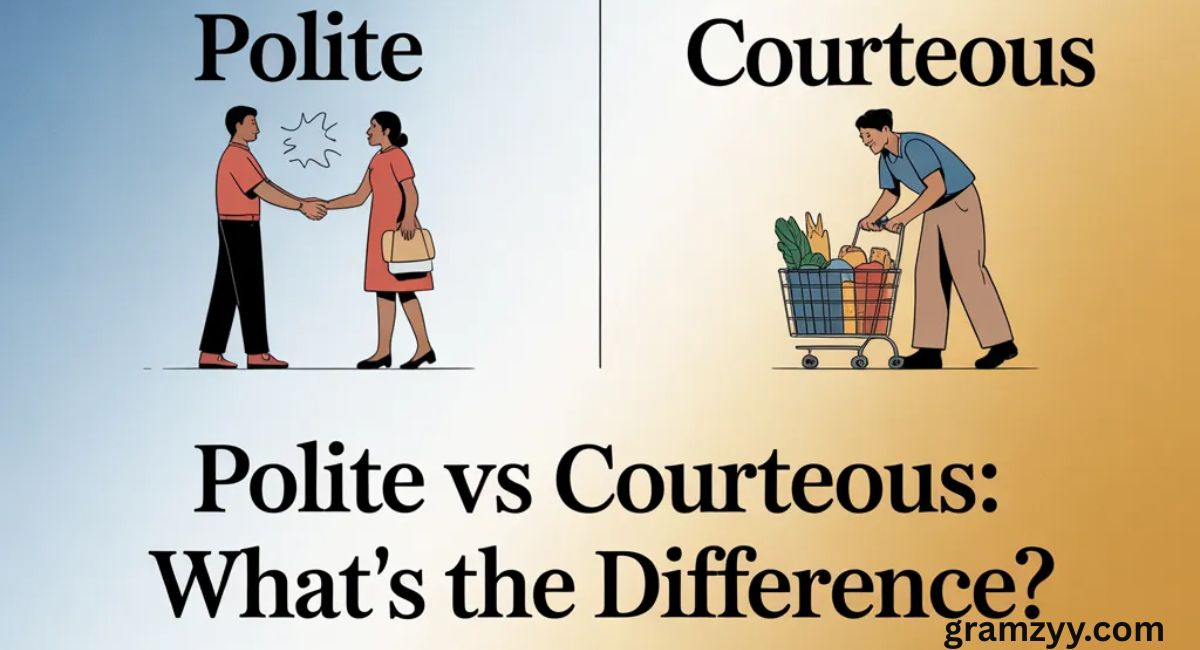
Most people use Polite vs Courteous as if they mean exactly the same thing. Open a thesaurus, and you’ll find one listed under the other. In casual conversation, swapping them rarely causes confusion. But if you look closer especially in professional writing, customer service, or formal communication these two words carry distinct meanings that matter.
Understanding the difference between polite vs courteous doesn’t just improve your vocabulary. It sharpens how you communicate, how you’re perceived, and how well you connect with others in both everyday and formal situations.
What Sets Polite and Courteous Apart?
At the core, both words describe positive social behavior. But they operate at different levels.
Polite means following the basic rules of good manners. It’s the behavioral minimum saying “please” and “thank you,” avoiding rude interruptions, keeping your tone civil. Politeness is about meeting a social standard, not exceeding it. It can be automatic, even mechanical.
Courteous means going a step further. It involves genuine warmth, active consideration, and thoughtfulness toward others. A courteous person doesn’t just avoid offending you they actually think about how their words and actions might affect you, and they act with care.
A useful way to frame it: politeness is the floor; courtesy is the ceiling.
| Feature | Polite | Courteous |
|---|---|---|
| Core meaning | Follows social rules and basic manners | Shows genuine warmth and consideration |
| Origin | Latin politus (“polished”) | Old French curteis (“of the court”) |
| Tone | Neutral to formal | Warm and elevated |
| Level of effort | Minimum expected | Goes beyond the expected |
| Motivation | Social obligation or convention | Genuine care for others |
| Common context | Everyday interactions | Professional, formal, or deeply personal settings |
You can be polite without being courteous. You can say “no thank you” in a perfectly correct tone and still leave someone feeling dismissed. Courtesy would add a brief, sincere explanation — a gesture that acknowledges the other person’s feelings.
Also read: “ Envolved” or “Involved”: Which Is Correct?
Where These Two Words Come From
Word origins reveal a lot about meaning.
Polite entered English from the Latin politus, the past participle of polire — meaning “to polish” or “to smooth.” The earliest English uses of the word referred literally to polished surfaces. By the mid-1700s, it had developed into the sense we know today: refined, well-mannered behavior. The idea of smoothing out roughness is still baked into the word — polite behavior removes friction from social interaction.
Courteous traces back to Old French curteis, meaning “having the manners of the court,” from curt (court). In medieval Europe, a king’s court had strict behavioral codes. To be courteous was to behave with the dignity, grace, and attentiveness expected of nobility. The word entered English around 1300, carrying with it those connotations of elevated, intentional respect.
So while polite is about being smooth and inoffensive, courteous is about actively performing respect with grace — an older, more elevated idea.
Polite vs Courteous in Practice
The real-world difference shows up clearly in specific situations. Here are some contexts where choosing the right word or demonstrating the right behavior genuinely matters.
In Customer Service
- “Our staff are polite” — promises that employees won’t be rude or dismissive.
- “Our staff are courteous” — promises active, warm, attentive engagement.
The second statement is a meaningfully higher commitment. Customers notice the difference.
In Professional Correspondence
- “A polite reminder” — a standard follow-up, free of aggression.
- “A courteous acknowledgment” — a response that shows genuine attention to the recipient and their situation.
In Formal or Legal Settings
- Polite often softens language: “He politely declined to comment.”
- Courteous describes deliberate, dignified conduct: “The judge was courteous to all parties.”
Everyday Life
- A polite person waits their turn to speak.
- A courteous person notices someone struggling and offers help without being asked.
The first is about restraint. The second is about active kindness.
Correct Usage Examples
Here are natural, accurate ways to use each word:
Polite:
- She gave a polite smile and moved on without making a scene.
- It’s polite to say “excuse me” when you need to pass through a crowd.
- He sent a polite but firm reply to the complaint.
- Please be polite when speaking with the guests.
Courteous:
- The hotel staff were exceptionally courteous throughout our stay.
- He was courteous enough to hold the elevator door open for everyone.
- A courteous driver lets pedestrians cross before proceeding.
- Her courteous manner made the difficult meeting feel far less tense.
Also read : To Fast or Too Fast
Incorrect Usage Examples
These examples show where the words get misused:
❌ “She gave a courteous nod and walked away without another word.” (A bare nod with no warmth isn’t courteous — it’s just polite at best.)
❌ “He was polite enough to spend 20 minutes helping the elderly man find his gate.” (Going that far out of your way is courtesy, not just politeness.)
❌ “The automated system gave a courteous response.” (Automated systems can be polite — they can’t be courteous, because courtesy requires genuine human consideration.)
Context Variations
Formal Writing
In legal briefs, official communications, and formal business letters, courteous signals a higher level of intentional respect. Writers use it when they want to convey that consideration for the reader is genuine, not perfunctory.
American vs British English
Both terms appear in American and British English. However, courteous tends to appear more in British formal writing and professional correspondence. In everyday American speech, polite is the far more common choice, and courteous is reserved for more elevated contexts.
Cultural Differences
In some cultures, politeness is deeply formalized. Japan, for example, has entire linguistic structures (keigo, or honorific speech) built around formal courtesy. Within that system, however, true courtesy the warm, proactive attention to another person’s needs still stands apart from mere rule-following. The distinction is nearly universal across cultures, even if the specific behaviors that express it vary widely.
Common Mistakes With Polite and Courteous
Understanding where writers go wrong helps you avoid the same errors.
Mistake 1: Using “courteous” for minimal behavior. If a behavior could be described simply as “not rude,” the right word is polite. Courtesy belongs where active warmth and genuine regard are present.
Mistake 2: Treating them as perfect synonyms. While they overlap, they’re not interchangeable in every context. Saying a machine or automated process is “courteous” misapplies the word — courtesy requires human intention and empathy.
Mistake 3: Confusing politeness with kindness. A polite person can be cold. A person can follow every social rule correctly and still leave others feeling uncared for. Kindness and warmth live on the courteous side of this spectrum.
Mistake 4: Assuming all courteous acts are grand gestures. Courtesy doesn’t require big effort. Something as small as a genuine smile, noticing that someone is confused and offering help, or crafting an email with the reader’s feelings in mind — these are courteous acts. The difference is intention and awareness, not scale.
Also read : Mine As Well, Might As Well, or Mind As Well
Quick-Reference Summary
| Polite | Courteous | |
|---|---|---|
| Definition | Follows social norms; avoids rudeness | Shows active warmth and genuine consideration |
| Example | “Thank you for your email.” | “I hope this message finds you well — I wanted to address your concern directly.” |
| Can be automatic? | Yes | No — requires intention |
| Stronger word? | No | Yes |
| Noun form | Politeness | Courtesy |
Conclusion
Polite vs Courteous both describe positive behavior, but they live at different points on the same scale. Politeness keeps social interactions smooth and friction-free. Courtesy adds something deeper genuine warmth, active consideration, and deliberate respect for the person in front of you.
In practice, being polite is the starting point. Being courteous is what people actually remember.
When you write a follow-up email, handle a difficult conversation, or interact with a stranger in need, ask yourself: am I just meeting the minimum, or am I bringing real consideration to this moment? That question is the difference between polite vs courteous and it’s worth asking often.
FAQs
Is courteous stronger than polite?
Yes. Courteous implies active warmth and genuine consideration, while polite describes meeting the basic standard of good manners.
Can you be polite but not courteous?
Absolutely. You can follow every social rule correctly and still come across as cold or indifferent — that’s polite without courtesy.
Can a machine or automated system be courteous?
No. Machines can be programmed to sound polite, but courtesy requires genuine human intention and empathy toward another person.
What is the noun form of each word?
The noun form of polite is politeness. The noun form of courteous is courtesy.
Which word is better for formal writing?
Courteous is the stronger choice in formal and professional contexts, as it conveys a higher level of intentional respect and active consideration.
Are polite and courteous synonyms?
They overlap significantly but are not true synonyms. Polite focuses on following social rules; courteous adds warmth, empathy, and proactive care for others.
Which word is more common in everyday speech?
Polite is far more common in everyday conversation. Courteous tends to appear in formal writing, customer service language, and professional settings.