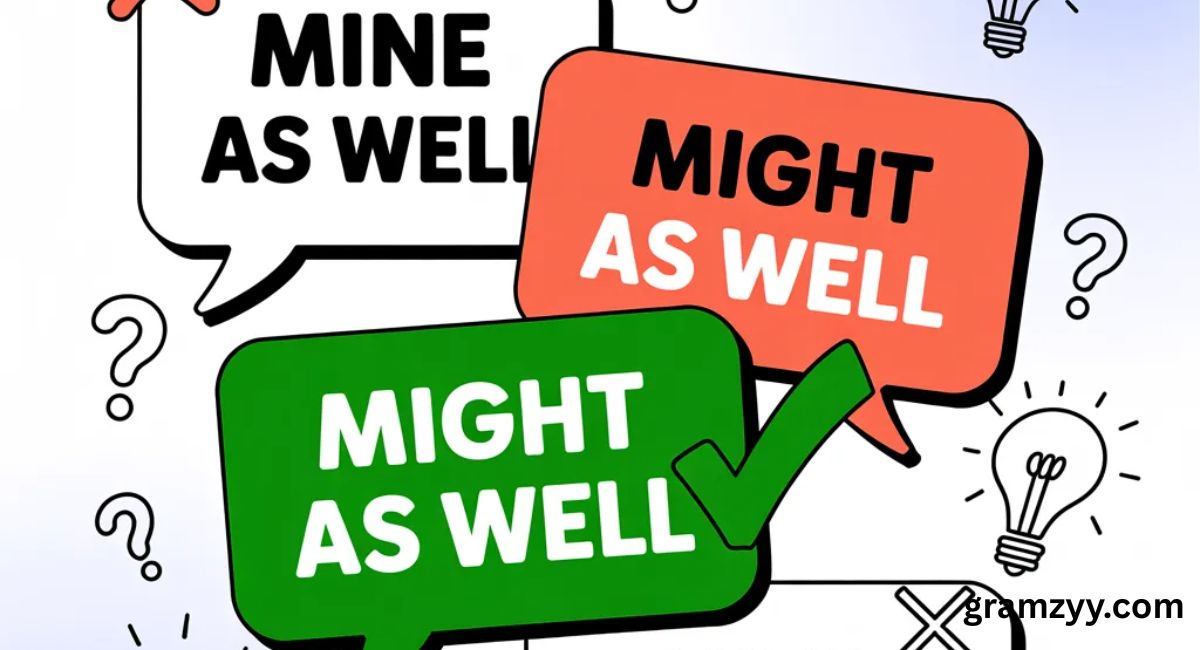
Mine as well might as well or mind as well .If you’ve ever typed “mine as well go” or heard someone say “mind as well try it,” you’re not alone. These three phrases trip up native English speakers and learners alike and the confusion is completely understandable. When spoken quickly in casual conversation, might as well, mine as well, and mind as well can sound nearly identical. But on paper, only one of them is almost always correct, and the differences between the other two matter a great deal.
This guide breaks down each phrase clearly, shows you exactly when (and whether) each one is appropriate, and gives you practical tools to stop second-guessing yourself.
Quick Answer: Which Phrase Is Correct?
“Might as well” is the correct idiomatic expression in standard English when you mean there is little reason not to do something or it makes logical sense to do it. The other two phrases “mine as well” and “mind as well” — are either situationally limited or outright incorrect.
| Phrase | Correct? | When to Use It |
|---|---|---|
| Might as well | ✅ Yes (standard idiom) | Suggesting an action when no better option exists |
| Mine as well | ⚠️ Sometimes | Only in possessive contexts (meaning “also mine”) |
| Mind as well | ❌ No | Never correct in standard English |
What Does “Might As Well” Mean?
“Might as well” is a modal idiom made up of the auxiliary verb might and the adverbial phrase as well. Together, they convey a sense of practical resignation or low-stakes suggestion — the idea that since nothing better is available, a particular action is reasonable.
Examples:
- We might as well leave early — traffic will only get worse.
- The meeting got cancelled, so I might as well finish this report.
- If the store’s already open, we might as well pick up groceries now.
Grammatically, might is a modal auxiliary verb, and it must always be followed by a base form verb (no to, no -ing). So “we might as well to go” or “we might as well going” are both wrong. The correct form is simply: might as well + base verb.
This phrase works equally well in informal conversation, casual emails, and even semi-formal writing. It’s one of the most commonly used idioms in everyday English.
See also: Input vs Imput — Which Is Correct?
What About “Mine As Well”?
Here’s where things get nuanced. “Mine as well” is not always wrong but it is almost always misused.
The word mine is a possessive pronoun, meaning “something that belongs to me.” The phrase as well means “also” or “too.” So “mine as well” correctly means also belonging to me — it is a possessive statement, not a suggestion idiom.
Correct use of “mine as well”:
- Your bag is blue, and mine as well. (= My bag is also blue.)
- She brought her umbrella, and I brought mine as well. (= I also brought my umbrella.)
Incorrect use of “mine as well”:
- ❌ I mine as well go home now. (Should be: I might as well go home now.)
- ❌ Mine as well order dessert while we’re here. (Should be: Might as well order dessert.)
The mix-up happens because when “might as well” is said quickly in casual speech, the t at the end of might softens significantly and the resulting sound is almost indistinguishable from mine. Linguists describe this as phonetic assimilation: the brain fills in familiar sounds based on what it expects to hear.
In formal or professional writing, “mine as well” in the possessive sense is perfectly valid. But if you’re trying to express the idiom, always use might.
What About “Mind As Well”?
“Mind as well” is never correct in standard English grammar.
Mind functions as either a noun (your thoughts, your mental state) or a verb (to object to something, to pay attention). It is not a modal auxiliary verb, so it cannot grammatically replace might in an idiomatic expression.
Why do people say it?
- Fast or slurred speech blends “might” and “mind”
- Regional accents can make the two sound similar
- Speech-to-text software mishears the phrase
- Non-native speakers learn by ear and repeat what they think they heard
Examples of the mistake:
- ❌ We mind as well call it a day. → ✅ We might as well call it a day.
- ❌ Mind as well try — nothing to lose. → ✅ Might as well try nothing to lose.
The only acceptable context for “mind as well” is in written dialogue where a character is deliberately portrayed as speaking in a regional dialect or informal manner. Even then, it should be used sparingly and intentionally.
Why Do People Confuse These Phrases?
The confusion is mostly rooted in phonetics — the science of how sounds work in spoken language. Here’s what’s happening:
- Speed of speech: In natural conversation, “might as well” is often run together as a single rapid unit — almost like one word.
- Soft consonants: The t in might is rarely hard or aspirated in connected speech, making it sound closer to mine or mind.
- Autocorrect and voice typing: Technology frequently substitutes the more common-looking word, turning typed “might” into “mine” or “mind.”
- Learning by ear: Both native speakers and English learners sometimes repeat phrases they’ve heard without seeing them written locking in the wrong spelling.
Understanding the why behind the confusion makes it much easier to catch the mistake.
American vs. British English: Any Difference?
Both American and British English use “might as well” as the standard idiom, with no difference in grammar or core meaning.
- 🇺🇸 American: “We might as well grab coffee before the meeting.”
- 🇬🇧 British: “We might as well pop in and grab a coffee.”
One minor distinction: British English speakers sometimes favour may as well as an alternative, which carries a slightly more formal or polite tone. May as well and might as well are largely interchangeable, though might is more common in everyday speech on both sides of the Atlantic.
“Mine as well” in the possessive sense appears in both dialects, though British speakers more commonly say mine too in casual speech. “Mind as well” is nonstandard in both dialects.
See also: Is “Much Better” Correct? Grammar Explained with Examples
Common Mistakes to Avoid
Using “Mine As Well” as a Suggestion Idiom
Writing I mine as well just do it now instead of I might as well just do it now is the single most common error. If you’re expressing a suggestion or practical decision — always use might.
Using “Mind As Well” in Any Standard Context
There is no standard English sentence where mind as well correctly replaces might as well. If you see it in your own writing, correct it immediately.
Forgetting the Base Verb Rule
After might as well, the following verb must be a base infinitive. For example:
- ✅ We might as well stay.
- ❌ We might as well staying.
- ❌ We might as well to stay.
Leaving “Mine As Well” Without a Clear Antecedent
In possessive use, mine needs to refer to something previously mentioned. Writing Well, mine as well in isolation is confusing expand it to Well, that one can be mine too or provide clear context.
Practical Tips to Get It Right Every Time
- Substitution test: Ask yourself — can I replace this phrase with “it makes sense to”? If yes, use might as well. If you’re talking about ownership, use mine as well.
- Read it aloud slowly: Say each word clearly. If you hear yourself saying mind, stop and correct to might.
- Check the grammar: After might as well, look for a base verb. If it’s missing or in the wrong form, revise.
- Avoid relying on autocorrect: Voice-to-text tools frequently mishear this phrase. Always proofread sentences containing any version of it.
- In formal writing: Stick to might as well for idioms and avoid both mine as well and mind as well unless the context specifically calls for them.
Sentence Examples at a Glance
| Situation | Correct Phrase | Example Sentence |
|---|---|---|
| Suggesting an action | Might as well | We might as well try the new route. |
| No better option exists | Might as well | The rain isn’t stopping — might as well head in. |
| Comparing possessions | Mine as well | She has a red coat, and mine as well. |
| Adding something you own | Mine as well | Your ticket was free, and mine as well. |
| Any suggestion context | ~~Mind as well~~ | Never correct — use “might as well.” |
Conclusion
The bottom line is simple: “might as well” is the standard, correct idiomatic phrase for expressing practical suggestions or resigned acceptance. “Mine as well” has a narrow, legitimate role in possessive comparisons but it’s often misused as a stand-in for the idiom. “Mind as well” is always an error in standard English and should be avoided in formal writing entirely.
When in doubt, slow down, read the sentence aloud, and ask yourself: am I suggesting an action, or am I talking about something I own? That one question will almost always point you to the right phrase.
Clear, accurate language isn’t just about grammar rules it’s about being understood exactly as you intend. And now that you know the difference, you can communicate with complete confidence.
FAQs
Is “mine as well” ever correct?
Yes — but only when mine is used as a possessive pronoun meaning “also belonging to me,” such as “Her idea worked, and mine as well.”
Why do people say “mine as well” instead of “might as well”?
Because when spoken quickly, might and mine sound nearly identical the soft t at the end of might blends into the following vowel, creating a sound very close to mine.(mine as well might as well or mind as well)
Is “mind as well” correct in any context?
No. Mind as well is never grammatically correct as a replacement for might as well in standard English.
Can I use “might as well” in formal writing?
Yes might as well is acceptable in most writing registers, from casual emails to semi-formal articles, though very formal academic or legal writing may call for more precise modal constructions.
What is the correct grammar structure for “might as well”?
The structure is: might + as well + base verb (e.g., might as well go, might as well try, might as well stay). Never add to before the verb.
What is the difference between “might as well” and “may as well”?
Both mean essentially the same thing. May as well is slightly more formal and more common in British English; might as well is the everyday standard in both American and British English.
Does autocorrect cause “mine as well” mistakes?
Yes — voice typing and autocorrect frequently mishear or swap might for mine, making proofreading especially important when using speech-to-text tools.