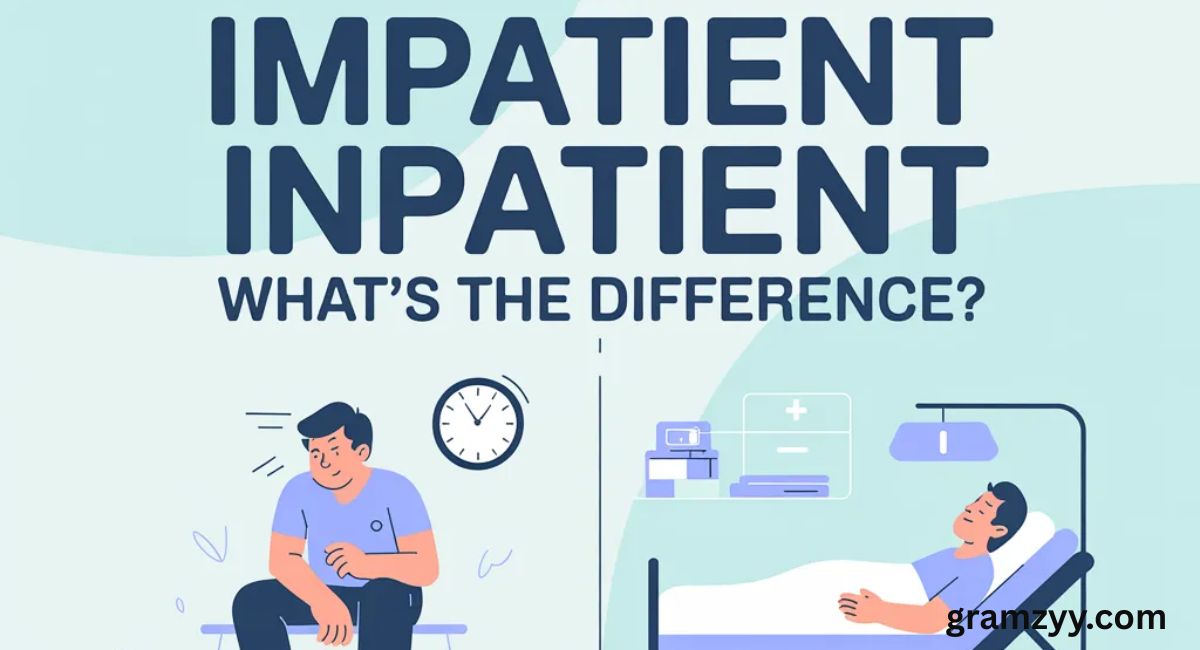
One letter. That’s all that separates Impatient vs Inpatient yet these two words belong to completely different worlds. One describes how you feel, the other describes where you are. Mix them up in a casual text and people might chuckle. Mix them up on a medical form or insurance document, and the consequences can be far more serious.
If you’ve ever paused mid-sentence wondering which word to use, this guide is for you. By the end, you’ll know exactly how to tell them apart every single time.
What “Impatient” vs “Inpatient” Actually Mean
Before diving into examples and comparisons, let’s establish clear, precise definitions for each word.
What Does “Impatient” Mean?
Impatient is an adjective that describes a person who lacks patience someone who feels restless, irritated, or anxious when things move too slowly. It expresses an emotional state, not a physical location.
- Part of speech: Adjective only
- Root: “Patient” (able to endure) + prefix “im-” (meaning “not”)
- Synonyms: Restless, anxious, fidgety, antsy, frustrated, eager
- Antonym: Patient
The prefix “im-” works the same way in words like impossible (not possible), immature (not mature), and impractical (not practical). So impatient simply means: not patient.
What Does “Inpatient” Mean?
Inpatient is both a noun and an adjective used exclusively in healthcare and medical contexts.
- As a noun: A person formally admitted to a hospital or medical facility for at least one overnight stay
- As an adjective: Relating to medical care that requires staying in a hospital
- Part of speech: Noun or adjective
- Root: “In-” (inside/within) + “patient” (a person receiving medical care)
- Opposite term: Outpatient (someone who receives treatment and goes home the same day)
The word “inpatient” literally means a patient who is in the hospital. It has nothing to do with emotions or waiting.
Also read: Tear vs Tare — When to Use Each Word
Quick-Reference Comparison Table
| Feature | Impatient | Inpatient |
|---|---|---|
| Part of Speech | Adjective | Noun or Adjective |
| Meaning | Unable to wait calmly; frustrated | A hospital patient admitted for overnight care |
| Context | Emotional / behavioral | Medical / healthcare |
| Prefix Meaning | “Im-” = not | “In-” = inside/within |
| Opposite Word | Patient (calm, tolerant) | Outpatient |
| Example | She was impatient in the queue. | He was admitted as an inpatient. |
| Used in Medical Docs? | No | Yes |
impatient vs inpatient: Examples That Show the Distinction
Correct Usage Examples
Using “Impatient” correctly (emotional context):
- The child grew impatient waiting for the school bus.
- I get impatient when meetings drag on without purpose.
- She was impatient for the test results to arrive.
- He tapped his fingers impatiently on the desk.
- Don’t be impatient good things take time.
Using “Inpatient” correctly (medical context):
- After the accident, she was admitted as an inpatient for three days.
- The hospital expanded its inpatient ward to accommodate more patients.
- Inpatient treatment is recommended for severe cases of pneumonia.
- The doctor reviewed all inpatient records before rounds.
- Insurance policies often distinguish between inpatient and outpatient care.
Incorrect Usage Examples
These are the kinds of mistakes that spellcheck will never catch — because both words are spelled correctly, just used in the wrong context.
| ❌ Incorrect | ✅ Correct |
|---|---|
| She felt inpatient waiting in line. | She felt impatient waiting in line. |
| The impatient stayed in the ICU overnight. | The inpatient stayed in the ICU overnight. |
| He was admitted to impatient care. | He was admitted to inpatient care. |
| Don’t be inpatient with me! | Don’t be impatient with me! |
| The impatient program runs for 30 days. | The inpatient program runs for 30 days. |
Context Variations
Impatient in Everyday Life
“Impatient” shows up in casual conversation, professional settings, and emotional descriptions across all walks of life:
- At work: “The manager grew impatient with repeated delays.”
- Parenting: “Young children are naturally impatient — waiting feels endless to them.”
- Technology: “Users become impatient when an app takes more than three seconds to load.”
- Relationships: “Being impatient with a partner can damage trust over time.”
Inpatient in Healthcare Settings
“Inpatient” lives almost exclusively in medical and clinical environments:
- Hospital documentation: Inpatient records, inpatient discharge summaries
- Insurance: Inpatient coverage vs. outpatient coverage
- Mental health: Inpatient psychiatric programs
- Rehabilitation: Inpatient rehab following surgery or injury
- Billing: Inpatient services are typically billed at a higher rate than outpatient visits
The Funny Overlap
Here’s a sentence that’s grammatically correct and actually makes sense:
“The inpatient was impatient to leave the hospital.”
Someone admitted to the hospital (inpatient) can certainly feel frustrated with the slow pace of recovery (impatient). Both words appear together — each used correctly.
Common Mistakes
Mistake 1: Writing “Impatient Care”
This is one of the most frequent errors in professional writing. People type “impatient care” when they mean “inpatient care.” The phrase “impatient care” is grammatically nonsensical in a medical context — it suggests care that is frustrated or anxious, not care provided inside a hospital.
Wrong: “Please check your impatient care coverage before surgery.” Right: “Please check your inpatient care coverage before surgery.”
Mistake 2: Using “Inpatient” for Emotional Frustration
Some writers, especially non-native English speakers, use “inpatient” to describe a person’s emotional state perhaps because they associate it with something negative. This is always incorrect.
Wrong: “She was very inpatient during the meeting.” Right: “She was very impatient during the meeting.”
Mistake 3: Trusting Spellcheck Alone
Both “impatient” and “inpatient” are valid English words, so spellcheck tools — including Grammarly and Microsoft Word will not flag either one as a misspelling. The mistake is contextual, not typographical. Always proofread for meaning, not just spelling.
Mistake 4: Hyphenating Either Word
Some writers write “in-patient” with a hyphen. The standard modern spelling in both American and British English is inpatient one word, no hyphen.
Why Do These Two Words Get Mixed Up?
There are several reasons this confusion is so widespread — even among educated, native English speakers:
- Near-identical pronunciation. When spoken quickly, “impatient” and “inpatient” sound almost identical. The “m” vs. “n” difference is subtle, especially in fast conversation.
- One-letter spelling difference. A single keystroke separates these words. In rushed typing, that gap is easy to miss.
- Shared root word. Both words contain “patient,” which creates a false sense that they’re related in meaning — they share etymology but not definition.
- Spellcheck doesn’t help. Since both are correctly spelled words, automated tools won’t flag the error.
- Limited medical exposure. Unless you work in healthcare, you may rarely encounter “inpatient” in context. Without familiarity, the emotional word (“impatient”) fills the gap by default.
Also read : Input vs Imput — Which Is Correct?
How to Tell Impatient and Inpatient Apart Every Time
Memory Trick #1: The Prefix Rule
- IM = I’M annoyed → emotional frustration → impatient
- IN = inside the hospital → medical status → inpatient
Memory Trick #2: The “Frustrated” Substitution Test
Replace the word with “frustrated.” If it fits naturally, use impatient. If it sounds strange because the sentence is about a hospital stay, use inpatient.
“She was frustrated waiting for the bus.” ✅ → Use impatient “She was frustrated in the ICU for two weeks.” ❌ → Use inpatient
Memory Trick #3: Break the Word Apart
Think of in + patient: a patient who is in the hospital. Simple, visual, and hard to forget.
Memory Trick #4: The Context Question
Before writing either word, ask yourself one question:
Emotion → impatient. Hospital stay → inpatient. That single check eliminates nearly every mistake.
FAQs
Is “impatient care” ever correct in a medical context?
No. The correct term is always inpatient care. “Impatient care” is a common writing error with no clinical meaning.
Can a person be both impatient and an inpatient at the same time?
Yes an inpatient (hospital patient) can feel impatient (frustrated with slow recovery). Both words apply to the same person in different ways.
Is “inpatient” the same as “outpatient”?
No. An inpatient stays in the hospital overnight or longer; an outpatient receives treatment and goes home the same day.
Does British English spell these words differently?
No. Both American and British English use the same spellings: impatient vs inpatient. No regional difference exists.
Will spellcheck catch if I use the wrong word?
No. Since both are correctly spelled English words, spellcheck won’t flag the error. Always review based on meaning and context.
Is “inpatient” always one word, or can it be hyphenated?
Modern standard usage is inpatient — one word, no hyphen. The hyphenated form “in-patient” is outdated.
Conclusion
impatient vs inpatient might look like cousins, but they live in entirely different neighborhoods of the English language. One captures a raw human emotion that restless, frustrated feeling when time moves too slowly. The other is a clinical term that places a person inside a hospital bed receiving ongoing care.
The one-letter difference between “m” and “n” changes meaning completely. Keep the context question in mind emotion or hospital? and you’ll never confuse these two words again. Whether you’re writing a medical report, filling out insurance paperwork, or simply crafting a clear email, the right word signals professionalism, precision, and clarity.