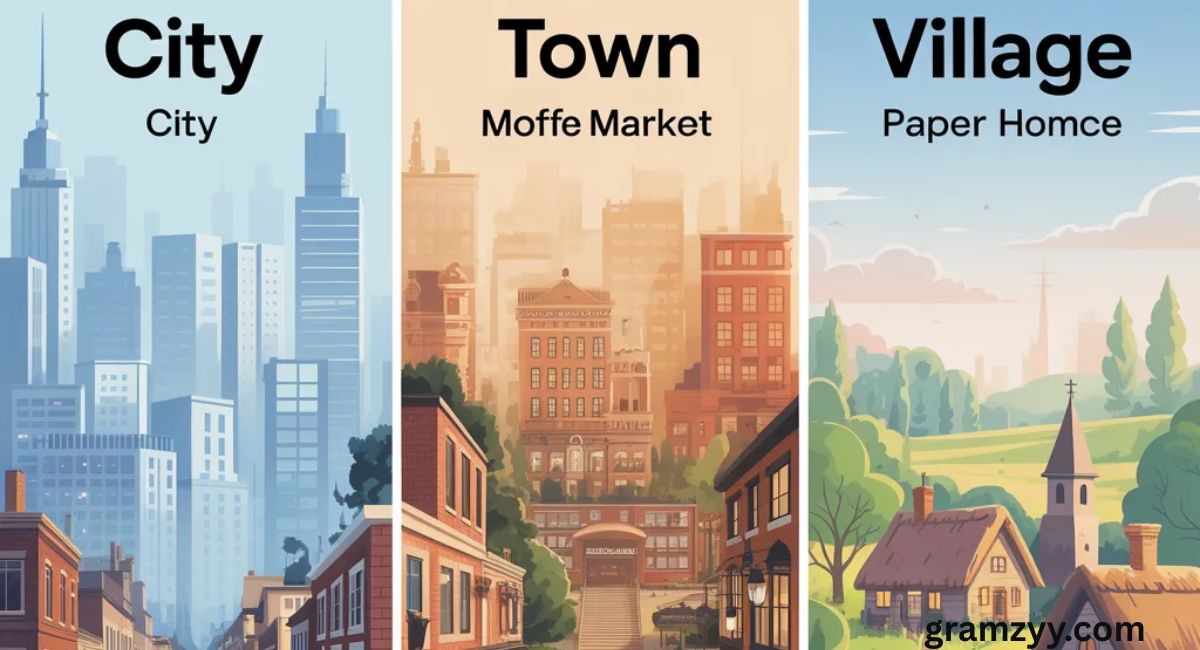
If you’ve ever driven through a place labeled “Town of Riverside” only to pass “Riverside City” two miles later, you know the confusion is real. These three words — city vs town vs village — are used every day, yet most people couldn’t define the difference if pressed. The answer isn’t just about size. It involves legal charters, population thresholds, administrative governance, and cultural context that varies wildly across countries.
This guide breaks down every layer of the distinction, with global examples, a comparison table, and practical memory aids so you never mix them up again.
Quick Answer: City vs Town vs Village at a Glance
| Feature | Village | Town | City |
|---|---|---|---|
| Typical Population | Under 1,000 | 1,000 – 100,000 | 100,000+ |
| Governance | Minimal/none | Local council | Mayor, full council |
| Infrastructure | Basic | Moderate | Advanced |
| Economy | Agricultural | Mixed | Diverse/commercial |
| Legal Status | Usually informal | Often incorporated | Chartered/incorporated |
| Lifestyle | Rural, close-knit | Semi-urban | Fast-paced, diverse |
Quick definition: A village is a small rural settlement with limited services. A town is a larger, often incorporated community with local government. A city is a major urban center — legally recognized, densely populated, and administratively complex.
Core Concepts and Historical Evolution
Etymology and Charter Systems
The word village traces back to the Old French village, meaning a group of buildings which is exactly what it is at its most basic. Town shares its roots with the Old English tun and the German Zaun, originally meaning an enclosed settlement or farmstead. City comes from the Latin civitas, referring to citizenship and civic life a hint that it was always tied to formal governance, not just size.
Throughout medieval Europe, towns earned their status through market charters — royal grants that allowed them to hold weekly markets and fairs. Cities went further, requiring either a cathedral or a direct grant from the crown. This heritage still echoes in British law today.
Administrative Nomenclature and Legal Mechanics
Here’s the part most people miss: legal status often matters more than population size. A place can be called a “city” by law even if only a few hundred people live there — and a sprawling community of 50,000 might legally be a “town” because it never went through formal incorporation.
In the United States, for example, Vernon, California operates as a fully incorporated city with a mayor and city council — and fewer than 200 residents. Meanwhile, Amherst, New York has over 130,000 people but remains legally classified as a town.
Also read : Spatter or Splatter Difference
How Population Thresholds Differ Globally
There is no universal population rule. The thresholds shift dramatically depending on where you are in the world.
United Kingdom Standards
The UK has one of the most historically distinct systems:
- Village: No official legal status. Generally rural, with a church and a small residential cluster. There is no minimum or maximum population, and many communities self-identify as villages even with several thousand residents.
- Town: Traditionally defined by a market charter granted by the monarch. Towns could hold markets and fairs a significant economic privilege in medieval times.
- City: Legally granted status by the Crown, historically tied to having a cathedral. This is why St Davids in Wales, with only around 1,600 residents, is officially a city it has a medieval cathedral.
City status in the UK is now granted through competition. In 2022, four new cities were created to mark the Queen’s Platinum Jubilee: Doncaster, Douglas (Isle of Man), Dunfermline, and Stanley (Falkland Islands).
United States Framework
The American system is largely state-driven and often counterintuitive:
- Village: Usually small, sometimes unincorporated, and may fall under a township or county’s jurisdiction.
- Town: Can be incorporated or unincorporated. In New England states, “town” is the primary unit of local government, covering both urban and rural areas. In some states, towns and cities differ mainly in their governance structure, not their size.
- City: An incorporated municipality with self-governance powers — a mayor-council or council-manager system, defined taxation rights, and public services.
In Louisiana, a town is specifically defined as a community with 1,001 to 4,999 residents. In Illinois, the legal distinction between a city and a village comes down to governance structure, not size.
International Variations
| Country | Village Threshold | Town Threshold | City Threshold |
|---|---|---|---|
| Denmark | 200+ people | 1,000+ | 10,000+ |
| Japan | — | — | 50,000+ with infrastructure |
| Canada | Varies by province | 1,000+ | 10,000+ |
| India | Under 5,000 | 5,000–100,000 | 100,000+ |
| Australia | “Localities” | “Townships” | “Metropolitan areas” |
| France | No distinction between town and city — both called villes |
Contextual Examples Across Settlement Types
Formal and Administrative Usage
In legal and planning documents, precision is non-negotiable. A zoning application might read:
“The proposed development sits within the incorporated city limits of Springfield, adjacent to the unincorporated town of Riverside.”
Here, “incorporated city” signals a legal charter. “Unincorporated town” means it functions as a named community but lacks formal municipal government. Using the wrong term in a legal filing can cause real problems misidentifying a municipality’s status affects jurisdiction, taxation, and public service boundaries.
Casual and Conversational Contexts
In everyday speech, the lines blur considerably. Americans frequently call any small settlement a “small town,” even when it technically qualifies as a village by population. Brits often call a place a “village” even when it has 4,000 residents, simply because it feels rural and community-oriented.
Context always shapes perception:
- “I grew up in a small town” — implies a modest, quiet community with a main street feel
- “She moved to the city for work” — implies an urban hub with career opportunities
- “The village has barely changed in 50 years” — implies tradition, stability, and rural character
The Nuance Trap
Watch out for these common misclassifications:
- Calling a place a “city” simply because it feels busy — many large, bustling towns are not legally cities
- Assuming every village is tiny — some UK “villages” have populations exceeding 10,000
- Using “town” and “city” interchangeably in formal writing — this can invalidate legal references
Settlement Classifications in Literature
Classic Literature Analysis
Authors have long used settlement type as a deliberate character-building device. In Jane Austen’s Pride and Prejudice, the Bennett family lives in a village (Longbourn), which signals rural gentility and limited social mobility. The nearby town of Meryton offers slightly broader society. London the city represents ambition, danger, and opportunity.
Thomas Hardy’s Wessex novels are almost entirely set in villages and market towns, where the rural-urban divide drives much of the dramatic tension. The city (usually London) looms as an abstract force of change.
Modern Urban Planning Context
In contemporary urban planning, the terminology extends further:
- Hamlet — smaller than a village; a cluster of dwellings without a church
- Suburb — a residential area on the outskirts of a city
- Metropolis — a large, dominant city
- Megalopolis — a chain of merged metropolitan areas (e.g., the BosWash corridor in the US)
- Conurbation — multiple towns or cities merged through urban growth
Understanding where settlements fit in this hierarchy matters for infrastructure planning, resource allocation, and demographic research.
Also read : Impatient vs Inpatient: What’s the Difference?
Synonyms and Regional Terminology
Semantic Neighbors
Different regions use different words for similar settlement types:
- Hamlet — a very small settlement, smaller than a village (common in UK and Canada)
- Township — used in South Africa, parts of the US, and Australia for administrative subdivisions
- Borough — used in the UK and US for certain incorporated communities (e.g., Manhattan Borough, Royal Borough of Kensington)
- Burgh — Scottish term for a historic town with trading rights
- Municipality — a broad administrative term covering any incorporated settlement
- Urban area / Metropolitan area — planning terms used to describe cities and their surrounding zones
Regional Variations
| Region | “Village” Equivalent | “Town” Equivalent | “City” Equivalent |
|---|---|---|---|
| Scotland | Clachan / hamlet | Burgh | City |
| South Africa | Settlement / township | Town | Metro/city |
| India | Gram / gaon | Qasbah / town | Shahar / city |
| France | Hameau | Bourg / commune | Ville |
| Germany | Dorf | Stadt (small) | Großstadt |
Common Mistakes and Classification Errors
These are the errors that come up most often in journalism, travel writing, and casual conversation:
- Confusing legal status with common usage. A place called “X City” in casual speech may not be a legally incorporated city at all.
- Applying one country’s rules globally.UK city status based on cathedrals means nothing in Japan, where authorities require 50,000 residents and proper infrastructure standards.
- Treating size as the only criterion. Governance structure, charter history, and economic function all contribute to classification.
- Calling every small American community a “town.” Many are legally unincorporated and technically villages or hamlets.
- Assuming a village is always backward or underdeveloped. Some of the wealthiest communities in England are legally villages.
Practical Tips and Field Notes
Memory Aids for Quick Decisions
Use this mental ladder when you’re unsure which word to use:
- Village → Think quiet, rural, few services, tight community
- Town → Think market, main street, local government, moderate size
- City → Think charter, skyline, diverse economy, complex governance
Or remember this shorthand: “Villages breathe, towns bustle, cities roar.”
When writing formally:
- Check whether the law incorporates the place and what classification it uses.
- Use the official designation if one exists (e.g., “City of Chicago,” “Town of Greenwich”)
- In informal writing, match cultural expectations — call it what locals call it
Read More : Is Summer Capitalized? Guide for Seasons
Conclusion
The difference between a City vs Town vs Village isn’t just a matter of size. Legal frameworks, historical charters, national standards, and cultural identity shape it. A cathedral can make a 1,600-person Welsh settlement a city. A township in New York can have 130,000 residents and still be a “town” by law.
When precision matters in legal documents, journalism, or academic writing always check the official designation. In everyday conversation, follow local usage and context. And when in doubt, remember: the label on the welcome sign isn’t always the whole story.
FAQs
What is the main difference between a City vs Town vs Village?
The key differences lie in population size, legal status, and governance. Cities are the largest with formal charters; towns are mid-sized with local councils; villages are small, often rural, with minimal formal administration.
Can a village be larger than a town?
Yes, technically. Classification depends on legal status, not just headcount. Some self-described “villages” in the UK have larger populations than officially designated “towns” in other regions.
What makes a city a city in the UK?
In the UK, city status is granted by the Crown through a formal competition process, historically linked to having a cathedral. Population size alone does not determine city status.
Is a town bigger than a village?
Generally, yes towns are larger than villages in most definitions. But the boundary isn’t fixed: a “small town” in the US might be what the UK would call a large village.
What is smaller than a village?
A hamlet a tiny cluster of homes without a church or local services is typically considered smaller than a village.
How does India classify cities, towns, and villages?
India uses census-based criteria. A statutory town has a municipal body. A census town requires 5,000+ residents, 400+ people per sq km density, and at least 75% of males in non-agricultural work. Cities are classified by population tiers, with Class I cities having 100,000+ residents.
Why do some US towns have more people than US cities?
Because in the US, legal incorporation not population determines classification. A community can remain a “town” legally even if it grows to hundreds of thousands, simply because it never applied for city incorporation status.(City vs Town vs Village)