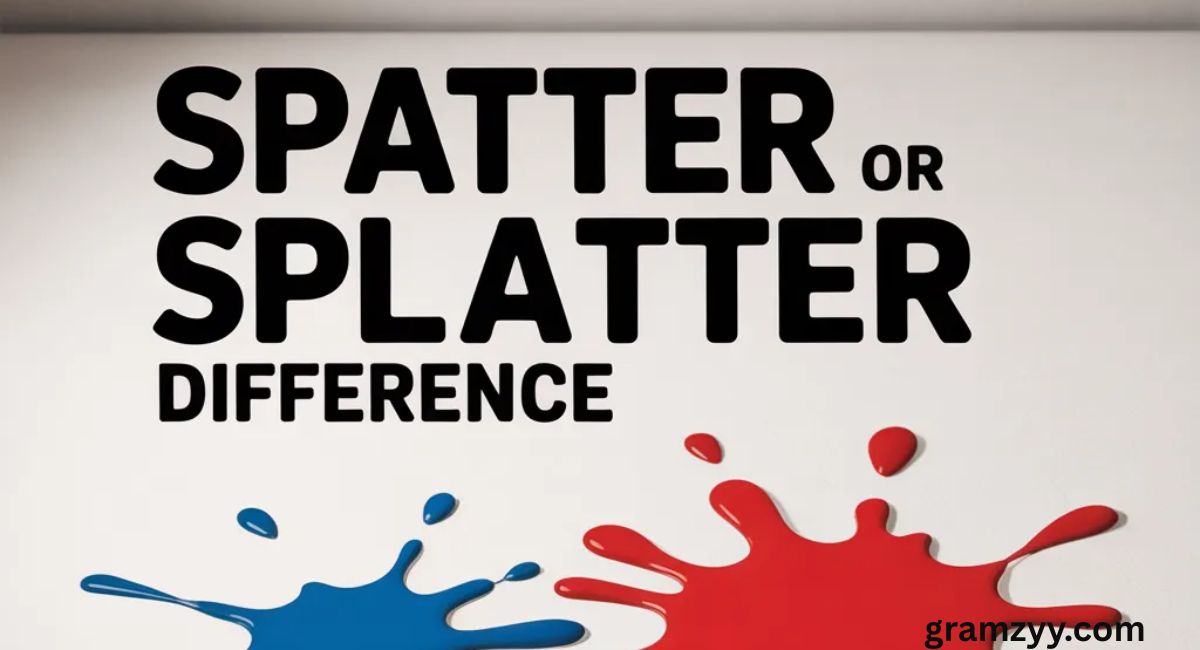
Quick Answer: Spatter or Splatter Difference refers to small droplets or particles scattered with low to medium force. Splatter refers to a larger, more chaotic spread of liquid caused by greater force or volume. Both words work as a verb and a noun but they are not always interchangeable.
If you have ever stood near a frying pan and felt tiny drops of hot oil hit your arm, that is spatter. If a toddler knocked over an entire bowl of spaghetti sauce and it flew across the wall, that is splatter. One word is precise and controlled. The other is dramatic and messy.
This guide explains the difference clearly, shows you real-world examples across cooking, art, and forensics, and gives you practical tips so you always pick the right word.
Basic Definitions and Parts of Speech
Both spatter and splatter function as either a verb or a noun.
| Feature | Spatter | Splatter |
|---|---|---|
| Part of Speech | Verb / Noun | Verb / Noun |
| Drop Size | Small | Large |
| Force Involved | Low to medium | Medium to high |
| Volume | Small amounts | Large amounts |
| Tone / Feel | Controlled, precise | Chaotic, dramatic |
| Common Contexts | Forensics, cooking, rain | Art, accidents, food fights |
| First Known Use | ~1600s | ~1785 |
What Does Spatter Mean?
As a verb, spatter means to scatter small drops of liquid onto a surface. As a noun, it refers to the resulting splash or pattern of tiny drops. The word traces back to the Frisian spatterje (“to send drops flying”) and the Middle Dutch bespatten (“to splash”). Forensic scientists, journalists, and technical writers rely on this word frequently, especially in the phrase blood spatter analysis.
What Does Splatter Mean?
Splatter appeared in English around 1785 and is believed to be a portmanteau — a blend of splash and spatter. That extra “L” in the middle is not random; phonetically, the “spl-” cluster carries more force when spoken aloud. Say both words out loud: spatter… splatter. You can feel the difference. The word suggests something hit hard, spread wide, and made a mess.
Spatter vs. Splatter: The Core Difference
The single most reliable way to choose the right word is to think about size and force.
- Use spatter when the drops are fine, scattered lightly, or result from a controlled process.
- Use splatter when the drops are large, the action is violent or careless, or a big volume of liquid is involved.
Think of it this way: a light rain spatters the pavement. A burst pipe splatters the ceiling.
Real-World Examples by Context
Example 1 — Cooking (Small Drops)
Oil began to spatter across the stovetop as the pan heated up.
Here, the drops are tiny and the action is gradual. Spatter is the natural choice because cooking oil mist consists of small particles moving with moderate force.
Example 2 — Cooking (Larger Drops)
She forgot to put the lid on the blender, and tomato soup splattered all over the kitchen.
A blender accident involves high force and a large volume of liquid flying in all directions. Splatter fits perfectly.
Also read : Impatient vs Inpatient: What’s the Difference?
Example 3 — Painting
The artist spattered the canvas with fine drops of white paint to mimic stars.
An intentional, fine-spray technique = spatter. Jackson Pollock, famously, was known to splatter — throwing large amounts of paint dramatically across his canvases.
Example 4 — Accident
Mud splattered up the side of the car as it drove through the puddle at full speed.
High-speed impact with a puddle creates large, chaotic drops. Splatter is correct.
Example 5 — Scientific / Forensic Description
The forensic analyst examined the blood spatter pattern to determine the angle of impact.
In forensic science, blood spatter is the only accepted term. You will never find a credentialed expert saying “blood splatter analysis.” The drops are measured, their trajectories calculated, and precision matters. The word splatter would undermine the technical accuracy of any report or courtroom testimony.
Example 6 — Visual Effect
The graphic designer added a paint splatter texture to the background for a grunge aesthetic.
In design and digital art, splatter is the dominant term because it conveys bold, expressive, and dramatic visual impact.
Also read : Is Summer Capitalized? Guide for Seasons
Common Mistakes
Mistake 1 — Using the Two Interchangeably Without Considering Scale
Many writers treat spatter and splatter as synonyms. While some dictionaries do list one as a definition of the other, careful writers distinguish them by scale. Saying “the rain splattered on the window” works, but “spattered” paints a more accurate, delicate image of light rain.
Mistake 2 — Ignoring Tone and Connotation
Spatter carries a clinical, restrained tone. Splatter feels louder and more chaotic. In creative writing, using splatter in a quiet, delicate scene will clash with the mood. Match the word to the energy of your sentence.
Mistake 3 — Wrong Verb-Object Collocations
- ✅ Blood spatter (forensic, technical)
- ❌ Blood splatter (colloquial but incorrect in professional contexts)
- ✅ Paint splatter (art, design)
- ✅ Oil spatter (cooking)
Mistake 4 — Overuse in Descriptions
Both words can lose their impact if overused in a single paragraph. Alternate with synonyms like spray, scatter, splash, or sprinkle to maintain readability.
Mistake 5 — Grammar Slips With Past Tense
Both words follow standard conjugation:
| Tense | Spatter | Splatter |
|---|---|---|
| Present | spatter / spatters | splatter / splatters |
| Past | spattered | splattered |
| Past Participle | spattered | splattered |
| Present Participle | spattering | splattering |
American vs. British English Differences
Core Meaning: Same Across Varieties
Neither word has a different definition in American English versus British English. The distinction between small drops (spatter) and large drops (splatter) holds true in both dialects.
Frequency and Preference
In informal writing, splatter appears more frequently in American English, especially in casual journalism and entertainment. British English tends slightly more toward spatter in technical and literary contexts, though both forms are understood across the Atlantic.
Spelling and Grammar
There are no spelling differences. The conjugation rules are identical. Both words follow the same double-letter rule in British English for past tense: spattered, splattered.
Idiomatic Expressions and Metaphor
Literal to Figurative Shift
Both words can shift from literal to figurative use, though this is more common with spatter:
The scandal spattered his reputation with accusations he couldn’t shake.
Here, spatter is used metaphorically to suggest small but damaging marks on someone’s image.
Forensic Phrase: Blood Spatter
This is one of the most important fixed phrases in the English language where the word choice is non-negotiable. Blood spatter analysis — or bloodstain pattern analysis — is a branch of forensic science used to determine the source, direction, and velocity of blood at a crime scene. The term blood splatter is considered incorrect and even unprofessional in forensic and legal contexts, though it is widely used in popular media.
Creative Writing and Tone
In fiction, both words are powerful tools. Spatter creates tension and dread (small drops suggest a wound, a drip, a quiet horror). Splatter creates spectacle and chaos (a burst, a crash, a dramatic moment). Horror writers and crime novelists often use both — choosing carefully based on the scene’s pace and intensity.
Also read : Polite vs Courteous: What’s the Difference?
Practical Tips for Choosing the Right Word
Tip 1 — Ask About Size and Force
If the drops are small and the force is moderate, use spatter. If the spread is large and the force is high, use splatter.
Tip 2 — Consider Tone and Context
Technical or forensic writing → spatter. Creative, expressive, or casual writing → splatter is often more natural.
Tip 3 — Match Collocations
Certain nouns almost always pair with one word. Blood spatter, oil spatter, and rain spatter are established collocations. Paint splatter and mud splatter lean toward splatter.
Tip 4 — Use Active Voice for Clarity
Active voice makes both words stronger:
- ✅ Grease spattered the stovetop.
- ❌ The stovetop was spattered with grease. (Passive — weaker)
Tip 5 — Keep Sentences Short for Visual Scenes
When describing action, shorter sentences let the words do the work:
- The bottle hit the floor. Sauce splattered up the wall. The room went silent.
Tip 6 — When Reporting, Use Precise Terms
In journalism, legal writing, or academic papers, spatter is typically the safer, more precise choice. Reserve splatter for contexts where volume and chaos are key details.
Tip 7 — Edit for Repetition
If you have used spatter or splatter twice in the same paragraph, replace one with scatter, spray, dash, or fling to vary your language.
Tip 8 — Test by Substitution
Swap the two words and read the sentence aloud. If one version sounds wrong or changes the image, stick with the original. Trust your ear.
Tip 9 — Use Modifiers for Precision
When you want to be precise without overthinking the choice, add a modifier:
- A fine spatter of oil covered the pan.
- A heavy splatter of mud coated the bumper.
Tip 10 — Teach With Images
If you are explaining this distinction to someone else, show two images: a light rain on a window (spatter) versus a paint explosion on a canvas (splatter). Visual contrast makes the difference instantly clear.
Revision Examples
Revision 1 — Cooking Description
- Before: The sauce began to splatter from the pan in tiny drops.
- After: The sauce began to spatter from the pan in tiny drops.
Small drops = spatter.
Revision 2 — Forensic Precision
- Before: The detective studied the blood splatter on the wall.
- After: The detective studied the blood spatter pattern on the wall.
In forensic contexts, spatter is always correct. Adding pattern strengthens the technical accuracy.
Revision 3 — Fictional Scene
- Before: Paint spattered across the floor in a wide, chaotic arc as the bucket tipped.
- After: Paint splattered across the floor in a wide, chaotic arc as the bucket tipped.
A full bucket tipping = high volume, high force = splatter.
Revision 4 — Scientific Report
- Before: Analysts noted the splatter distribution was consistent with a medium-velocity impact.
- After: Analysts noted the spatter distribution was consistent with a medium-velocity impact.
Scientific and forensic reports require spatter.
Read it : Puddle
FAQs
Is “blood splatter” correct?
No in forensic science, the correct term is blood spatter. Blood splatter is a common colloquial error often seen in TV crime dramas.
Can spatter and splatter be used interchangeably?
Technically, some dictionaries allow it, but careful writers distinguish them: spatter for small drops, splatter for large or chaotic spreads.
Is splatter a real word or just informal?
It is a real, standard English word. It originated around 1785 and is widely accepted in both formal and informal writing.
Which word is more common in everyday speech?
Splatter tends to appear more frequently in casual, informal language. Spatter is more common in technical, scientific, and formal writing.
What part of speech are spatter and splatter?
Both words function as either a verb (to spatter, to splatter) or a noun (a spatter, a splatter).
How do you pronounce spatter and splatter?
Spatter is pronounced SPAT-er. Splatter is pronounced SPLAT-er. The added “L” gives splatter a slightly heavier, more forceful sound.
Is there a difference in British and American English?
The core meanings are the same. Minor frequency differences exist, with splatter being slightly more common in casual American writing.
Conclusion
The difference between spatter and splatter comes down to one simple idea: scale and force. Small, fine, controlled drops belong to spatter. Large, chaotic, forceful sprays belong to splatter. When in doubt, ask yourself: is this a drizzle or a burst?
In forensic science, the choice is never ambiguous blood spatter is always correct. In cooking, art, and everyday language, the two words exist on a spectrum, and choosing the precise one makes your writing sharper and more vivid.
Understanding this distinction will not only improve your vocabulary it will make your writing feel more authoritative, whether you are drafting a crime novel, a scientific report, or a cooking blog.