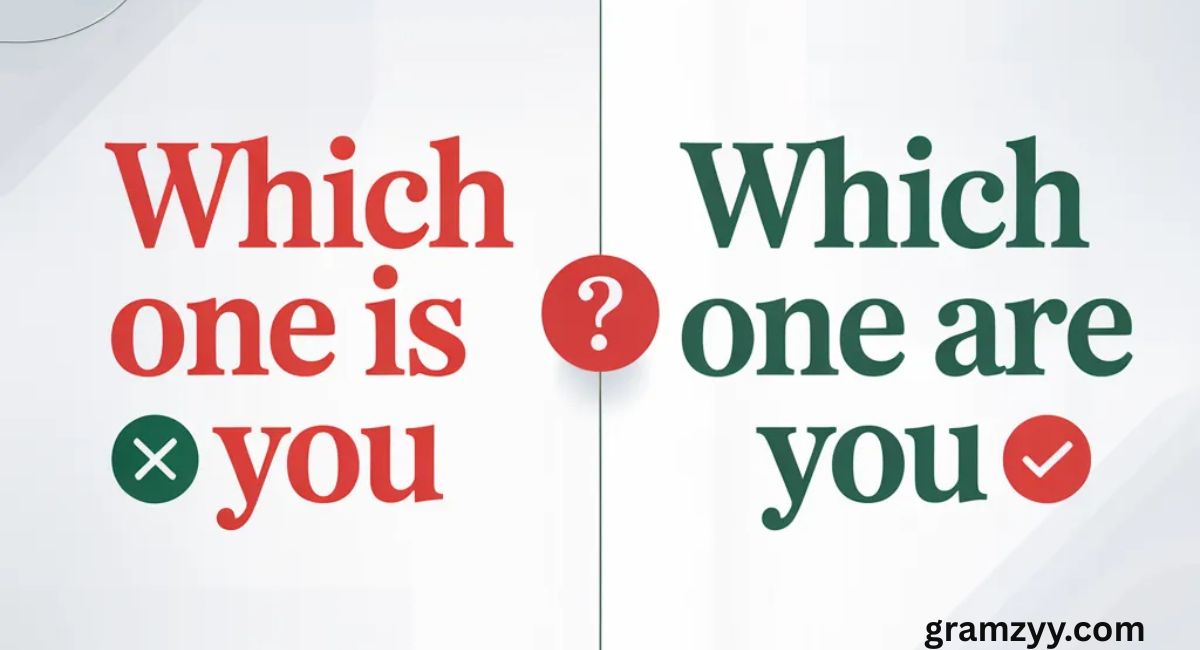
You’re scrolling through a group photo. You want to ask a friend to point themselves out. Do you type which one is you or which one are you?” Both sound familiar — but only one is grammatically correct in standard English. And the difference comes down to a single grammar rule that trips up even fluent speakers.
Let’s settle this once and for all.
The Quick Answer
“Which one are you?” is the grammatically correct phrase.
“Which one is you?” is nonstandard and considered a grammar error in formal writing and professional communication. You may hear it in casual speech, song lyrics, or sitcom dialogue — but those are stylistic choices, not models to follow.
The Grammar Rule Behind “Which One Are You”
The reason is straightforward: subject-verb agreement.
In English grammar, the verb in a sentence must match its subject in person and number. The pronoun you whether referring to one person or many always pairs with the verb are, never with is.
- ✅ You are → always correct
- ❌ You is → always wrong
This rule holds without exception in standard English. “Is” belongs to the third-person singular: he is, she is, it is. The moment your subject is you, the correct linking verb is are.
So in the question “Which one __ you?”, the subject doing the identifying is you. The verb must agree with it — and that means are.
| Pronoun | Correct Verb Form | Example |
|---|---|---|
| I | am | Which one am I? |
| You | are | Which one are you? |
| He / She / It | is | Which one is she? |
| We / They | are | Which one are they? |
Why Do People Say “Which One Is You”?
If “which one is you” is wrong, why does it sound so natural to so many people? There are a few solid reasons.
1. Inverted Sentence Structure Creates Confusion
In questions, the verb often comes before the subject. When you flip the sentence, “Which one” lands right next to the verb — and writers instinctively attach the verb to the nearest noun. Since “one” is singular, “is” feels like the logical fit.
But here’s the thing: “one” isn’t the true subject of the sentence. You are. And that changes everything.
2. Analogy with Other Correct Phrases
Phrases like “That is you” and “This is you” are perfectly correct. Because “is you” appears in valid sentences, speakers unconsciously extend the pattern to questions — even when the grammar doesn’t support it.
3. Casual Speech Bends the Rules
Spoken English has always moved faster than written grammar rules. In everyday conversation, clarity matters more than precision. So “which one is you?” gets a pass in casual talk, even though it would raise eyebrows in a formal email or academic paper.
Also read : City vs Town vs Village: What’s the Difference?
“Which One Are You” in Practice: Usage Examples
✅ Correct Usage
- Look at this old class photo — which one are you?
- There are five characters in the game. Which one are you?
- I saw the team photo on LinkedIn. Which one are you?
- Of all the Hogwarts houses, which one are you?
- Out of these personality types, which one are you?
❌ Incorrect Usage
- ~~Which one is you in this photo?~~
- ~~I’m not sure which one is you on that list.~~
- ~~Of the four options, which one is you?~~
Context Variations
The correct phrasing doesn’t change regardless of context — whether you’re asking casually, writing formally, or even posing a metaphorical question:
- Metaphorical: “Which one are you — the early bird or the night owl?”
- Formal written: “Please indicate which one you are among the provided options.”
- Indirect question: “Can you tell me which one you are?”
- First person: “Which one am I?” — Note: with I, the verb switches to am, not are or is.
A Simple Trick to Get It Right Every Time
Two mental shortcuts will help you lock in the correct form — and you won’t forget it again.
Trick 1: Reverse the Question
Before you write “Which one __ you?”, flip the sentence around:
“You __ which one?”
Now read it aloud. Would you say “You is which one?” Absolutely not — it sounds completely wrong. “You are which one?” is the only option that feels natural. Transfer that back to the original question, and you get “Which one are you?” — every time.
Also read : Tear vs Tare — When to Use Each Word
Trick 2: Swap in a Third-Person Pronoun
Replace you with she or he and listen:
“Which one is she?” → sounds right ✅
“Which one is you?” → suddenly sounds wrong ❌
This swap instantly exposes the mismatch. When you restore you, your ear already knows the verb should change from is to are.
Is “Which One Is You” Ever Acceptable?
The short answer: not in standard writing. But context matters.
In creative writing and fiction, a character might say “Which one is you?” to convey a specific voice, dialect, or personality. Writers use intentional grammar deviations to make dialogue feel authentic to a character’s background.
In song lyrics and media, rhythm and rhyme sometimes override grammar. A line might use “is you” because it fits the beat, not because it’s correct.
In certain regional dialects, particularly some varieties of informal American English, “is” occasionally appears with “you” but even in those contexts, it’s considered nonstandard and is not a model for formal writing.
The rule of thumb: In any professional, academic, or public-facing writing, always use “which one are you?”
Also read : Reevaluation or Re-evaluation: Which Spelling Is Correct?
Quick Reference Summary
| Phrase | Grammatically Correct? | Best Used In |
|---|---|---|
| Which one are you? | ✅ Yes | All formal and informal contexts |
| Which one is you? | ❌ No | Creative/dialectal speech only |
FAQs
Is “which one are you” grammatically correct?
Yes. “Which one are you?” is the grammatically correct form because “you” always takes the verb “are” in standard English.
Why does “which one is you” sound okay to some people?
Because phrases like “That is you” are correct, speakers unconsciously apply the same pattern to questions — even though the grammar rule doesn’t extend there.
Can “which one is you” ever be correct?
In standard writing, no. It may appear in casual speech, song lyrics, or fiction for stylistic purposes, but it’s not accepted in formal or professional contexts.
What grammar rule governs this choice?
Subject-verb agreement. Since “you” is the subject of the question, the verb must agree with it. “You” always pairs with “are,” never with “is.”
What if I’m asking about myself — “which one am I”?
That’s correct. “I” is first-person singular and takes “am.” So “which one am I?” follows the same subject-verb agreement rule.
How do I remember the correct form?
Try reversing the sentence: “You which one?” You’d never say “You is which one,” so the correct form “You are which one?” reveals that the question should be “Which one are you?”
Conclusion
The answer is clear: “Which one are you?” is correct, and it’s the phrase you should use in any serious writing or communication. The confusion is understandable inverted questions, casual speech patterns, and familiar phrases like “that is you” all pull writers toward the wrong form. But the grammar rule is firm: you takes are, always. Memorize the reversal trick, apply it when you’re unsure, and you’ll never mix these two up again.