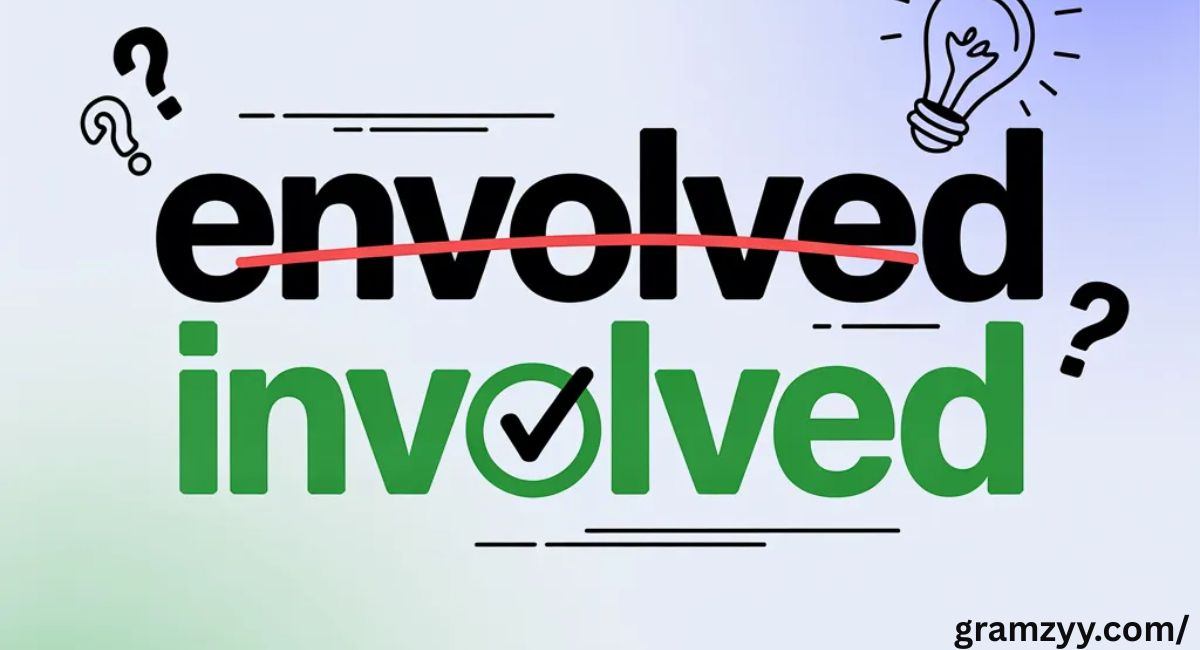
envolved or involved If you’ve ever typed “envolved” and had spell-check underline it in red, you’re not alone. This is one of the most common spelling slip-ups in English — and the fix is simple. “Involved” is always correct. “Envolved” does not exist in any standard English dictionary. Period.
This guide breaks down exactly why the confusion happens, what “involved” actually means, and how to make sure you never mix them up again.
Why “Envolved” Is Not a Word
“Envolved” has no Latin root, no historical usage, and no entry in any recognized dictionary. It is a misspelling created by analogy with “en-” prefix words — a reasonable guess, but wrong.
The real root of the word is Latin: involvere, meaning “to wrap up” or “to entangle.” Notice the prefix — “in-“, not “en-.” That Latin origin has carried through into modern English unchanged, which is why the spelling “involved” has been consistent since at least the 14th century.
According to Google’s Ngram Viewer, which tracks word usage across millions of books, “involved” has been consistently used since the 1600s. “Envolved” appears almost zero times, confirming it is not a recognized term.
The “en-” Prefix Problem
So why do so many people write “envolved”? English has a large family of “en-” prefix words — enclose, ensure, engage, envelop, enlarge and writers apply that pattern to new words without thinking. “Envolve” sounds like it follows the same logic as “enclose.” It does not.
It’s a pattern recognition error, not a reflection of someone’s intelligence. Your brain sees a word that sounds like it starts with “en” and autocompletes accordingly. Understanding the trap is usually all it takes to stop falling into it.
How to Use “Involved” Correctly
“Involved” is a remarkably flexible word. It functions both as a past tense verb and as an adjective, and its meaning shifts depending on the context.
“Involved” scores high in versatility. It can be a verb or an adjective, and its uses range from everyday situations to emotional contexts and formal writing.
Here are the three main meanings:
| Meaning | Description | Quick Example |
|---|---|---|
| Participation | Taking part in something | “She was involved in the event planning.” |
| Complexity | Something difficult or intricate | “The instructions were quite involved.” |
| Emotional connection | Personally or romantically linked | “They became involved after working together.” |
Correct Usage Examples
Let’s look at how “involved” works across different scenarios:
Participation / Engagement
- She has been involve in community outreach for over a decade.
- Three departments were involve in finalizing the report.
- Our team got involve in the merger discussions early on.
Complexity / Intricacy
- The assembly process was far more involved than the manual suggested.
- The legal case turned into a long, involved negotiation.
- His explanation was so involve that even the experts struggled to follow.
Emotional or Relational Context
- They became emotionally involved after collaborating on the project.
- She’s deeply involve in her children’s education.
- He didn’t want to get involve in the argument.
Incorrect Usage Examples
To make the contrast clear, here are common errors alongside their corrections:
| ❌ Incorrect (Envolved) | ✅ Correct (Involved) |
|---|---|
| The participants were envolved in the study. | The participants were involved in the study. |
| She got envolved in the charity project. | She got involved in the charity project. |
| The plot was too envolved to follow. | The plot was too involved to follow. |
| We’re proud to be envolved in our community. | We’re proud to be involved in our community. |
| How many people were envolved? | How many people were involved? |
Spell-checkers catch this error about 87% of the time, but autocorrect sometimes misses it. Don’t rely on software alone — knowing the rule yourself is the most reliable safety net.
Context Variations
One reason “involved” is such a useful word is that it adapts naturally to different registers and settings.
Professional Writing
In workplace communication, “involved” signals participation and accountability:
- “Which stakeholders were involve in this decision?”
- “Our legal team was involve from the outset.”
Academic Writing
In student manuscripts, “envolved” appears most often in methodology sections — a typical example: “the participants envolved in the study.” In every case, replacing “envolved” with “involved” fixes the sentence immediately.
Casual / Everyday Speech
- “I don’t want to get involve.”
- “She’s really involved in that new hobby.”
Legal and Formal Contexts
- “Several contractors were involve in the dispute.”
- “The process involves multiple regulatory steps.”
The word form changes depending on tense, but the spelling stays rock-solid:
| Form | Example |
|---|---|
| Base verb | involve |
| Present tense | involves / involve |
| Past tense | involved |
| Present participle | involving |
| Noun form | involvement |
None of these ever use “en-.”
See also: Mine As Well, Might As Well, or Mind As Well
Common “Envolved” Spelling Mistakes
The confusion doesn’t always appear in isolation. In roughly 80% of cases, writers who spell “envolved” also write “envolve” as the verb form. They have built an entire incorrect word family. The solution is to correct all forms at once.
Here’s a quick look at the full incorrect “family” vs. the correct forms:
| ❌ Incorrect Form | ✅ Correct Form |
|---|---|
| envolve | involve |
| envolved | involved |
| envolving | involving |
| envolvement | involvement |
Another common source of confusion is the word “evolve” — which is a real word, but means something entirely different. “Evolved” comes from “evolve,” meaning to develop or change over time. If you mean participation or connection, you want “involved.” If you mean gradual development or change, you want “evolved.” They are not interchangeable.
How to Remember the Correct Spelling of “Involved”
A few practical memory tricks:
- The “IN” anchor: You are IN something when you are INvolved. The prefix “in” matches the idea of being inside or included in something. That’s your hook.
- Trace the Latin root: Involvere → involve → involved. The “in-” was there at the beginning and has never changed.
- Read it aloud: “I got envolved in the project” sounds subtly off compare to “I got involved in the project.” Trust your ear — spoken English has preserve the “in-” pronunciation all along.
- Eliminate “evolved”: Ask yourself — do I mean participated in, or changed over time? If it’s participation, the answer “involved,” full stop.
- Spell it out deliberately: i-n-v-o-l-v-e-d. Fifteen letters, starting with the ninth letter of the alphabet, not the fifth.
As Benjamin Franklin reportedly put it: “Tell me and I forget. Teach me and I remember. Involve me and I learn.” Even in that famous quote, the spelling is clear — involve, not envolve.
What Does “Involved” Mean in Different Contexts?
Because “involved” carries more than one meaning, context is everything. Here’s a breakdown of how the word shifts:
1. Active Participation
The most common use. Someone is taking part in an activity, project, or event.
2. Complexity or Difficulty
Used as an adjective to describe something intricate or hard to follow.
“The tax code is incredibly involved — even accountants find it challenging.”
3. Romantic or Personal Relationship
Describes an emotional or intimate connection between people.
“She didn’t know they were involved until much later.”
4. Legal or Formal Responsibility
Indicates that someone played a role in an event, often with accountability implications.
“Three parties were involved in the contract dispute.”
5. Research or Academic Processes
Common in methodology sections to describe study participants or research steps.
“All subjects involved in the trial provided written consent.”
Conclusion
The answer is clear and absolute: “involved” is correct, and “envolved” is not a word. It doesn’t appear in Merriam-Webster, the Oxford English Dictionary, or the Cambridge Dictionary — because it has never existed in standard English.
The mix-up happens because of a genuine pattern in the language: English has many “en-” prefix words that feel familiar. But “involved” has always started with “in-,” rooted in its Latin origin involvere, and that will never change.
Use “involved” when you mean participating in something, describing something complex, or expressing an emotional connection. Double-check your writing, and whenever you feel unsure, remember: involved people stay engaged.
FAQs
“envolved” ever correct in any context?
No. “Envolved” is never correct in any context, dialect, or style of English. Always use “involved.”(envolved or involved)
What is the difference between “involved” and “evolved”?
“Involved” means participating in or connected to something; “evolved” means developed or changed over time. They are completely different words.
How do you pronounce “involved”?
The correct pronunciation is /ɪnˈvɒlvd/ — the stress falls on the second syllable, and the prefix sounds like “in,” not “en.”
Will spell-checkers always catch “envolved”?
Most spell-checkers will flag it, but autocorrect tools occasionally miss it. Knowing the rule yourself is more reliable than depending on software.(envolved or involved)
What is the noun form of “involved”?
The noun form is “involvement” — also beginning with “in-,” never “en-.”
Can “involved” being uses as an adjective?
Yes. “Involved” functions as both a past tense verb and an adjective meaning complex or intricate, as in “a long, involved explanation.”
Why do so many people write “envolved”?
Because English has many common “en-” prefix words (enclose, ensure, engage, envelop), and writers sometimes apply that pattern to “involved” by mistake. It’s a prefix pattern error, not a reflection of overall language ability.(envolved or involved)