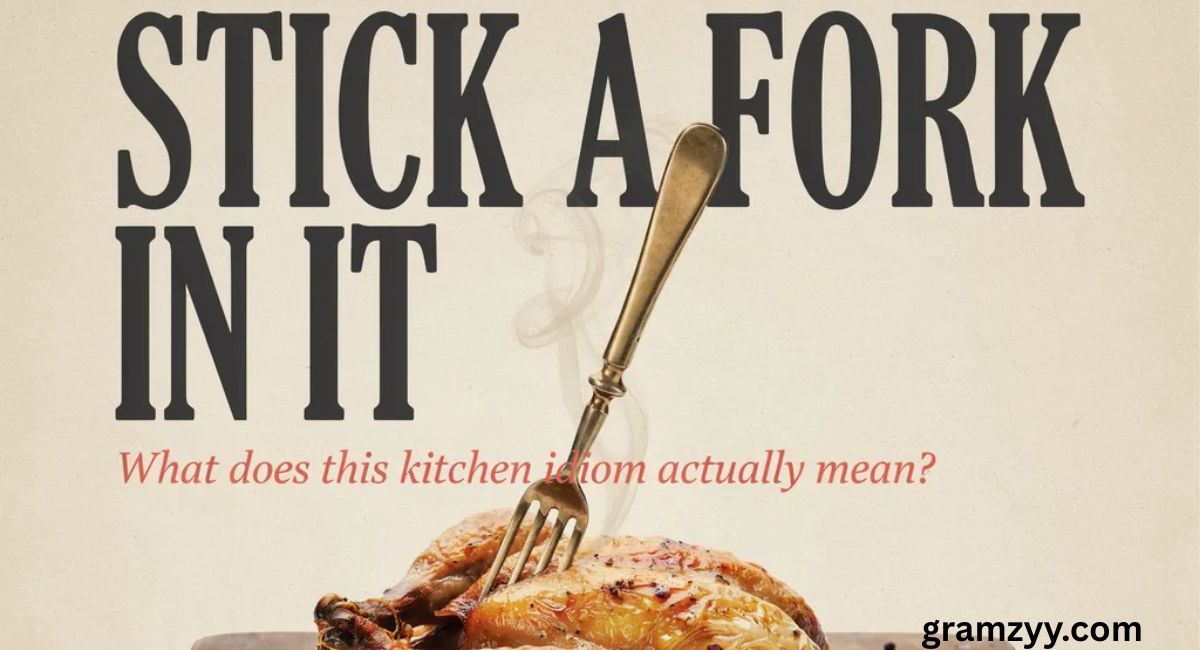
Ever heard someone say “stick a fork in it” and wondered what forks have to do with anything? This punchy American idiom appears in sports commentary, workplace conversations, social media posts, and everyday speech.This guide explains its meaning, origin, and usage in clear, simple terms.
What Does “Stick a Fork in It” Mean?
“Stick a fork in it” is an informal American idiom that means something is completely finished, over, or beyond recovery.
The full phrase behind the idiom is: “Stick a fork in it — it’s done.” Over time, the second half got dropped, and the shortened version stuck.
The word “done” carries a double meaning that makes this idiom clever:
- In the kitchen: done means thoroughly cooked
- In everyday life: done means finished, exhausted, or concluded
This wordplay is what gives the expression its staying power. It’s vivid, visual, and instantly understood.
See also : It Is Must vs It Is a Must: Which Form Is Correct?
Quick Definition Table:
| Phrase | Meaning | Tone |
|---|---|---|
| Stick a fork in it | Something is completely finished | Informal, humorous |
| Stick a fork in me | I am completely exhausted or done | Casual, self-deprecating |
| Stick a fork in him/her | That person is finished or done | Sports/commentary context |
Where Did This Phrase Come From?
The Kitchen Origin
Before meat thermometers became common, cooks used simple methods to check whether food was ready. One of the oldest techniques involved poking meat with a fork This method was often used for roasts, turkey, and ham.
That literal act — sticking a fork in to test doneness — gradually evolved into a figurative expression signaling that something had reached its end point.
The Sports Connection
American sports commentators, especially in baseball and football, helped popularize the phrase and bring it into mainstream culture. Announcers needed quick, colorful ways to signal that a game was effectively over.
The earliest known figurative use is credited to Dizzy Dean, the legendary baseball player and broadcaster. In the 1940s, he reportedly said of an underperforming pitcher: “You can stick a fork in him, folks — he’s done.” That line captured the imagination of sports fans and media alike.
By the 1970s and 80s, the idiom had spread well beyond baseball. Linguistic researchers, including Barry Popik, have documented its growing use in broader American popular culture during this era.
How Do You Use “Stick a Fork in It”?
Correct Usage Examples
Here are natural, contextually appropriate ways to use this idiom:
Completing a project:
“We just submitted the final report. Stick a fork in it — we’re done!”
A losing sports team:
“Down by 30 with two minutes left? You can stick a fork in them. This one’s over.”
Personal exhaustion:
“After moving boxes all day, stick a fork in me. I’m completely spent.”
A failed plan:
“The campaign flopped three times in a row. Stick a fork in it and let’s start fresh.”
Ending a relationship or project:
“After three years of trying to revive that friendship, I finally had to stick a fork in it.”
Incorrect Usage Examples
❌ Wrong — using it for something incomplete:
“I’m halfway through this report, so let’s stick a fork in it.” (The idiom means fully finished, not halfway.)
Wrong — using it in a formal document:
“Following extensive review, we recommend the committee stick a fork in this proposal.” (Far too casual for professional or formal writing.)
❌ Wrong — using it in a sensitive or serious situation:
“The patient had a rough surgery. Stick a fork in him.” (Deeply inappropriate. Medical, grief, and crisis contexts require respectful, precise language.)
❌ Wrong — grammatical misuse:
“Let’s stick a fork into this problem.” (The standard phrase is “stick a fork in it,” not “into this.”)
Context Variations
The phrase shifts in tone depending on who says it and how:
| Context | Example | Tone |
|---|---|---|
| Sports broadcast | “Stick a fork in the Rams — this game is over.” | Dramatic, exciting |
| Office conversation | “We passed QA testing. Stick a fork in version 3.0!” | Celebratory, casual |
| Social media | “That trend is dead. Stick a fork in it.” | Sarcastic, humorous |
| Personal exhaustion | “After that hike, stick a fork in me.” | Playful, self-deprecating |
| Failed plan | “That idea never worked. Stick a fork in it.” | Decisive, final |
See also : Passersby or Passerbyers: Which Plural Is Correct?
Common Mistakes People Make
Even fluent English speakers misuse this idiom from time to time. Here are the most frequent errors:
- Using it too early — The phrase implies total completion.
- Using it in formal writing — Academic papers, business proposals, legal documents, and official reports are no place for this idiom. It belongs in casual speech and informal writing only.
- Using it in sensitive situations — Illness, grief, personal loss, or serious crises call for respectful, direct language. The casual humor of this phrase can come across as cold or dismissive in the wrong setting.
- Using it with an international audience — Non-native English speakers may not recognize this American idiom.
Memory Tricks for This Expression
Struggling to remember what “stick a fork in it” means? These mental hooks will help:
- Picture a roast dinner. Imagine poking a fork into a perfectly cooked piece of meat. When it slides in easily, dinner’s ready — that’s done.
- Focus on the word “done.” Done means cooked in the kitchen. Done means finished in life. Both uses of “done” connect directly to this phrase.
- Think of a sports announcer. Picture a broadcaster declaring a losing team finished. The drama and finality of sports commentary is exactly where this idiom thrives.
- Associate it with informality. Whenever you hear or think of this phrase, mentally tag it as casual. That reminder will stop you from using it in the wrong setting.
When Should You Avoid This Phrase?
Knowing when not to say something is just as valuable as knowing when to use it. Avoid “stick a fork in it” in these situations:
Formal or professional writing: Essays, reports, cover letters, business proposals, and academic papers demand precise, formal language. This idiom has no place there.
Sensitive or emotional conversations: Discussions involving death, serious illness, divorce, or personal trauma require care and compassion. A casual idiom like this can minimize the weight of what someone is going through.
International or cross-cultural communication: American idioms often don’t translate well across cultures. If your audience includes non-native English speakers or international colleagues, opt for plain language.
Legal or medical contexts: These fields require accuracy and professionalism. Colourful idioms can create confusion or seem flippant.
Similar Expressions
If “stick a fork in it” feels too casual for a given moment, here are alternatives that carry a similar meaning:
- “Call it a day” — Signals stopping, often at a natural stopping point
- “Done and dusted” — British English for completely finished
- “That’s a wrap” — Common in film and TV production; signals completion
- “Over and out” — From radio communication; signals a final, definitive end
- “It’s all over but the crying” — Means the outcome is certain, even if formalities remain
See also : For Who or For Whom: What’s the Difference?
FAQs
What does “stick a fork in it” mean in simple terms?
It means something is completely finished or over — nothing more can be done.
Who first used “stick a fork in it” figuratively?
Baseball legend and broadcaster Dizzy Dean is credited with its earliest known figurative use in the 1940s.
Is “stick a fork in me” the same expression?
Yes — “stick a fork in me” simply shifts the meaning to personal exhaustion or completion rather than an external situation.
Can I use “stick a fork in it” at work?
Only in casual, friendly workplace settings. Avoid it in formal documents, presentations to clients, or professional reports.
What’s a formal alternative to “stick a fork in it”?
Use “this matter is concluded,” “the project is complete,” or simply “we’re finished.”
Conclusion
“Stick a fork in it” is one of those idioms that feels instantly satisfying once you understand it. Rooted in a centuries-old kitchen practice and popularized through American sports commentary, it delivers finality with a dash of humor.
Use it where it fits, skip it where it doesn’t, and you’ll sound like a natural English speaker who genuinely understands the language — not just the words.