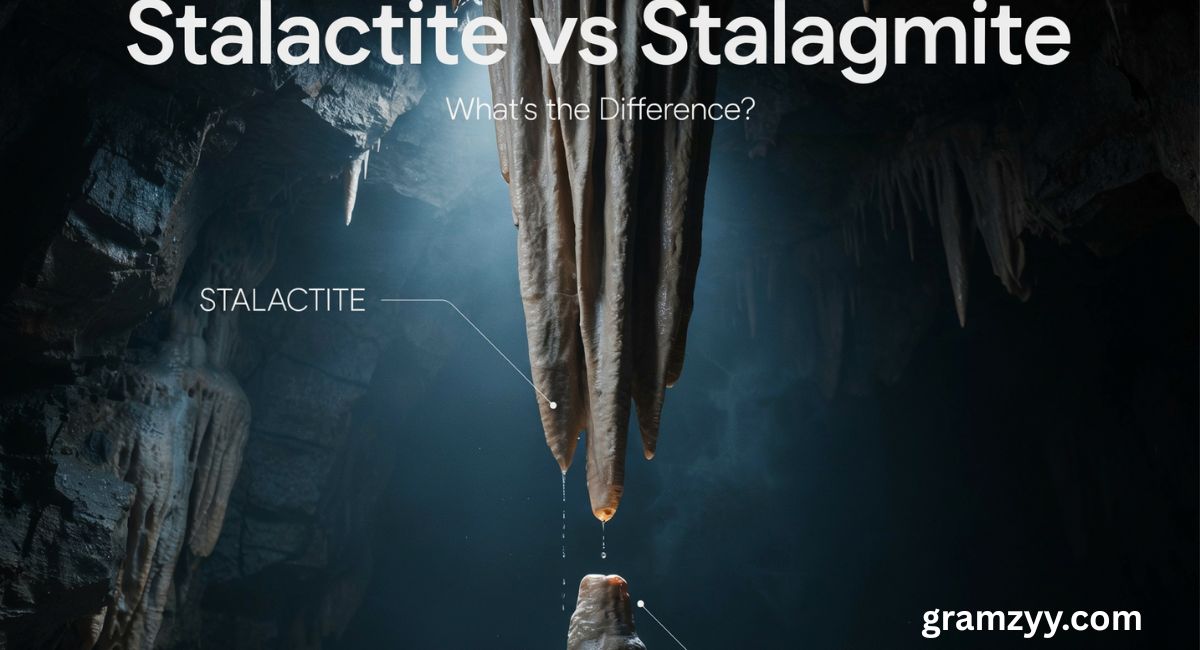
Stalactite vs stalagmite: Walk into any limestone cave and you’ll see strange, pointy formations hanging from the ceiling and rising from the floor. Most people call them all “stalactites” or mix up the two names entirely — and honestly, who can blame them? The words look almost identical and sound even more alike out loud.
The good news is that once you understand where each formation grows and how it’s built, you’ll never confuse them again. This guide breaks down everything you need to know: the meanings, the science behind their formation, the easiest ways to tell them apart, and a few memory tricks geologists and tour guides swear by.
Stalactite vs Stalagmite: What’s the Difference?
In short: a stalactite hangs down from the ceiling of a cave, while a stalagmite grows up from the cave floor. Both are mineral formations called speleothems, and both form from the same dripping, mineral-rich water — they just grow in opposite directions.
| Feature | Stalactite | Stalagmite |
|---|---|---|
| Location | Hangs from the cave ceiling | Rises from the cave floor |
| Growth direction | Downward | Upward |
| Shape | Slender, icicle-like, tapers to a point | Thicker, mound-like, rounded tip |
| Thickness | Thicker at the top, narrow at the tip | Thicker at the base, narrower toward the top |
| Central channel | Often has a hollow tube in the center | No central tube |
| Memory clue | “T” for top / ceiling | “G” for ground / floor |
If a stalactite and a stalagmite grow toward each other long enough, they eventually meet and fuse into a single solid structure known as a column or pillar.
What Do Stalactite and Stalagmite Mean?
Both words trace back to the Greek term stalassein, meaning “to drip” — a fitting origin since dripping water is exactly what creates these formations.
- Stalactite: a tapering mineral deposit that hangs from the roof or wall of a cave, formed by mineral-laden water dripping from above.
- Stalagmite: a mound-shaped mineral deposit that builds upward from a cave floor where dripping water lands and leaves mineral residue behind.
Both belong to a broader category of cave formations called speleothems — a word combining the Greek roots for “cave” and “deposit.” Other speleothems include flowstone, cave popcorn, and soda straws, but stalactites and stalagmites remain the most recognizable.
How Do Stalactites and Stalagmites Form?
The process behind both formations starts long before water ever reaches a cave.
- Rainwater seeps into the ground and trickles through cracks in limestone or dolomite rock.
- As it travels, the water absorbs carbon dioxide, turning it into a weak carbonic acid.
- This mildly acidic water dissolves calcium carbonate from the surrounding rock, carrying it along as calcium bicarbonate.
- When the water reaches the cave ceiling, it loses carbon dioxide and some of the dissolved mineral converts back into solid calcite.
- A thin ring of calcite is left behind around the drip point, and repeated drops slowly build a hanging stalactite.
- Any water that falls before depositing all its mineral content hits the cave floor below, where the remaining calcite settles and builds an upward-growing stalagmite.
This is an extremely slow process. On average, these formations grow only around 10 centimeters every thousand years, though the exact rate depends on water flow, mineral concentration, and humidity inside the cave. Some recorded stalactites are estimated to be well over 100,000 years old. Because the two formations share a single drip source, a stalactite often (though not always) has a matching stalagmite growing directly beneath it.
See also : Checkup vs Check-Up — Which Is Correct?
How Can You Tell a Stalactite from a Stalagmite?
If you’re standing in a cave and need a quick answer, look at these visual cues:
- Position — Anything hanging overhead is a stalactite; anything rising from the ground is a stalagmite.
- Shape — Stalactites are narrow and pointed, similar to icicles. Stalagmites are broader and rounder, more like small mounds or cones.
- Tip — Stalactites usually end in a sharp point. Stalagmites tend to have flatter, rounded tops.
- Width pattern — Stalactites are widest near the ceiling and taper as they descend. Stalagmites are widest at the base and narrow as they rise.
- Surface texture — Stalactites often have a hollow central channel from years of water flowing through them; stalagmites are typically solid all the way through.
When in doubt, remember that gravity does the explaining for you: water drips down, so the hanging formation comes first, and whatever it leaves behind on the floor comes second.
See also : Prescribe or Proscribe
Examples of Stalactite and Stalagmite in Sentences
Seeing the words used correctly in context makes them much easier to remember.
Correct Usage Examples
- The tour guide pointed to a massive stalactite hanging just above our heads.
- A single stalagmite in the center of the chamber had grown nearly six feet tall.
- Over thousands of years, the stalactite and stalagmite finally met to form a column.
- Cavers were warned not to touch the stalactites, since skin oil can stop their growth.
Incorrect Usage Examples
- “Watch your head on that stalagmite!” — Incorrect, since nothing on the ceiling is a stalagmite.
- “I tripped over a stalactite on the cave floor.” — Incorrect, since stalactites don’t grow on the ground.
- “The stalagmite dripped water onto my shoulder.” — Incorrect, since dripping comes from the ceiling formation, the stalactite.
Context Variations
- Geology class: “Students measured the growth rate of a stalagmite using calcite layering.”
- Travel writing: “The cenote’s ceiling was lined with delicate stalactites that glittered under our flashlights.”
- Fiction: “She ducked beneath a row of jagged stalactites as the tunnel narrowed.”
- Science journalism: “Researchers studied an ancient stalagmite to reconstruct centuries of rainfall data.”
Common Stalactite vs Stalagmite Mistakes
Even confident writers slip up here. Watch out for these recurring errors:
- Swapping the direction — Saying a stalagmite “hangs” or a stalactite “rises” reverses their meaning entirely.
- Misspelling under pressure — Writers often drop a letter or swap the “c” and “g,” producing nonexistent versions of either word.
- Assuming they always pair up — Not every stalactite has a stalagmite directly below it, and vice versa.
- Calling every formation a stalactite — Many people default to this term for any cave formation, even ones growing from the floor.
- Treating “speleothem” and “stalactite” as interchangeable — Speleothem is the umbrella term; stalactites and stalagmites are just two types within it.
Memory Tricks to Remember the Difference
These tried-and-tested tricks make the distinction stick almost instantly:
| Trick | How It Works |
|---|---|
| Letter association | Stalactite has a “t” for top; stalagmite has a “g” for ground. |
| Ceiling phrase | “Stalactites hold tight to the ceiling.” |
| Action phrase | Stala(g)mites might grow up and touch the ceiling; stala(c)tites are already stuck to it. |
| Rhyme trick | “Tites” hang tight from above; “mites” might rise from below. |
Pick whichever version sticks best in your head — most people only need one solid mental shortcut to never mix them up again.
Why Do People Confuse Stalactite and Stalagmite?
The confusion isn’t a coincidence — it comes down to a few simple reasons:
- The two words differ by only two letters, both buried mid-word.
- They sound almost identical when spoken quickly.
- Most people only encounter the words once, briefly, in a school science class, with little reinforcement after that.
- Both formations appear in the same caves, so it’s easy to point at the wrong one.
- Neither word comes up often enough in daily life to become second nature.
Once you’ve used a memory trick once or twice, the difference tends to stick for good.
See also : Is Used vs Has Been Used vs Was Used
Context and Usage Guide
Knowing when to use each term matters as much as knowing what they mean.
- Use stalactite for any formation hanging from a cave ceiling, wall overhang, or even man-made tunnels and mines.
- Use stalagmite for a mound-shaped formation rising from a cave floor.
- In scientific writing, pair both terms with “speleothem,” “calcite,” or “dripstone” for added precision.
- In travel writing, both words add vivid, sensory detail when describing caves, cenotes, or grottos.
- Avoid using either term as a loose stand-in for “rock formation,” since that weakens precision for readers who know the geology.
FAQs
Which one hangs from the ceiling, a stalactite or a stalagmite?
A stalactite hangs from the ceiling. A stalagmite grows upward from the floor.
What is the easiest way to remember the difference?
Remember that stalactite has a “t” for top, while stalagmite has a “g” for ground.
Can a stalactite and stalagmite join together?
Yes. When they grow toward each other long enough, they fuse into a single structure called a column or pillar.
How long does it take for a stalactite or stalagmite to form?
Growth is extremely slow, averaging around 10 centimeters per thousand years, depending on water flow and mineral content. (stalactite vs stalagmite)
Are stalactites and stalagmites the same type of formation?
They’re both speleothems made mainly of calcite, but they differ in location, shape, and growth direction.
Conclusion
stalactite vs stalagmite might sound like geology trivia, but the difference is simple once it clicks: one hangs from above, the other builds from below, and both form from the same slow mineral drip over thousands of years. Next time you’re exploring a cave — or just settling a trivia round — you’ll know exactly which formation is which.