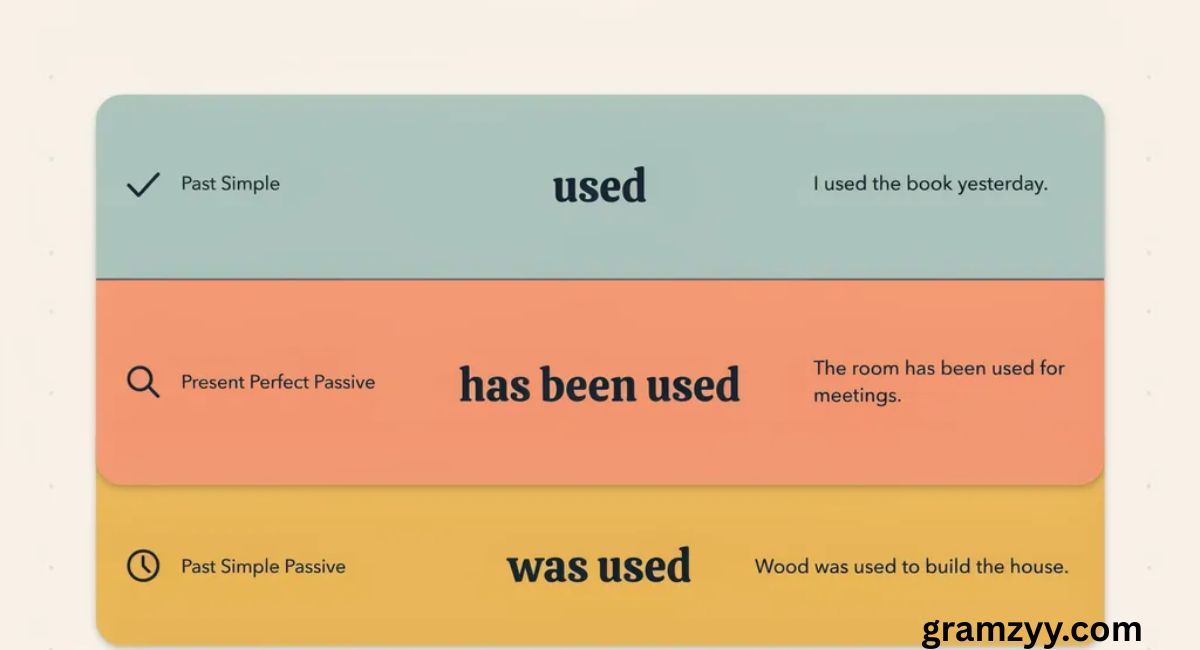
Choosing between is used has been used vs was used is one of the most common grammar challenges in English. Each form is a passive construction, but each one places an action in a different time relationship with the present. Get the wrong one and your sentence can mislead a reader, weaken a report, or muddle academic writing. This guide breaks down every form clearly, with labeled examples, comparison tables, common mistakes, and ten practical tips.
| Form | Tense | Time Meaning | Example |
|---|---|---|---|
| is used | Present simple passive | Current habit or general fact | This software is used daily by the team. |
| has been used | Present perfect passive | Past action still relevant now | This technique has been used in three trials so far. |
| was used | Simple past passive | Completed action at a definite past time | That tool was used before the upgrade last year. |
Contextual Examples
The clearest way to master these three forms is to see them working side by side in realistic sentences. Below, each part of speech is labele so you can trace the grammar pattern quickly.
Basic Passive Forms Labeled
Each passive is built from the same template: subject + auxiliary verb (be) + past participle. Only the auxiliary changes to show tense and aspect.
SUBJECT Python AUX is PAST PART use in data science courses worldwide.
The SUBJECT This method AUX has been PAST PART use in medical research for decades.
SUBJECT The old bridge PAST PART use until the new one opened in 2018.
Active/Passive Comparisons With Labels
| Active Voice | Passive Voice | Form |
|---|---|---|
| Doctors use this drug routinely. | This drug is used routinely. | Present simple passive |
| Researchers have used this model twice. | This model has been used twice. | Present perfect passive |
| Engineers used the old system before 2020. | The old system was used before 2020. | Simple past passive |
Questions and Negatives With Labels
Question (present passive): Is this tool use in production? → Yes, it is.
Negative (present passive): This feature is not use anymore.
Question (present perfect passive): Has this method been use before? → Yes, it has.
Negative (present perfect passive): The data has not been use yet.
Question (simple past passive): Was this approach use in the pilot? → Yes, it was.
Negative (simple past passive): The prototype was not use in the final test.
Time Markers and Meaning Checks
Time markers are the fastest way to pick the right form. The table below shows which signal words force which passive.
| Time Marker | Correct Form | Example |
|---|---|---|
| every day, always, generally, in most cases | is used | This formula is used in every calculation. |
| already, recently, so far, this week, ever, never, just | has been used | The app has been used over a million times already. |
| yesterday, last year, in 2019, at that time, before… | was used | Steam power was used in factories throughout the 1800s. |
Common Mistakes
Most errors come down to five predictable traps. Knowing them in advance saves you from repeating them.
Mistake 1 — Wrong Auxiliary With Tense
✗ The data have been use last Monday. (plural auxiliary with a definite past time — wrong)
✓ The data was use last Monday. (definite past time requires simple past passive)
The word last Monday pins the action to a specific past moment, which forces was use, not the present perfect.
Mistake 2 — Confusing Present Simple Passive With Present Perfect Passive
✗ This method is use in three clinical trials so far this year.
✓ This method has been use in three clinical trials so far this year.
“So far this year” indicates an unfinished time period — a classic trigger for the present perfect passive.
Mistake 3 — Using Was Use for Present Relevance
✗ This approach was use to improve efficiency. (but the effect is still active now)
✓ This approach has been use to improve efficiency.
If the result of an action is still visible or relevant today, has been use is the appropriate choice. Was use closes the door on the past; has been use leaves it open.
See also : Bad Rap or Bad Rep: Which Phrase Should You Use?
Mistake 4 — Subject–Verb Agreement Errors With Is/Has/Was
✗ The results is use to draw conclusions.
✓ The results are use to draw conclusions. (plural subject → are)
✓ The result is use to draw a conclusion. (singular subject → is)
Remember: is/has/was go with singular subjects; are/have/were go with plural subjects.
Mistake 5 — Omitted Agent or Time Marker That Changes Meaning
✗ This system was use. (by whom? when? the sentence is incomplete in context)
✓ This system was use by the engineering team in Q3 2023.
In formal or technical writing, leaving out the agent or time reference when they are important can confuse the reader or undermine the credibility of your work.
American vs British English Differences
Core Grammar Is the Same
The three passive forms follow identical grammar rules in both American and British English. Subject–verb agreement, auxiliary choice, and past participle form do not vary by dialect. A sentence that is grammatically correct in American English is correct in British English too.
Subtle Preference in Style Guides
British English tends to favor the present perfect passive in contexts where American English accepts the simple past passive, especially when the time frame is “today” or “this week.” For example:
- British: The form has been use twice today. American: The form was use twice today.
Both are grammatically valid; the difference reflects a stylistic tendency, not a rule.
Use in Reporting and Journalism
Journalistic style in both countries tends to prefer was use for clear past events, since news writing values directness and economy. Academic and scientific prose in both varieties leans toward has been use when linking past methods to present findings.
Pronunciation and Pacing
There are no grammar-changing pronunciation differences between dialects. In fast speech, has been use is sometimes reduce to /həzbɪnjuːzd/. In formal presentations, speakers may replace it with an active construction for pace and clarity: instead of “this approach has been use,” they might say “researchers have used this approach.”
See also : Blow This Popsicle Stand: Meaning and Usage
Idiomatic Expressions
The passive form with used appears in several fixed expressions. It is important not to confuse these idioms with the standard passive tenses covered above.
Common Passive Idioms With Labels
| Expression | Meaning | Note |
|---|---|---|
| used to + infinitive | Past habit no longer true: She used to run every morning. | NOT a passive — “used” is a semi-modal here |
| be used to + noun/gerund | Accustomed to something: He is used to long meetings. | NOT a passive of “use” — stative expression |
| get used to | Become accustomed: You will get used to the new system. | Idiomatic; uses “get” passive informally |
Verbs Often Found With These Passives
These verbs commonly appear in the same structures and are worth practicing together: applied, adopted, implemented, employed, deployed, incorporated, leveraged, relied upon, referred to, built upon. Each can follow the same is / has been / was + past participle pattern.
Practical Tips
Tip 1 — Ask What You Mean: Present Habit, Recent Use, or Past Event?
Before writing, ask yourself one question: Is this action happening now, still relevant from the past, or fully finishe? The answer maps directly onto is use, has been use, or was use.
Tip 2 — Check for Time Markers That Force a Tense
Words like yesterday, last year, in 2020 demand was use. Like already, recently, ever, so far demand has been use. Words like always, generally, every day point to is use. Spot the marker first, then choose the form.
Tip 3 — Label the Parts of Speech to Avoid Mistakes
When revising, quickly label your subject, auxiliary, and past participle. This habit catches agreement errors (results is use → results are use) and wrong auxiliary choices before they reach a reader.
Tip 4 — Watch for Idioms With “Used To”
Do not confuse the idiom used to + infinitive (past habit) or be use to + gerund (accustomed) with the passive forms. These are entirely different constructions that happen to share the same word.
Tip 5 — Choose Active Voice When Clearer
Passive constructions are valuable, but active voice is often stronger. “Researchers have use this method” is more direct than “this method has been use by researchers.” Reach for passive when the subject is unknown, unimportant, or when you want to emphasize the object.
Tip 6 — Use Present Perfect Passive to Emphasize Present Result
Has been used is especially powerful in academic writing, business reports, and literature reviews where you want to show that past work still informs current conclusions. It signals continuity and relevance.
Tip 7 — Avoid Redundant Agents With Passive Auxiliaries
Do not write “this method has been use by people.” If the agent (by people) adds no information, drop it. Write “this method has been use widely” instead.
Tip 8 — Check Agreement Carefully With Collective Nouns
Collective nouns like team, committee, data can be tricky. In American English, data is treate as plural (the data are use), while in British English it can be singular or plural. Check the style guide your context requires.
Tip 9 — Read Aloud to Hear Tense and Aspect Fit
A sentence that sounds awkward when read aloud often contains a tense mismatch. Reading aloud slows down your internal editor and makes it easier to spot when was use feels wrong where has been use should be.
Tip 10 — Edit for Economy and Clarity
After drafting, scan every passive and ask: does this sentence need to be passive at all? If yes, does it use the correct form? Cutting unnecessary passives and correcting wrong tenses in one pass tightens writing significantly.
Revision Examples and Fixes
Example: Wrong Time Marker With Present Perfect
✗ This database has been use in 2019 to store patient records.
✓ This database was use in 2019 to store patient records.
In 2019 is a definite, closed time marker. It requires the simple past passive (was use), not the present perfect passive.
Example: Subject–Verb Agreement
✗ The samples has been use in the second trial.
✓ The samples have been use in the second trial.
The subject samples is plural. The auxiliary must match: have been use, not has been use.
Example: Active Voice Replacement
Passive (weak): This approach has been use by us to cut costs by 30%.
Active (stronger): We have used this approach to cut costs by 30%.
When the agent is known and relevant, active voice is clean and more confident — especially in business communication.
See also : A Day Well Spent: Meaning, Usage, and Common Mistakes
FAQs
Can “is use,” “has been use vs “was use” be use interchangeably?
No. Each carries a distinct time meaning and swapping them changes what the sentence communicates about when and whether an action is still relevant.
Which form is most formal — is use, has been use, or was use?
All three appear in formal writing. Has been use is most common in academic prose for linking past research to present findings. (Is Used vs Has Been Used vs Was Used)
Is “has been use” correct for a singular subject?
Yes — has been use pairs with a singular subject; have been use pairs with plural subjects.
What is the difference between “was use” and “used to be use”?
Was use describes a single past action; use to be use emphasizes a repeat past habit that no longer happens.
Can I use “is use” in academic writing?
Absolutely — it is appropriate when describing current methods, standard procedures, or general scientific principles that remain active. (Is Used vs Has Been Used vs Was Used)
Does British English prefer “has been use” over “was use”?
British English tends to favor the present perfect for recent events, so you will see has been use slightly more often in UK writing for recent past actions.
Conclusion
Mastering the difference between is use, has been use vs was use comes down to one core idea: time control. Is use describes what happens now or in general. Has been use connects a past action to a present result or ongoing relevance. Was use places an action firmly in a completed past.
To choose correctly every time, check the time markers in your sentence, label the subject to confirm agreement, and ask whether the action still matters in the present moment. With those three steps, the right form becomes obvious — and your writing becomes cleaner, more credible, and more precise.