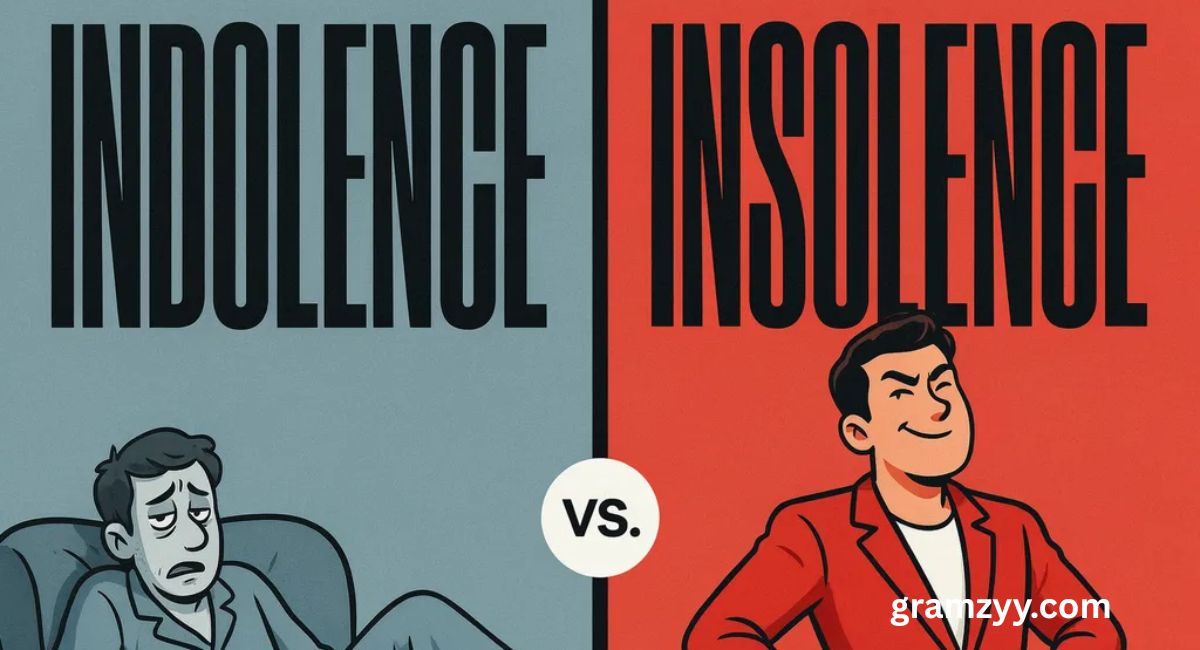
Indolence vs insolence: You’re writing a performance review. You mean to say an employee is lazy, but you accidentally type “insolent.” Or you call a rude student “indolent” during a class discussion — and confuse your audience entirely. It happens more than you think, and the consequences aren’t minor. These two words look like twins, sound nearly identical, but describe completely opposite human behaviors. This guide breaks down everything you need to know — their definitions, origins, grammar, usage, and foolproof memory tricks — so you never mix them up again.
Why This Confuses Even Professionals
Indolence and insolence are what linguists call minimal pairs by near-phoneme — words that differ by only one or two sounds or letters but carry drastically different meanings. Both are formal, three-syllable nouns ending in -olence. appear most often in academic writing, professional evaluations, and literary prose. Both describe negative qualities in people.
That combination — similar sound, similar context, similar tone — is a perfect storm for confusion. Even experienced writers, editors, and HR professionals slip up. A manager once wrote “His insolence affected team output” when what they meant was that the employee’s laziness was slowing things down. The reader likely pictured a rude, combative worker — not a sluggish one.
The stakes are real. In a legal document, a performance review, or an academic essay, using the wrong word can misrepresent someone’s character entirely.
Historical Roots: Two Latin Words, Two Different Journeys
Both words are born from Latin — which is exactly why they look so similar today. But their journeys through history diverged dramatically.
The Etymology of Indolence: From Pain to Laziness
Indolence traces directly to the Latin indolentia, built from two components: in- (meaning “not”) and dolere (meaning “to suffer pain or grieve”). Literally, indolentia meant “freedom from pain” or “insensibility.”
The earliest English uses around 1600 applied the word medically — prisoners under torture who showed no reaction were said to exhibit indolence. By the 1650s, a transitional meaning emerged: “a state of rest, neither painful nor pleasurable.” Think of it as neutral comfort, like lying in a hammock not particularly happy or unhappy.
By 1710, the modern sense solidified. Writers like Richard Steele began using indolence to mean “love of ease” and “avoidance of effort.” The conceptual bridge makes logical sense: if taking pains meant working hard, then someone who avoided all pain was, naturally, avoiding all work.
The Etymology of Insolence: From Unusual to Unacceptable
Insolence derives from the Latin insolentia, from in- (not) and solere (to be accustomed). The original meaning was remarkably neutral — “unusual, unfamiliar, unaccustomed.” Romans used insolens to describe anything outside established norms, not necessarily with negative intent.
The word’s character darkened over centuries. Classical writers like Cicero deployed insolentia against political opponents to suggest arrogance and contemptuous behavior that violated social hierarchy. By the time Middle French passed insolence into English in the late 14th century, the meaning had fully shifted to its modern form: deliberate disrespect, especially toward authority.
See also: Introduction To vs Introduction Of: What’s the Difference?
The Grammatical Architecture Behind the Confusion
Both words function as nouns in standard usage. Each has a corresponding adjective — indolent and insolent — which follow the same grammatical rules.
| Feature | Indolence | Insolence |
|---|---|---|
| Part of speech | Noun | Noun |
| Adjective form | Indolent | Insolent |
| Syllable count | 3 (in-do-lence) | 3 (in-so-lence) |
| Latin root | indolentia (freedom from pain) | insolentia (unusual, arrogant) |
| Direction | Inward (affects the person) | Outward (affects others) |
| Tone | Passive, sluggish | Active, defiant |
| Synonyms | Laziness, sloth, idleness | Rudeness, impudence, arrogance |
| Antonyms | Diligence, industriousness | Respect, deference, courtesy |
Notice the key structural difference: indolence is inward-facing. It affects the individual’s own productivity and output. Insolence is outward-facing — it targets other people and disrupts relationships, social order, or authority structures.
Real-World Examples: Context Changes Everything
Professional Settings: The Workplace
In the workplace, these words appear most often in performance reviews, disciplinary records, and HR documentation. Getting them wrong here can have serious consequences.
- Indolence at work: “Despite repeated warnings, Marcus’s indolence has resulted in three missed deadlines this quarter. His lack of initiative is affecting team performance.”
- Insolence at work: “During the board presentation, Sarah’s insolence — dismissing the CEO’s question with a wave of her hand — shocked everyone present.”
Notice the difference in what each sentence describes. Marcus has a motivation problem. Sarah has a respect problem. These require entirely different managerial responses.
Academic Environments: The Classroom
Teachers and professors encounter both behaviors regularly, and the distinction matters enormously for disciplinary action and parent communication.
- Indolence in the classroom: “The teacher’s report noted Jordan’s habitual indolence — assignments submitted late, readings left incomplete, participation minimal.”
- Insolence in the classroom: “The principal had to intervene after a student’s insolence during the assembly, where they openly mocked the guest speaker.”
A lazy student needs motivation strategies. An insolent student needs behavioral intervention. Confusing the two in a school record is not just grammatically wrong — it’s diagnostically wrong.
Casual Conversation: Tone Shifts
In everyday speech, both words sound formal and slightly old-fashioned. Most people would say “lazy” instead of “indolent” or “rude” instead of “insolent.” But when they do appear in conversation, clarity of meaning matters:
- “I can’t believe his indolence — he’s had three weeks to clean that apartment.”
- “Her insolence at dinner last night was embarrassing. She talked back to her grandmother the entire meal.”
See also: For Your Records: Meaning, Usage, and Examples
The Neuroscience of Confusion: Why Your Brain Keeps Mixing These Up
There’s actual science behind why these words trip people up. The brain processes language through a combination of phonological encoding (how words sound) and orthographic recognition (how they look). When two words share nearly identical sound and visual patterns, the brain sometimes retrieves the wrong one — especially in low-frequency vocabulary situations.
Because most people encounter indolence and insolence rarely — primarily in formal reading or high-register writing — they’ve never formed strong individual memory traces for each word. The brain essentially stores them in the same “formal vocabulary drawer,” filing them together because they’re both negative, both formal, both uncommon.
Cognitive load compounds the problem. When writing quickly, under deadline, or in an emotionally charged situation, the brain reaches for the first close match. That’s often the wrong one.
The solution isn’t simply reading the definitions once more. It’s building a distinct sensory anchor for each word — which the memory devices section below addresses directly.
Synonyms, Antonyms, and Semantic Neighbors
Understanding Indolence Through Related Terms
Knowing which words live near indolence in meaning helps you sense when to use it:
- Synonyms: laziness, sloth, idleness, lethargy, apathy, inertia, torpor, sluggishness
- Antonyms: diligence, industriousness, vigor, initiative, ambition, drive
- Related concepts: procrastination, inaction, passivity, disengagement
Indolence sits closest to laziness in everyday language, but it carries a slightly more literary and habitual connotation. It’s not just a bad day — it’s a pattern.
Understanding Insolence Through Related Terms
- Synonyms: rudeness, impudence, impertinence, disrespect, audacity, cheekiness, contempt, effrontery
- Antonyms: respect, courtesy, deference, humility, civility, decorum
- Related concepts: defiance, arrogance, disregard for authority, rebelliousness
Insolence is closest to impudence in register — both carry the sense of deliberate, targeted disrespect toward someone with social authority. Unlike mere rudeness, insolence tends to be more intentional and more confrontational.
Regional Variations: American vs. British Usage
Both words are standard in formal English worldwide, but subtle patterns exist between American and British usage.
In American English, insolence appears frequently in school disciplinary codes, legal proceedings, and parenting literature. Indolence shows up more in literary criticism and historical commentary.
In British English, both words enjoy slightly broader everyday usage, particularly in formal correspondence and educational contexts. British newspapers are more likely to describe a politician’s indolence or a teenager’s insolence than their American counterparts, who would default to laziness or rudeness.
Neither spelling nor meaning differs between the two varieties — this is purely a usage frequency distinction.
See also: There Has Been vs There Have Been — What’s the Difference?
Common Mistakes and Mental Triggers
Here are the errors that appear most often — and the quick fixes:
| Incorrect Usage | Corrected Version | Why |
|---|---|---|
| “Her insolence kept her from finishing the project.” | “Her indolence kept her…” | Laziness delays work; rudeness doesn’t |
| “The manager punished his indolence at meetings.” | “…punished his insolence at meetings.” | Challenging a manager is disrespect, not laziness |
| “His indolence toward the teacher was unacceptable.” | “His insolence toward the teacher…” | Disrespect toward a person = insolence |
| “Indolence is the reason she talks back.” | “Insolence is the reason she talks back.” | Talking back is active disrespect |
The Psychology Behind the Errors
Most errors fall into two categories. The first is context collapse — the writer knows what behavior they’re describing but grabs the wrong label in the moment. The second is assumption blending — the writer vaguely knows both words are negative and assumes they’re interchangeable. They’re not.
The cleanest test: substitute your word with either laziness or rudeness. If laziness fits, use indolence. If rudeness fits, use insolence.
Field Observations
Real-world misuse of these words follows predictable patterns across different writing environments:
In education: Teachers writing behavioral referrals most commonly confuse insolence (what they almost always mean — a student was disrespectful) with indolence (which they rarely intend, since behavioral referrals address conduct, not motivation).
Business writing: HR professionals most commonly swap indolence (what they mean — an employee is underperforming due to lack of effort) with insolence (which implies the employee is actively challenging authority).
In literary analysis: Students writing about characters sometimes call a slothful, unmotivated character insolent, when the correct literary term is indolent. Fitzgerald’s daisy isn’t insolent — she’s indolent.
Practical Tips for Permanent Mastery
- Run the substitution test — Replace your word with “laziness” or “rudeness.” The right synonym reveals the right word.
- Check the direction — Is the behavior aimed inward (self) or outward (others)? Inward = indolence. Outward = insolence.
- Ask about motivation — Does the person not want to work, or do they not respect authority? The former is indolence; the latter is insolence.
- Build a vocabulary chart — Keep a personal reference list of commonly confused word pairs. Seeing them together regularly builds distinct memory traces over time.
- Write practice sentences — Try rewriting the same scenario using each word. The sentence that makes logical sense reveals which word belongs there.
Memory Devices That Actually Work
The “D” and “S” Trick:
- Indolence has a “d” — think “do nothing.” The indolent person does nothing.
- Insolence has an “s” — think “sass.” The insolent person sasses back.
The Mental Picture Method: Picture an indolent person slumped on a couch, unwilling to move. Now picture an insolent person pointing a finger, arguing defiantly with their boss. Two completely different scenes. Two completely different words. Lock each image to its word.
The Root Word Bridge:
- Indolence → indolent → idle (they all share that passive, low-energy quality)
- Insolence → insolent → insulting (all three carry that sharp, outward edge)
The Rhyme Device:
- “Lazy and indolent share the same dent — both make a dent in your productivity.”
- “Insolent and insulting both start with ins — both sting.”
Conclusion
Indolence vs insolence are two of the English language’s most reliably confused word pairs — not because people are careless, but because the words are genuinely similar in form while being genuinely different in meaning. One describes a habit of avoiding effort. The other describes a pattern of showing contempt. One turns inward; the other turns outward. One disappoints; the other offends.
Master the distinction and you’ll write with more precision, communicate with more authority, and avoid the kind of embarrassing errors that slip through even professional documents. The next time you reach for one of these words, pause for a second: laziness or rudeness? Passive or aggressive? Then choose accordingly.
FAQs
What is the simplest way to remember Indolence vs insolence?
Indolence = idle + do nothing (laziness). Insolence = insulting + sass (rudeness). The “d” in indolence stands for “do nothing”; the “s” in insolence stands for “sass.” (Indolence vs insolence)
Can someone be both indolent and insolent at the same time?
Yes — an employee can avoid work (indolent) and argue rudely when confronted about it (insolent). The two behaviors are separate but can coexist.
Is indolence always a negative trait?
Nearly always in modern usage, though historically it described a neutral state of painless rest. Today it implies a problematic lack of effort or initiative. (Indolence vs insolence)
What is the adjective form of indolence vs insolence?
The adjective form of indolence vs indolent. The adjective form of insolence is insolent. Example: “an indolent worker” versus “an insolent employee.”
Which word is more commonly used in formal writing?
Both appear in formal registers, but insolence is slightly more common in disciplinary, legal, and educational contexts, while indolence appears more frequently in literary and historical writing.
Is insolence always directed at authority figures?
Primarily, yes. Insolence describes disrespect toward someone in a position of authority — a teacher, employer, parent, or official. However, it can describe general contemptuous behavior in broader contexts.
How do you use indolence in a sentence correctly?
“Despite her talent, chronic indolence prevented her from reaching her professional potential.” The word describes habitual avoidance of effort — not rudeness. (Indolence vs insolence)