Two verbs. One small letter apart. Completely opposite meanings. If you have ever typed one when you meant the other, you are not alone — this is one of the most common word-choice errors in academic, medical, and legal writing. Understanding prescribe or proscribe is not just a grammar exercise; getting it wrong can change the entire meaning of a sentence, sometimes with serious consequences.
This guide breaks down both words with clear examples, common mistakes, regional differences, and practical tips so you never mix them up again.
Contextual Examples
Basic Meanings and Parts of Speech
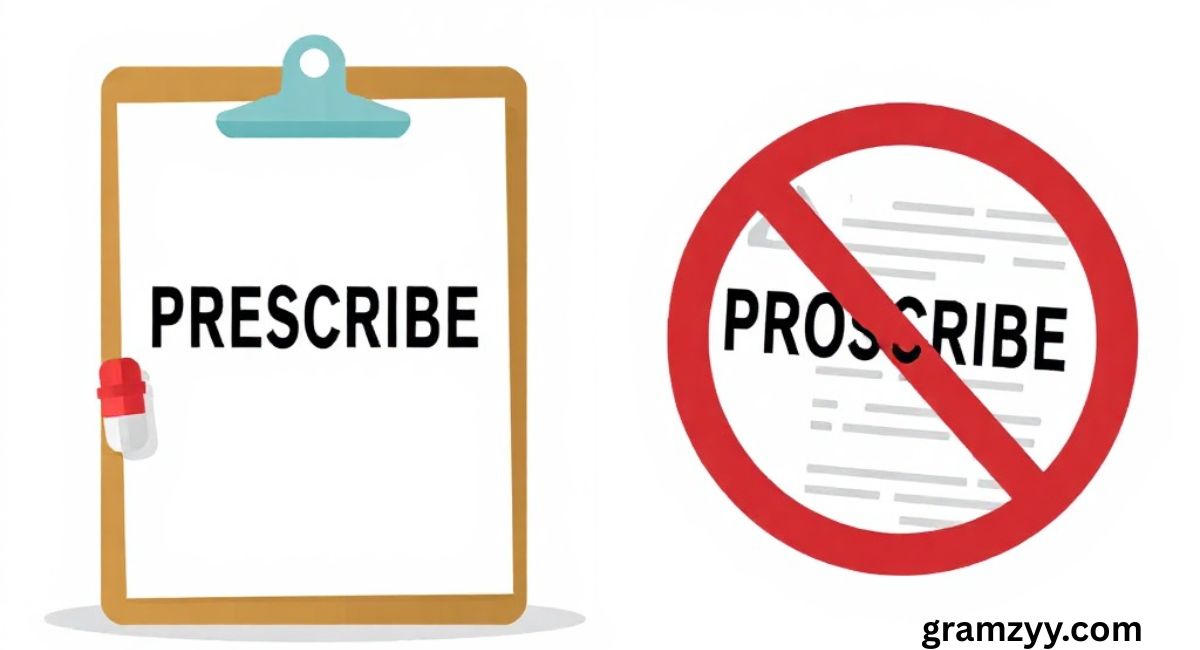
Both words are verbs. They share a Latin root (scribere, meaning “to write”), but their prefixes take them in opposite directions.
| Word | Prefix | Core Meaning | Noun Form | Adjective Form |
|---|---|---|---|---|
| Prescribe | pre- (before) | To recommend, order, or lay down a rule | Prescription | Prescriptive |
| Proscribe | pro- (publicly forth) | To forbid, ban, or outlaw | Proscription | Proscriptive |
A quick memory trick: proscribe contains the letter O, just like “no.” When you proscribe something, you say “no” to it. Prescribe shares its E with “yes” — you recommend or allow something.
Example 1 — Medicine vs Law
Prescribe is most familiar in medical contexts. A licensed physician recommends a treatment or medication to a patient.
- The cardiologist prescribed a low-sodium diet and daily exercise.
Proscribe appears in legal or regulatory contexts, where an authority forbids a specific action or behavior.
- The new regulation proscribes the discharge of industrial waste into rivers.
Notice how swapping these words would make the sentences nonsensical — or dangerously misleading.
Example 2 — Instructional Use
Prescribe also works outside medicine to mean “to officially establish rules or procedures.”
- The employee handbook prescribes a clear dress code for client-facing staff.
- The Constitution prescribes the process by which amendments may be added.
This instructional sense is common in law, policy writing, and academic style guides.
Example 3 — Forbidding Use
Proscribe steps in when something is being banned, condemned, or outlawed — usually with legal weight.
- Several countries have proscribed the organization as a terrorist group.
- Smoking is proscribed in all enclosed public spaces.
This word carries a formal, often punitive tone. You would rarely hear it in casual conversation.
Example 4 — Clarifying Contrast
Placing both words side by side reveals the sharpness of their opposition:
- The guidelines prescribe the use of safety helmets; they equally proscribe entering the site without one.
This kind of parallel structure works well in policy documents, where both what is required and what is banned need to be stated clearly.
Example 5 — Passive Voice Use
Both verbs are frequently used in passive constructions, especially in formal and legal writing.
- Rest and fluids were prescribed by the attending physician.
- The practice was formally proscribed by the council in 2019.
Passive voice suits these words well because attention stays on the rule or decision, not the person giving it.
Example 6 — Prescription vs Proscription Nouns
The noun forms are equally easy to confuse because they look nearly identical.
- She picked up her prescription from the pharmacy. (what the doctor ordered)
- The government issued a proscription against the sale of counterfeit goods. (official ban)
A useful check: if you can replace the noun with “doctor’s order” or “recommended course,” use prescription. If you can replace it with “ban” or “prohibition,” use proscription.
See also : Is Used vs Has Been Used vs Was Used
Common Mistakes
Mistake 1 — Swapping the Words
The single most common error is simply using one word where the other belongs.
❌ My doctor proscribed antibiotics for the infection. ✅ My doctor prescribed antibiotics for the infection.
Doctors prescribe — they recommend treatment. They do not proscribe unless they are forbidding you from taking something, which would require a very different sentence.
Mistake 2 — Treating Proscribe as a Prescribe Synonym
Some writers assume these words are interchangeable variants of the same idea. They are not. They are near-antonyms. Using proscribe when you mean prescribe does not just weaken your writing — it reverses your meaning entirely.
Mistake 3 — Confusing Prefixes
The prefix pro- usually carries a positive meaning in English (progress, promote, provide). This leads many people to assume proscribe must be the “positive” or “recommending” word. It is not. In proscribe, the pro- means “publicly forth,” as in publicly denouncing or declaring something banned.
Mistake 4 — Using Proscribe in Casual Speech
Proscribe belongs to formal registers — legal texts, government documents, official policy. Using it in everyday speech often sounds odd or out of place.
Awkward: My gym proscribes phones in the sauna. Natural: My gym bans phones in the sauna.
Save proscribe for contexts where the formal weight actually serves the sentence.
Mistake 5 — Incorrect Verb Forms
Neither verb takes irregular forms. Both follow standard conjugation, but writers sometimes invent forms that do not exist.
| Form | Prescribe | Proscribe |
|---|---|---|
| Base | prescribe | proscribe |
| Past tense | prescribed | proscribed |
| Past participle | prescribed | proscribed |
| Present participle | prescribing | proscribing |
| Third-person singular | prescribes | proscribes |
❌ The rule was proscribeded. — This is not a word. The past form is simply proscribed.
American vs British English Differences
Core Meanings: Same Across Varieties
Neither word has a different meaning in American vs British English. A British judge and an American judge would use proscribe in the same legal sense. A British GP and an American physician both prescribe medication.
Frequency and Tone
In American English, prescribe appears more often in everyday contexts — partly because American healthcare discussions dominate mainstream media. In British English, both words appear with similar frequency in legal and policy contexts, but proscribe feels slightly more at home in British statutory language.
Register and Context
British legal texts tend to use proscribed organization as a fixed collocation, particularly under anti-terrorism legislation. American legal writing more commonly uses prohibited or banned where British writers might choose proscribed.
Idiomatic and Cultural Notes
In American grammar education, prescriptive grammar vs descriptive grammar is a well-known debate. In British academic writing, the same terms apply with equal weight. Neither country uses proscriptive grammar as a standard term, though it is technically correct.
See also : What Does “Fish Dont Fry in the Kitchen” Mean?
Idiomatic Expressions
Prescribe Common Phrases
- Prescribe a course of action — to recommend a set of steps
- Prescribe penalties — used in legal language to establish punishments
- As prescribed by law — following official rules or statutes
- Prescribed burn — a controlled fire set intentionally for land management
Proscribe Common Phrases
- Proscribed organization — a group officially banned by a government
- Proscribed substance — a substance made illegal by law
- Proscribed conduct — behavior forbidden under a code or regulation
Figurative Uses
Both words occasionally appear outside their literal contexts:
- Society once proscribed behaviors that are now considered normal. (condemned informally)
- The style guide prescribes shorter sentences for better readability. (recommends firmly)
These figurative uses are valid, but clarity is key — the context should make the intended meaning immediately obvious.
Practical Tips
Tip 1 — Use a Simple Meaning Test
Before writing either word, ask: Am I recommending or ordering something, or am I forbidding something?
- Recommending → prescribe
- Forbidding → proscribe
Tip 2 — Substitute Plain Verbs to Check Meaning
Replace the verb with a simpler synonym and see which fits:
- Can you replace it with recommend, order, or authorize? → Use prescribe
- Can you replace it with ban, forbid, or outlaw? → Use proscribe
Tip 3 — Watch Legal vs Medical Context
Prescribe dominates medical writing. Proscribe dominates legal writing. If you are drafting a patient care plan, you almost certainly want prescribe. If you are drafting a regulatory document about banned activities, you almost certainly want proscribe.
Tip 4 — Check Collocations and Objects
What follows each verb also signals the right choice:
- Prescribe naturally collocates with: medication, treatment, dosage, rest, exercise, procedure, rule
- Proscribe naturally collocates with: organization, conduct, activity, substance, behavior
Tip 5 — Mind Register
Proscribe is a formal word. If your audience is general or the tone is conversational, ban or forbid will serve you better. Reserve proscribe for legal, academic, or policy-heavy writing.
Tip 6 — Correct Verb Forms and Agreement
Always use the standard conjugated forms. There are no irregular forms, no double-d endings, and no shortcuts.
Tip 7 — Use Active Voice for Clarity
Passive constructions are common with both words, but active voice often removes ambiguity:
- ✅ The committee prescribed a new procedure. (clear and direct)
- ✅ The law proscribes this activity. (clear and direct)
Tip 8 — Avoid Near-Opposite Confusion by Rewriting
If a sentence feels unclear, replace the confusing verb entirely. “The policy forbids X” and “the policy requires Y” are simpler and harder to misread.
Tip 9 — Teach With Minimal Pairs
When explaining the difference to others, use a minimal pair — two sentences that are identical except for the one word:
- The doctor prescribed the medication. (authorized it)
- The committee proscribed the medication. (banned it)
The contrast is immediate and memorable.
Tip 10 — Use Dictionary or Legal Glossary When Unsure
For academic or professional documents, verify usage with a trusted source: Merriam-Webster, Oxford English Dictionary, or a legal glossary. A single wrong word in a contract or clinical note can create serious misunderstandings.
Revision Examples
Revision 1 — Fixing Swapped Verbs
❌ The health authority proscribed a vaccine schedule for newborns. ✅ The health authority prescribed a vaccine schedule for newborns.
A health authority recommends a schedule — it does not ban one.
Revision 2 — Choosing Plain Language
❌ The office proscribes eating at your desk. ✅ The office prohibits eating at your desk. (or: does not allow eating at your desk)
Proscribe sounds overly formal in an office context. Prohibits or a plain phrasing works better.
Revision 3 — Clarifying Medical Context
❌ She was proscribed three weeks of bed rest. ✅ She was prescribed three weeks of bed rest.
Medical recommendations always use prescribe. Proscribe would imply her bed rest was officially banned — the opposite of the intended meaning.
Revision 4 — Correcting Tense and Agreement
❌ The council has proscribeded the rally. ✅ The council has proscribed the rally.
The past participle is proscribed, not proscribeded. No additional suffix is needed.
See also : Bad Rap or Bad Rep: Which Phrase Should You Use?
Conclusion
Prescribe and proscribe are not just similar-looking words — they are functional opposites. One recommends or authorizes; the other bans or condemns. Getting them right matters in medicine, law, policy, and anywhere precise language is expected.
The simplest rule: if you are giving someone something to do or take, use prescribe. If you are taking something away or making it off-limits, use proscribe. When in doubt, swap in a plain synonym — recommend or ban — and you will never go wrong.
FAQs
Q: What is the main difference between prescribe and proscribe?
Prescribe means to recommend or officially order something; proscribe means to forbid or ban it. They are near-opposites.
Q: Can a doctor proscribe medication?
Only if they are banning a patient from taking it. In standard usage, doctors prescribe — they recommend treatment, not ban it.
Q: Do prescribe and proscribe have the same noun form?
No. Prescribe → prescription; Proscribe → proscription. They look similar but carry opposite meanings.
Q: Is proscribe used in everyday conversation?
Rarely. It belongs to formal, legal, or official writing. In casual speech, ban or forbid sounds more natural.
Q: Is the meaning of these words the same in British and American English?
Yes — the core meanings are identical in both varieties, though British legal writing slightly favors proscribed more than American usage does.