If you’ve ever heard someone say “Don’t be such a Scrooge!” and wondered exactly what it scrooge meaning — and why it carries so much weight — you’re in the right place. The word “scrooge” is one of the most recognizable terms in the English language, yet many people use it without fully understanding its depth, origin, or the subtle differences in how it can be applied. This guide breaks it all down clearly, with real examples, grammar tips, and everything you need to use the word correctly.
What Does “Scrooge” Mean?
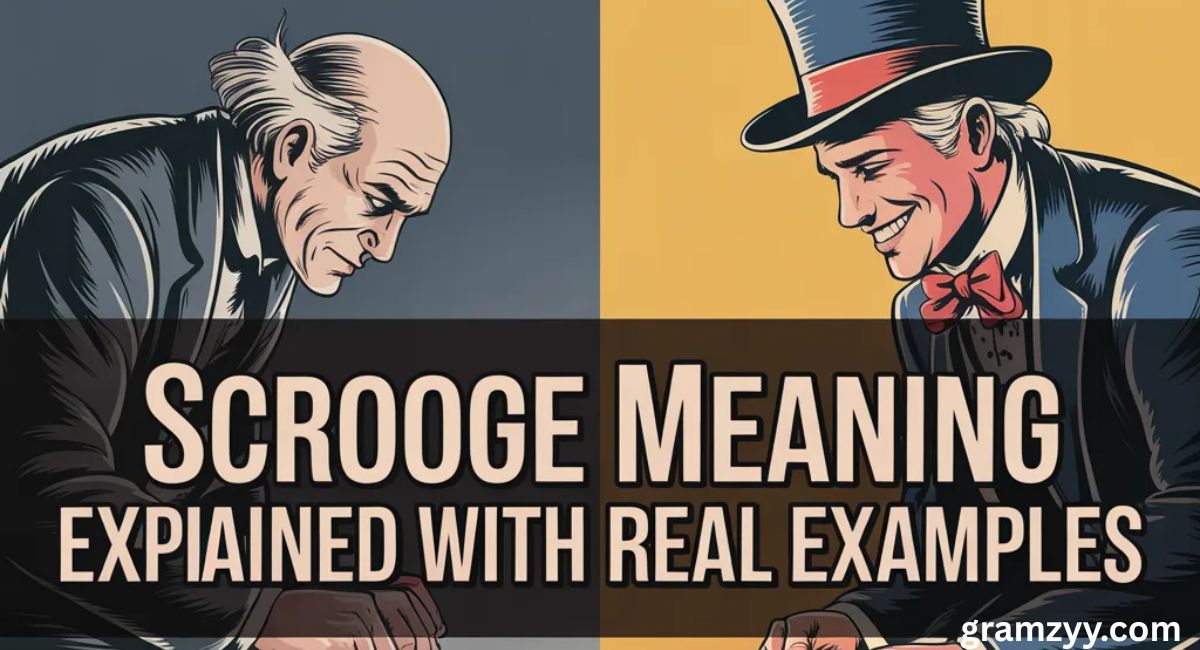
At its core, scrooge (noun) means a miserly, selfish, or tight-fisted person — someone who refuses to spend money or share with others, even when they can easily afford to. It describes not just frugality, but an attitude of coldness, selfishness, and an unwillingness to participate in generosity.
According to Merriam-Webster, a scrooge is simply “a miserly person.” Cambridge Dictionary defines it as “someone who spends as little money as possible and is not generous.” But in everyday use, the word carries even more emotional color than those definitions suggest.
Think of it this way: a careful budgeter saves money out of necessity or wisdom. A scrooge hoards it out of selfishness — even when spending would bring joy to others.
Quick Definition Box:
| Term | Meaning |
|---|---|
| Scrooge (noun) | A mean, miserly, ungenerous person |
| Scrooge-like (adjective) | Behaving in the manner of a scrooge |
| Synonyms | Miser, skinflint, penny-pincher, cheapskate, tightwad |
| Antonyms | Philanthropist, benefactor, generous person |
Is “Scrooge” Always Negative?
Mostly yes — but context changes the tone significantly.
In formal or serious writing, calling someone a scrooge is clearly a criticism. It implies they are not just frugal but emotionally cold and unwilling to share.
In casual or friendly conversation, the word can be used playfully. Friends tease each other with it all the time:
- “Come on, don’t be a scrooge — it’s just one round of drinks!”
- “He’s a bit of a scrooge at Secret Santa, but he means well.”
So while the word always has a slightly negative edge, the severity depends entirely on tone and relationship. Among close friends, it’s often light-hearted. Among strangers or in professional settings, it can feel genuinely insulting.
One thing that makes “scrooge” unique compared to synonyms like miser or cheapskate is its literary DNA. Because the original Scrooge eventually transformed and became generous, the word also quietly hints that change is possible — that even the stingiest person can turn things around.
See also : Passersby or Passerbyers: Which Plural Is Correct?
Where Does the Word Come From?
The word “scrooge” is a classic example of an eponym — a word born from a person’s name. Specifically, it comes from Ebenezer Scrooge, the central character in Charles Dickens’s novella A Christmas Carol, published in 1843.
In the story, Scrooge is a bitter, cold-hearted moneylender who despises Christmas, treats his employee Bob Cratchit cruelly, and refuses every act of charity. His behavior was so vividly drawn by Dickens that his surname became shorthand for that entire personality type.
By around 1905, according to etymologists, “scrooge” was already being used as a common noun — meaning any miserly person, not just the fictional character.
But where did Dickens get the name? Scholars have proposed a few theories:
- The Old English dialectal word “scrouge” (also spelled scrooge), meaning to squeeze, press, or crowd — suggesting someone who “squeezes” every penny
- Possible inspiration from a real-life Edinburgh merchant named Ebenezer Scroggie, whose gravestone Dickens reportedly misread
- The phonetic feel of the word itself evokes “screw” and “grouch,” which may have been deliberate
Whatever the origin, the name stuck — and today “scrooge” is recognized in virtually every English-speaking country.
Fun Fact: The word “scrounge” (meaning to search for or beg things) shares the same etymological root as “scrooge.” Both descend from the old dialectal word meaning to squeeze or press.
Examples of “Scrooge” in Sentences
Understanding a word is much easier when you see it in action. Here’s how “scrooge” appears across different contexts.
Correct Usage
These sentences use “scrooge” properly — to describe someone who is unreasonably tight with money or emotionally withholding in a way that affects others:
- “My uncle is a real scrooge — he charges his own kids rent to live at home.”
- “Don’t be a scrooge about the tip; the server worked hard.”
- “She played the scrooge at the office gift exchange and brought a pen.”
- “He’s acting like a scrooge this Christmas — won’t even buy a tree.”
- “The landlord is a total scrooge; he won’t fix the heating but raises rent every year.”
Notice that in each case, the person isn’t just being careful with money — they’re being stingy in a way that impacts others negatively.
Incorrect Usage
These examples show where the word is misapplied:
- ❌ “She’s a scrooge because she cooks at home instead of eating out.” — Cooking at home is wise budgeting, not stinginess.
- ❌ “He’s a scrooge because he doesn’t like crowded parties.” — Introversion is not the same as being miserly.
- ❌ “My company is a scrooge for not giving free lunches.” — Companies limiting perks isn’t the same as personal miserliness.
Key rule: Scrooge implies selfish withholding that harms or disappoints others — not simply being careful, private, or budget-conscious.
Context Variations
The word shifts subtly depending on where and how it’s used:
| Context | Example | Tone |
|---|---|---|
| Casual / Friends | “Stop being a scrooge and buy a round!” | Playful |
| Family setting | “Dad’s such a scrooge at Christmas.” | Mild criticism |
| Workplace | “The boss is a real scrooge about raises.” | Genuine complaint |
| Media / Writing | “The CEO was painted as a modern-day scrooge.” | Figurative / literary |
| Holiday season | “Even a scrooge would enjoy this event.” | Humorous |
Common Mistakes with “Scrooge”
Even native English speakers get tripped up. Here are the most frequent errors:
- Confusing frugality with stinginess. Being budget-savvy is not the same as being a scrooge. The distinction matters — one is practical, the other is selfish.
- Capitalizing incorrectly. When referring to the fictional character, write Scrooge (capital S). When using it as a general word for any stingy person, lowercase is standard: “he’s a scrooge.”
- Using it to mean “antisocial” alone. Scrooge means miserly, not just unfriendly. Someone can be shy or reclusive without being a scrooge.
- Overusing it casually. Calling someone a scrooge repeatedly — even as a joke — can start to feel like genuine criticism. Use it sparingly for effect.
- Applying it to organizations loosely. While you can call a company “scrooge-like,” calling a corporation a scrooge sounds unnatural. The word works best for people.
How Do You Remember the Meaning?
Here are a few memory tricks that work well:
- Visualize Ebenezer Scrooge — the hunched, coin-counting old man from A Christmas Carol. That image is the word’s entire personality.
- Sound association: “Scrooge” sounds like “screw” — as in someone who screws you out of generosity.
- Think: “Squeeze every penny.” The etymological root of the word literally means to squeeze or press — which is exactly what a scrooge does with money.
- Rhyme it: “A scrooge won’t budge — not even a smudge.”
- Pop culture anchor: Think of Scrooge McDuck from DuckTales — literally swimming in gold coins he won’t share. That’s the essence of the word.
When Should You Use This Word?
“Scrooge” is most effective when:
- You want a vivid, emotionally loaded word for someone who is selfishly tight with money
- You’re writing informal content, creative pieces, or casual conversation
- You want to imply not just stinginess, but also coldness or lack of holiday spirit
- You’re describing someone whose cheapness actively affects other people — not just their own lifestyle choices
Avoid it when:
- The person is simply being responsible with money and it doesn’t hurt anyone
- You need a neutral or professional tone (use “frugal,” “cost-conscious,” or “conservative” instead)
- You’re unsure whether the person will take it as a joke — it can sting
See also : For Who or For Whom: What’s the Difference?
FAQs
What is the simplest definition of scrooge?
A scrooge meaning is a person who is selfish and unwilling to spend or share money, even when they can afford to.
Is “scrooge” a real dictionary word?
Yes. It appears in Merriam-Webster, Cambridge, Collins, and Oxford dictionaries as a standard English noun scrooge meaning a miserly person.
Should “scrooge” be capitalized?
Capitalize it (Scrooge) when referring to the Dickens character. Use lowercase (scrooge) when using it as a general noun for any stingy person.
What is the opposite of a scrooge?
The opposite of a scrooge is a generous, giving person — sometimes called a philanthropist, benefactor, or simply someone with an open hand.
Can you call someone a scrooge as a compliment?
Not really. Even in playful use, it carries a negative undertone. It’s best used humorously among close friends, not as genuine praise.
Is “scrooge” used outside of Christmas?
Yes — while it’s most common during the holiday season, the word applies year-round to anyone consistently stingy or withholding, regardless of the time of year.
What’s the difference between a scrooge and a miser?
Both describe stingy people, but “scrooge” also implies emotional coldness and antisocial behavior, while “miser” focuses purely on the hoarding of money.
Conclusion
The word scrooge packs more meaning into seven letters than most words manage in a full sentence. It’s not just about being cheap — it captures an entire attitude: selfish, cold, withholding, and resistant to joy. Born from Dickens’s genius and shaped by over 180 years of cultural use, it remains one of the most expressive words in the English language.
Use it when you want impact. Use it when frugality crosses into selfishness. And remember — even Scrooge himself eventually came around. The word, at its deepest level, is really a reminder that generosity is always possible.