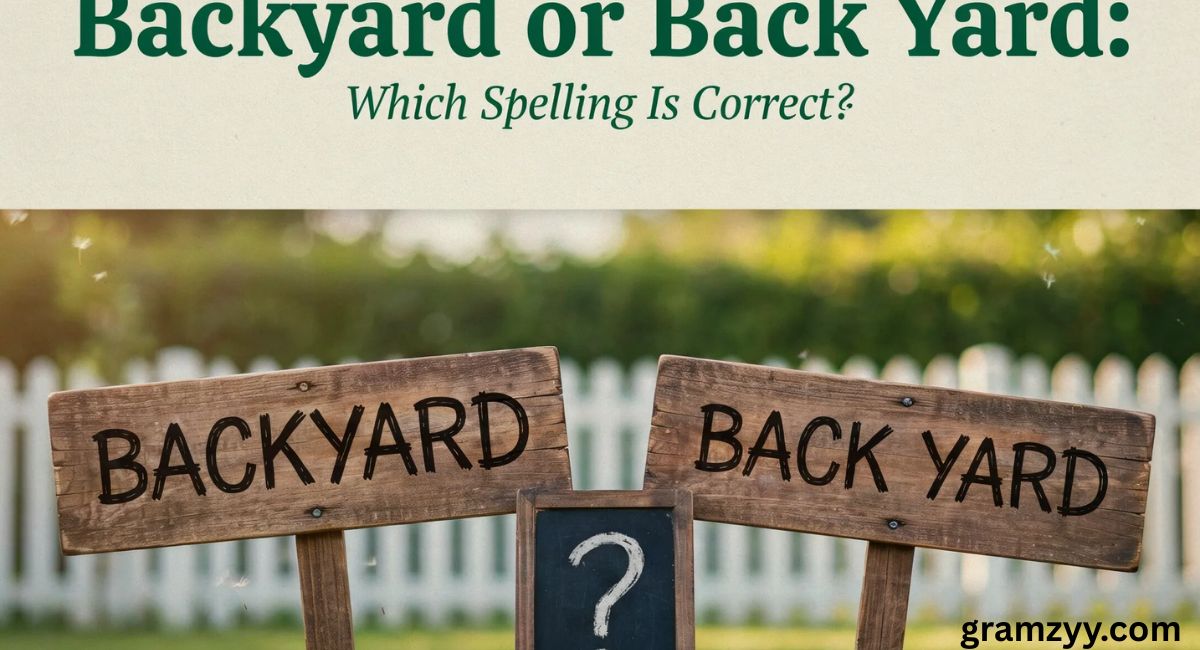
If you’ve ever paused mid-sentence wondering whether to write backyard or back yard as one word or two, you’re not alone. It’s one of those small spelling questions that trips up even careful writers. The short answer: both spellings are technically acceptable, but backyard (one word) is the modern standard for almost every context.
This guide breaks down the grammar rules, real-world examples, common mistakes, and an easy memory trick — so you’ll never second-guess this word again.
What Does “Backyard” Mean?
Backyard (also written back yard) refers to the outdoor area located directly behind a house or building. In suburban neighborhoods, this space typically includes a lawn, garden, patio, fence, or play area.
Beyond the literal meaning, backyard also carries a figurative sense. When someone says “crimes committed in our own backyard,” they mean problems happening close to home — in our own community or neighborhood.
Merriam-Webster lists two definitions:
- Noun: An area at the rear of a house; also, a nearby area or neighborhood.
- Adjective: Located or occurring in a backyard; also, lacking professional training (as in backyard breeder).
In British English, the equivalent term is often back garden rather than backyard, though when backyard is used in British writing, it still appears as one word.
See also : For Who or For Whom: What’s the Difference?
When Should You Use Back Yard?
Back yard (two words) is the older, more traditional spelling. According to grammar experts at Washington State University, the two-word form is technically more accurate when the word functions as a noun phrase — that is, when you’re pointing to the physical space itself.
So in formal or traditional grammar terms:
- Two words (noun phrase): “She planted roses in the back yard.”
- One word (compound adjective or noun): “They hosted a backyard barbecue.”
However, in practice, this distinction has blurred significantly. Most major newspapers, blogs, real estate listings, and style guides use backyard as one word in both noun and adjective contexts. The two-word form back yard is still grammatically valid, but it often reads as older, more deliberate, or style-specific writing.
When two words may still appear:
- In older published texts or classic literature
- When a specific editorial or house style requires it
- In formal academic writing that follows strict compound-noun rules
- When extra emphasis is placed on the physical location
Which Spelling Is More Common Today?
Backyard (one word) dominates modern usage by a wide margin.
Every major dictionary — including Merriam-Webster, Oxford, and Cambridge — lists backyard as the primary entry. The two-word form back yard may appear as a variant, but the compound is clearly the default.
Usage data from published books and digital text confirms this trend. In American English especially, backyard has been the preferred spelling since the mid-20th century, when compound nouns like backpack, backpedal, and backfire all consolidated into single words.
| Form | Part of Speech | Common Usage |
|---|---|---|
| backyard | Noun / Adjective | ✅ Standard modern spelling |
| back yard | Noun phrase | ⚠️ Acceptable but less common |
| back-yard | Hyphenated adjective | ❌ Rarely used; largely outdated |
Note on front yard: Interestingly, the opposite isn’t true for the front of the house. Front yard has no standard compound form — it stays as two words and there is no frontyard. The same rule simply doesn’t apply in reverse.
See also : Passersby or Passerbyers: Which Plural Is Correct?
Examples of “Backyard” and “Back Yard”
Correct Usage
These sentences reflect standard, modern English spelling:
- “The kids spent the whole afternoon playing in the backyard.”
- “We’re planning a backyard barbecue this Saturday.”
- “The backyard fence needs a fresh coat of paint.”
- “After the rain, the backyard smelled like fresh earth.”
- “She converted her backyard into a vegetable garden.”
- “They hired a landscaper to redesign the entire backyard.”
When using the two-word form as a noun phrase (less common but not wrong):
- “He sat reading a book in the back yard.”
- “The dog ran straight to the back yard when let off the leash.”
Incorrect Usage
Avoid these common errors:
| Incorrect | Correct | Why |
|---|---|---|
| back-yard party | backyard party | Hyphenated form is outdated |
| back yard barbecue | backyard barbecue | Adjective before noun = one word |
| He backyarded the lawn | He cleaned up the backyard | Backyard is never a verb |
| The back yards are large | The backyards are large | Plural of compound noun |
Context Variations
Usage can shift slightly depending on the type of writing:
- Casual/everyday writing: Use backyard in all cases.
- Real estate listings: Backyard is the clear standard (“spacious backyard with pool”).
- Journalism: Most major publications prefer backyard for both noun and adjective uses.
- Formal/academic writing: Some style guides may still call for back yard as a noun phrase — check your guide.
- Older or vintage texts: You may encounter back yard or even back-yard — both were more common before 1950.
Common Mistakes with “Backyard” and “Back Yard”
Even experienced writers stumble here. Here are the most frequent errors:
1. Using the hyphenated form back-yard This spelling appears occasionally but is not the normal modern form. Unless a specific style sheet requires it, skip the hyphen entirely.
2. Switching randomly between both spellings Inconsistency looks sloppy in any published piece. If you use backyard in paragraph one, don’t switch to back yard in paragraph three. Pick one and stay consistent throughout.
3. Treating backyard as a verb Backyard is strictly a noun or adjective. You can’t backyard something. Write “I cleaned up the backyard” — not “I backyarded the patio.”
4. Assuming front yard follows the same rule It doesn’t. Front yard is always two words. There is no compound form frontyard in standard English.
5. Using back yard as a modifier before a noun While back yard works fine as a standalone noun phrase, it doesn’t work well as an adjective. Write “a backyard garden,” not “a back yard garden.”
See also : Dieing vs Dying: Which Spelling Is Correct?
How Do You Remember the Difference?
Here’s a simple memory trick that works every time:
Think of backpack and backpedal.
Both of these words start with back and are written as single compounds. The same pattern applies to backyard. When back combines with another word to form a single concept, it usually becomes one word in modern English.
If you’re still unsure, ask yourself two quick questions:
- Is it acting as an adjective before a noun? → Use backyard (one word). Example: backyard pool party.
- Is it a noun phrase standing alone? → Backyard still works, but back yard is also acceptable. Example: relaxing in the backyard / back yard.
When in doubt, default to backyard. It’s the spelling your readers will recognize instantly, and it’s what every major dictionary lists first.
Conclusion
The spelling debate between backyard and back yard has a clear winner in everyday modern English: backyard as one word. It functions smoothly as both a noun and an adjective, it matches what readers expect, and it’s the form backed by Merriam-Webster and most major style guides.
That said, back yard (two words) isn’t wrong — it’s just less common and tends to sound older or more formal. If you’re writing for a modern audience, stick with the compound backyard unless a specific style guide tells you otherwise.
The next time you’re describing a summer cookout, a garden project, or a kids’ play area, you can write with confidence: it’s your backyard.
FAQs
Is “backyard” one word or two?
Backyard is most commonly written as one word in modern English. The two-word form back yard is acceptable but less frequent.
Can “back yard” be used as an adjective?
Not typically. When used before a noun as a modifier, the one-word form backyard is correct — for example, backyard barbecue, not back yard barbecue.
Is “back-yard” (hyphenated) ever correct?
Rarely. The hyphenated form is largely outdated. Stick with backyard or, in limited contexts, back yard.
Which dictionary lists “backyard” as the correct spelling?
Merriam-Webster, Oxford, and Cambridge all list backyard (one word) as the primary entry.
Does British English use “backyard” or “back garden”?
British English usually refers to this space as a back garden. When backyard is used in British writing, it is still written as one word.
Is “frontyard” a word?
No. Unlike backyard, the term front yard has no compound form. It is always written as two separate words.
Does the spelling affect SEO in online writing?
Yes. In digital content such as blogs, real estate pages, and how-to articles, backyard (one word) is the dominant search term. Using the two-word form may reduce visibility in search results.