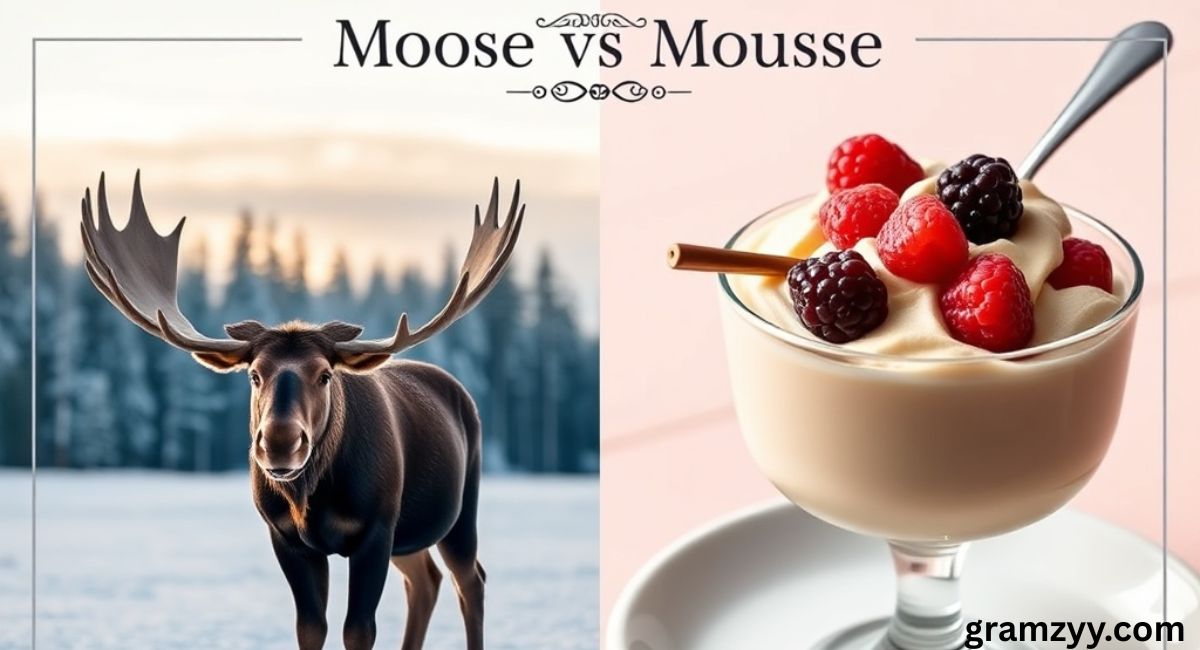
Moose vs mousse: If you’ve ever typed “chocolate moose” in a recipe or described seeing a “mousse in the forest,” you’re not alone. These two words are homophones — they sound exactly the same when spoken — but their meanings couldn’t be more different. One is a wild animal weighing up to 1,500 pounds; the other is a light, airy food or hair product.
Confusing moose and mousse is a surprisingly common writing mistake, even among native English speakers. This guide breaks down everything you need to know: definitions, correct usage, memory tricks, and real-world examples. By the end, you’ll never mix them up again.
The Core Difference Between Moose and Mousse
At a glance, here’s what separates these two words:
| Feature | Moose | Mousse |
|---|---|---|
| Type | Noun (animal) | Noun (food or hair product) |
| Spelling | M-O-O-S-E | M-O-U-S-S-E |
| Origin | Eastern Abenaki (Native American) | French (means “foam” or “froth”) |
| Plural | Moose (unchanged) | Mousses |
| Context | Wildlife, nature, forests | Cooking, desserts, hair care |
Both words are pronounced identically — /muːs/ — which rhymes with “goose.” That shared sound is exactly why writers confuse them so often.
Quick definition:
- Moose = a large mammal from the deer family, native to northern forests across North America, Europe, and Asia
- Mousse = either a light, whipped dessert (like chocolate mousse) or a foamy hair styling product
The spelling is the only signal — and it’s a reliable one, once you know the pattern.
See also: Alright vs All Right: Which is correct?
How to Use Moose and Mousse in Context
Correct Usage of Moose
Moose is always used as a noun. It refers to Alces alces, the largest member of the deer family. Adult males are known for their massive, palmate antlers and can weigh between 800–1,500 pounds.
One key grammar note: the plural of moose is moose, not “mooses.” This makes it one of the rare English nouns that stays the same in both singular and plural form.
Example sentences using moose:
- We spotted a moose grazing near the lake at dawn.
- Three moose were blocking the trail during our hike through Maine.
- A bull moose can become aggressive during rutting season — keep your distance.
- Researchers are tracking moose populations to monitor the health of northern ecosystems.
- The wildlife preserve is home to a small herd of moose that visitors can observe safely.
Correct Usage of Mousse
Mousse (borrowed directly from French, where it means “foam”) has two main uses in English:
1. Culinary mousse — a light, airy dish made by folding whipped cream or beaten egg whites into a flavored base. It can be sweet (chocolate mousse, lemon mousse) or savory (salmon mousse, chicken liver mousse).
2. Hair mousse — a foamy styling product applied to damp hair to add volume, hold, or texture.
Example sentences using mousse:
- She finished the dinner party with a silky chocolate mousse that everyone raved about.
- The chef’s salmon mousse was the standout dish of the evening.
- He worked a dollop of mousse through his curls before blow-drying.
- The recipe calls for mousse as the filling between the cake layers.
Context Variations
The context of your sentence will almost always tell you which word belongs:
- Writing about wildlife, forests, nature documentaries, or Canadian roads? → Moose
- Writing about French cuisine, dessert menus, or hair salons? → Mousse
In British English, some writers use “hair foam” as an alternative to hair mousse, but “mousse” remains the standard term globally. Canadians encounter the word “moose” frequently in everyday writing, given how common the animal is across the country.
Common Mistakes with Moose vs Mousse
Here are the most common errors writers make — and how to fix them:
| Incorrect | Correct | Why It’s Wrong |
|---|---|---|
| I made a chocolate moose for dessert. | chocolate mousse | Moose is an animal, not a food |
| She applied mousse to her coat in the forest. | moose spotted in the forest | Mousse is a product, not wildlife |
| We saw three mooses near the cabin. | three moose | “Mooses” is not a valid plural |
| The chef’s moose recipe was divine. | chef’s mousse recipe | Context is culinary, not wildlife |
Why This Mistake Happens
This confusion usually comes down to a few predictable triggers:
- Fast typing or dictation — when you’re writing quickly, your brain processes the sound, not the spelling
- Voice-to-text software — speech recognition tools can’t determine context and may default to the more common-looking spelling
- Autocorrect blindness — spell-checkers won’t flag either word as wrong, since both are valid English words
- French spelling unfamiliarity — “mousse” contains the French “ou” pattern that looks unusual to English eyes, so writers sometimes revert to the simpler-looking “moose”
This mistake increases among non-native English speakers and even appears in published manuscripts, social media posts, and restaurant menus.
See also: All Is Well or All Is Good: Which Phrase Is Better?
How to Remember the Difference
The Double-O Memory Trick
Look at the two O’s in M-OO-SE. Picture them as the wide, round eyes of the animal staring at you from the treeline. Two round eyes = wild animal = moose.
Mousse, on the other hand, has the French “ou” spelling — a clear signal that it comes from the French culinary or beauty tradition. If the word has a European, creamy, or salon-ready feel, it’s mousse.
The Quick Test
Before you write either word, ask yourself one question:
“Am I talking about something alive in a forest — or something I can eat or style my hair with?”
- Alive in the wild? → Moose
- On a plate or in a bathroom? → Mousse
Another mnemonic that works well: “Moose roam. Mousse foams.”
That two-second mental check will catch nearly every potential error.
Visualizing Moose vs Mousse
Think of it this way: moose belongs in nature, and mousse belongs in the kitchen or at a salon. These worlds never overlap.
MOOSE                          MOUSSE
──────────────────────         ──────────────────────
🦌 Large forest animal         🍫 Whipped dessert
🌲 Found in the wild           💇 Hair styling foam
🇨🇦 Common in Canada            🇫🇷 French origin
📷 Wildlife photography        🍽️ Fancy restaurant menus
The visual separation is striking. You’ll never find a moose in a dessert bowl, and you’d never style your hair with a 1,500-pound animal. Let the context do the work for you.
When to Use Moose vs Mousse
Use Moose When Writing About:
- Wildlife observation and nature documentaries
- Hunting seasons and game conservation
- Canadian or Alaskan wilderness travel
- Ecology, biodiversity, and forest ecosystems
- Children’s books or stories featuring forest animals
- National parks and wildlife refuges
Examples:
- The national park reported a record moose sighting this season.
- Conservation teams are working to protect moose habitats from urban expansion.
Use Mousse When Writing About:
- Dessert recipes and French cuisine
- Savory dishes with whipped or airy textures (salmon mousse, liver mousse)
- Hair care routines and salon product reviews
- Restaurant menus and food blogging
- Baking, pastry arts, and culinary school training
Examples:
- The pastry chef demonstrated how to make a classic chocolate mousse using only three ingredients.
- Apply a quarter-sized amount of mousse to damp hair and scrunch upward for natural curl definition.
See also: As the Crow Flies: Meaning, Usage, and Examples
FAQs
What is the difference between moose and mousse?
Moose is a large wild animal from the deer family, while mousse is either a whipped dessert or a foamy hair styling product. They sound identical but have completely different meanings and spellings.
Is the plural of moose “mooses”?
No. The plural of moose is simply moose — the word doesn’t change form. Saying “mooses” is incorrect in standard English.
Can mousse be savory?
Yes. Mousse can be savory as well as sweet. Salmon mousse, chicken liver mousse, and vegetable mousse are all common savory preparations found in French and modern cuisine.
Does autocorrect catch moose vs mousse errors?
No. Both words are correctly spelled English words, so spell-checkers and autocorrect tools won’t flag the mistake. You need to rely on context awareness.
Is mousse always from France?
The word “mousse” comes from French, where it means “foam” or “froth.” The culinary technique and the hair product term both entered English through this French root.
Are moose dangerous?
Yes, moose can be dangerous, especially bull moose during mating season. Despite their calm appearance, they are unpredictable and should never be approached in the wild.
Conclusion
The moose vs mousse mix-up is one of the most relatable spelling errors in English — it trips up learners and native speakers alike because the two words are phonetically identical. But the fix is simple: moose is always the animal; mousse is always the food or hair product.
Use the double-O trick to picture those big round animal eyes, remember that mousse carries a French accent, and ask yourself one quick question before writing: forest or fork?
With these tools in your vocabulary toolkit, you’ll write with confidence and accuracy every time.